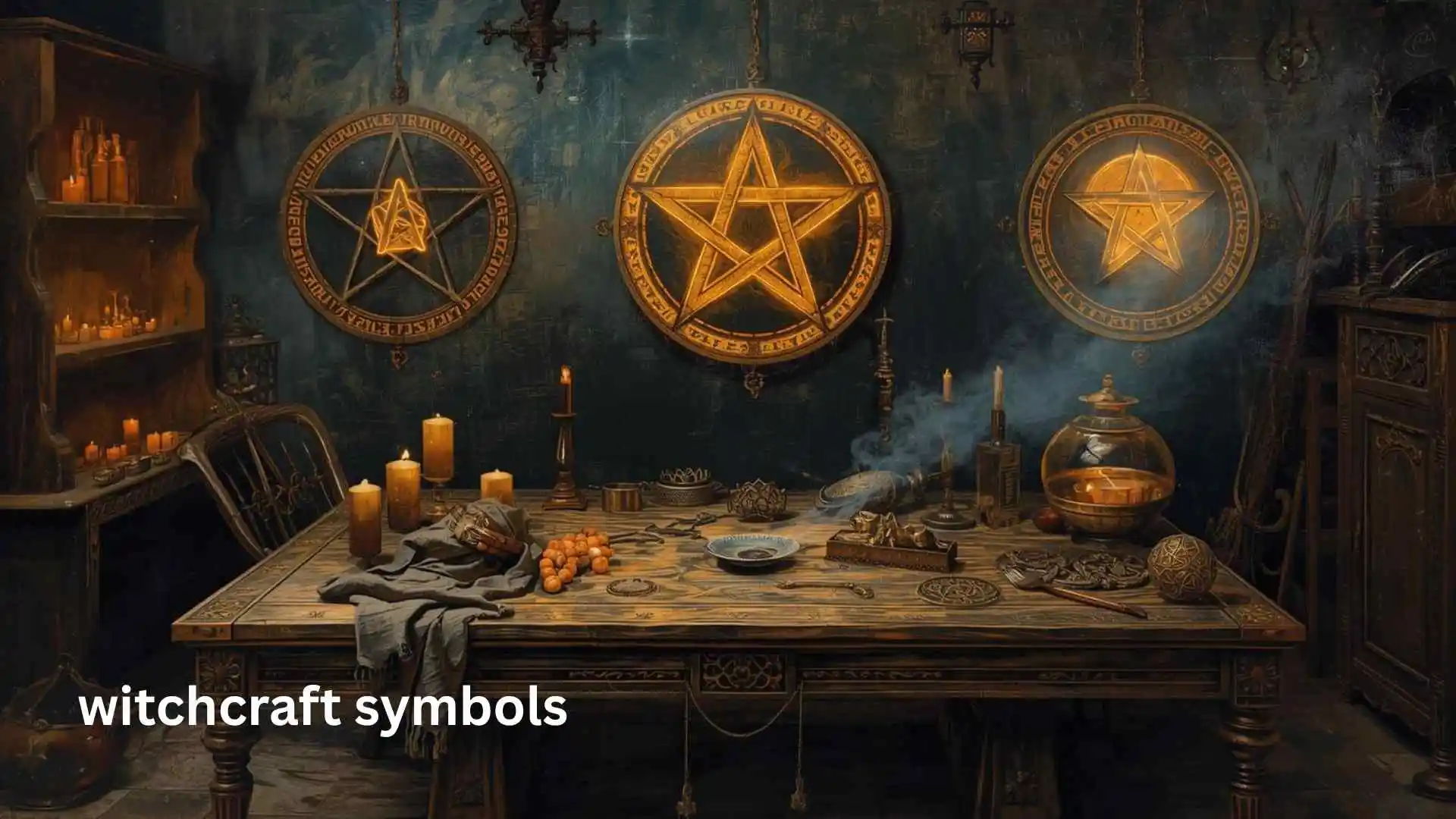
Witchcraft symbols have whispered across millennia, carved into candle wax, embroidered into ritual cloaks, and traced in the air with trembling fingers.
These are not mere decorative scratches but living hieroglyphs of human longing for protection, power, and connection to the invisible world.
From the paleolithic caves to modern tattoo studios, these marks carry the weight of persecuted healers, cunning folk, and the wild heart of nature worship itself. In this deep exploration, you will learn not just what these symbols look like, but why they still pulse with meaning in your dreams, your fears, and your quiet hopes.
What Are Witchcraft Symbols?
Witchcraft symbols are visual languages used across magical traditions to direct energy, invoke spiritual forces, protect against harm, and represent cosmic principles. Unlike random doodles, each line, curve, and intersection follows a logic rooted in natural patterns, celestial movements, and human psychology.
Historically, these symbols appeared in grimoires like the Key of Solomon (14th century), in folk magic traditions from Appalachia to Siberia, and in the clandestine marks carved into church doors by practitioners who feared the stake. The word “symbol” itself comes from the Greek symbolon — a broken token whose two halves, when reunited, proved identity and trust. Witchcraft symbols work the same way. They unite the practitioner with hidden forces.
Culturally, they have been misunderstood, demonized, and sensationalized. Yet at their core, they serve three universal human needs: protection from the unknown, control over fate, and communion with the divine as felt through nature.
Deep Symbolic Meaning of Witchcraft Marks
Spiritual Level
Every witchcraft symbol acts as a keyhole into non ordinary reality. When drawn with intent, the symbol becomes a living sigil — a condensed prayer. Spirits, ancestors, or elemental forces are said to recognize these shapes like old friends. The circle, for instance, is not just a shape but the womb of the Goddess, the serpent eating its own tail, the planet itself breathing.
Psychological Level
Carl Jung recognized witchcraft symbols as archetypes rising from the collective unconscious. The pentagram, for example, mirrors the human body (head, arms, legs) and speaks to our deep need for wholeness. Drawing these symbols quiets the rational mind and invites the intuitive self forward. In trauma recovery, some modern therapists note that patients instinctively draw protective circles and crosses — a spontaneous return to ancient psychic armor.
Cultural Level
These symbols are rebellion and reverence together. During the Burning Times, a hexagram scratched on a doorframe was an act of defiance. In modern covens, the same symbol represents the union of fire and water, sun and moon. Witchcraft symbols carry the scars of persecution and the hope of reclamation. They are not static. They evolve with each generation of witches who claim them.
Types and Variations of Witchcraft Symbols
1. Pentagram (Pentacle)
Visual: A five pointed star enclosed in a circle, one point upward.
Meaning: The four classical elements (earth, air, fire, water) crowned by spirit. Protection, mastery, and the human soul’s ascent.
Appears: Wiccan altars, medieval amulets, pirate flags (as a protective sign), modern tattoos, and the seal of the city of Jerusalem.
2. Triquetra
Visual: Three interlocking arcs forming a triangular knot.
Meaning: Triple Goddess (maiden, mother, crone), past/present/future, body/mind/spirit.
Appears: Celtic Christian manuscripts (Book of Kells), Norse runestones, Neopagan jewelry, and the TV show Charmed.
3. Hecate’s Wheel (Strophalos)
Visual: A labyrinth like coil with a central spiral and curved crossbars.
Meaning: Rebirth, crossroads magic, and the serpent power (kundalini) rising. Sacred to Hecate, goddess of witchcraft.
Appears: Ancient Greek coins, modern devotional altars, astral travel meditation guides.
4. Eye of Horus (Wedjat)
Visual: A stylized human eye with a teardrop and falcon markings.
Meaning: Healing, protection, and the moon’s cycles. Represents the restored eye of the god Horus after brutal conflict.
Appears: Egyptian tomb paintings, protective jewelry, modern Kemetic witchcraft, and conspiracy pop culture.
5. Algiz Rune
Visual: An upright trident shape with a central stem and two angled arms.
Meaning: Defense against evil, spiritual sanctuary, the elk’s antlers signaling safety.
Appears: Elder Futhark inscriptions, Norse amulets, modern rune casting sets, and the logo of the band Led Zeppelin.
6. Helm of Awe (Ægishjálmur)
Visual: Eight spoked tridents radiating from a central point.
Meaning: Inducing fear in enemies, victory in battle, and psychological strength.
Appears: Icelandic grimoires (Galdrabók), Viking reenactment tattoos, and military talismans.
7. Crossroads Sigil
Visual: A simple X or cross inside a circle with directional markers.
Meaning: Liminal space where offerings are made to Hecate or Papa Legba. Decision magic.
Appears: Hoodoo folklore, blues musician legends (Robert Johnson at the crossroads), and dreamwork journals.
8. Spiral
Visual: A continuous coiled line radiating inward or outward.
Meaning: The soul’s journey, seasonal cycles (samhain to samhain), and the labyrinth of rebirth.
Appears: Newgrange passage tomb (Ireland), Spiral Jetty earthwork, feminist witchcraft art, and hypnagogic vision states.
Witchcraft Symbols Across Cultures
Ancient Egypt: Symbols like the Ankh (eternal life) and the Djed pillar (stability) were used in temple magic to protect the pharaoh’s soul. Ritual wands carved with Thoth’s ibis opened the mouths of statues, animating them as divine vessels.
Norse & Germanic: Runes doubled as writing and sorcery. The týr rune was carved under your left arm for victory. The bjarkan rune (birch) was a mother’s protection for a newborn. Every mark was a spell.
Hoodoo & Appalachian Folk Magic: Crossroads, black salt circles, and the “hex sign” (painted barn stars in Pennsylvania Dutch country) blended African, Native American, and European symbols. A six petal rose on a barn meant welcome; eight points meant fiery protection.
Greek & Roman: Phallus symbols (fascinus) were carved into doorways to avert the evil eye. The Hekate’s key opened the underworld’s gates. Witches buried curse tablets (defixiones) scratched with crossed lines and backwards letters to bind enemies.
Modern Wicca & Neopagan: Borrows heavily from Celtic, Hermetic, and Gardnerian sources. The athame (ritual knife) is never used to cut physical objects but to inscribe air symbols. The coven’s book of shadows becomes a personal lexicon of symbols learned through dreams and initiation.
Witchcraft Symbols in Art, Movies, and Pop Culture
Movies: The Blair Witch Project weaponized the stick figure symbol into a modern folklore icon. Suspiria (2018) used dancing body lines as living sigils for Mother Suspiriorum. In The Craft, the invocation of Manon involves drawing a pentagram in the air — a moment that taught a generation of teenagers their first magical gesture.
Paintings: Albrecht Dürer’s Melencolia I hides a magic square, pentacle, and compass. Francisco Goya’s Witches’ Sabbath shows the Devil as a horned goat surrounded by occult symbols — a propaganda image that fueled fear and fascination.
Books: The Chilling Adventures of Sabrina features the “Mark of the Beast” as a badge of freedom, not damnation. In A Discovery of Witches, Diana Bishop’s genealogy is encoded in alchemical symbols. Children’s books like The Worst Witch soften pentagrams into school crests.
Tattoos: The most requested witchcraft symbols in tattoo studios today are the triple moon (waxing, full, waning), the hive hex (for community protection), and personal sigils created in ritual. Many survivors of religious trauma tattoo the pentagram to reclaim agency.
Fashion: Alexander McQueen’s final collection featured Hecate’s wheels embroidered into velvet. Witchcore aesthetics on TikTok popularize hand drawn symbol patches on jean jackets. The symbol is no longer hidden; it is worn as a whisper of resistance.
Spiritual and Dream Meaning of Witchcraft Symbols
When witchcraft symbols appear in dreams or meditation, they rarely announce themselves as warnings. They arrive disguised.
Dreaming of a broken pentagram does not predict evil. It often means a core belief you held about yourself (spirit leading the elements) has shattered. You are being asked to rebuild.
Seeing a spiral in deep trance — especially expanding outward — signals a kundalini or spiritual awakening. Your sleeping mind is showing you your own growth pattern.
An eye symbol (Horus, evil eye, or third eye) blinking at you during hypnagogia (the state between wake and sleep) is your intuition’s self check. It asks: what truth are you refusing to see?
A cross or crossroads in a nightmare where you feel paralyzed represents a real life decision you have avoided. The witches of folklore believed the crossroads appears in dreams seven days before a life changing choice must be made.
Practitioners advise keeping a “dream sigil journal” beside your bed. Draw any symbol you recall immediately upon waking. Over months, your personal vocabulary of meaningful marks will emerge — more powerful than any inherited from a book.
Positive vs. Negative Meanings of the Same Symbol
The same witchcraft symbol can hold radically opposite meanings depending on intent, tradition, and era.
Pentagram: Positive — protection, mastery, the human divine. Negative — inverted, it became a Hollywood sign for Satanism (though historical Satanism rarely used it). In Wicca, an inverted pentagram simply shifts spirit below the elements, representing initiation.
Eye of Horus: Positive — healing, royal power, lunar cycles. Negative — in Egyptian magic, the same eye could be threatened or destroyed in ritual to symbolically unmake an enemy’s health.
Algiz Rune: Positive — divine protection, sanctuary. Negative — when drawn reversed or with a broken branch, it meant “the guardian has fallen” or a warning of betrayal.
Crossroads Sigil: Positive — opportunity, meeting spirits, solving paradoxes. Negative — in folk horror, a crossroads deal with a dark entity leads to eternal debt.
Spiral: Positive — evolution, the goddess’s womb. Negative — a backtracking spiral (retrograde in dreams) symbolizes repetitive trauma loops or obsessive thoughts.
The difference is never the ink. It is the emotional voltage behind the hand that draws it.
Why Humans Are Attracted to Witchcraft Symbols
We are meaning making animals. Your brain organizes the chaos of light and shadow into patterns. Witchcraft symbols give that pattern making impulse a sacred container.
Psychologically, symbols reduce existential terror. A child afraid of the dark draws a sun on their palm. An adult afraid of illness wears a Hamsa hand. The symbol becomes a transitional object — a bridge between raw fear and felt safety.
Emotionally, these marks connect us to ancestors who had no science but deep intuition. When you trace a pentagram on your skin before a job interview, you are not mad. You are tapping into a 4,000 year old technology of focus and courage. The symbol works because you work. It focuses your scattered intent.
Culturally, in an age of digital noise, witchcraft symbols offer tangible, hand made magic. They can be scratched into earth, painted with ash, or sewn into a pillow. They ask nothing of you except attention and belief in your own agency.
People are also drawn to the taboo. After centuries of demonization, reclaiming a persecuted symbol is an act of decolonization. Witches today carve pentacles into their doorframes not to frighten neighbors but to declare: I will not hide. My protection is my birthright.
Frequently Asked Questions About Witchcraft Symbols
1. Are witchcraft symbols evil or satanic?
No. Most witchcraft symbols predate Christianity by thousands of years. They are neutral tools for focus and protection. Evil intent comes from the user, not the symbol. The pentagram was used in early Christian art to represent the five wounds of Christ.
2. Can anyone use witchcraft symbols, or do you need to be initiated?
Anyone with respect and study can use them. However, closed traditions (like specific Hoodoo veves or Norse rune initiations) request you learn from a lineage holder. Personal sigils you create yourself are always ethical and powerful.
3. What is the most powerful protection symbol in witchcraft?
The Helm of Awe (for active defense against enemies) and the simple unbroken circle (for general spiritual shielding) are historically cited as the strongest. Many folk witches layer symbols — for example, drawing Algiz inside a circle.
4. How do I create my own witchcraft symbol (sigil)?
Write your intention as a short sentence. Remove all repeating letters. Arrange the remaining letters into a monogram style shape. Simplify until it looks like a magical glyph. Charge it with breath, candle flame, or dance. Destroy it if you want the spell to release; keep it if you want the energy to grow.
5. Why do witches draw symbols on candles?
Candle magic uses symbols to program the flame. Carving a money sigil into a green candle tells your subconscious — and the universe — exactly what the fire is for. The melting wax releases the symbol’s energy into the air.
6. Are there symbols I should avoid?
Avoid symbols you do not understand. Avoid cultural appropriation of Indigenous or African diaspora symbols unless invited. Avoid any symbol you feel genuine dread toward — that is your intuition saying “not for you at this time.”
Conclusion
Witchcraft symbols are not dusty relics from superstitious ages. They are the alphabet of your inner wild. From the spiral on a seashell to the crossroad you pass each morning, these marks wait for you to see them with new eyes. You do not need a coven or a spell book. You only need a single symbol that whispers to your chest, a quiet hand to draw it, and the courage to believe that intention matters. Go ahead. Trace a circle around your own name today. Watch what follows.

Sophia Reed
Hi, I’m Sophia Reed, a storyteller at heart who finds magic in everyday moments. Ever since I could hold a pen, I’ve been weaving tales that explore love, courage, and the unexpected twists of life. Writing allows me to connect with readers on a deeper level, sharing emotions and experiences that resonate across worlds. When I’m not lost in my stories, you can find me wandering through quiet streets, sipping coffee, or dreaming up my next plot twist. I believe every story has the power to inspire, heal, and transport. Through my books, I hope to leave a piece of my imagination with you.
Books:
-
Whispers of the Heart
-
Shadows and Sunlight