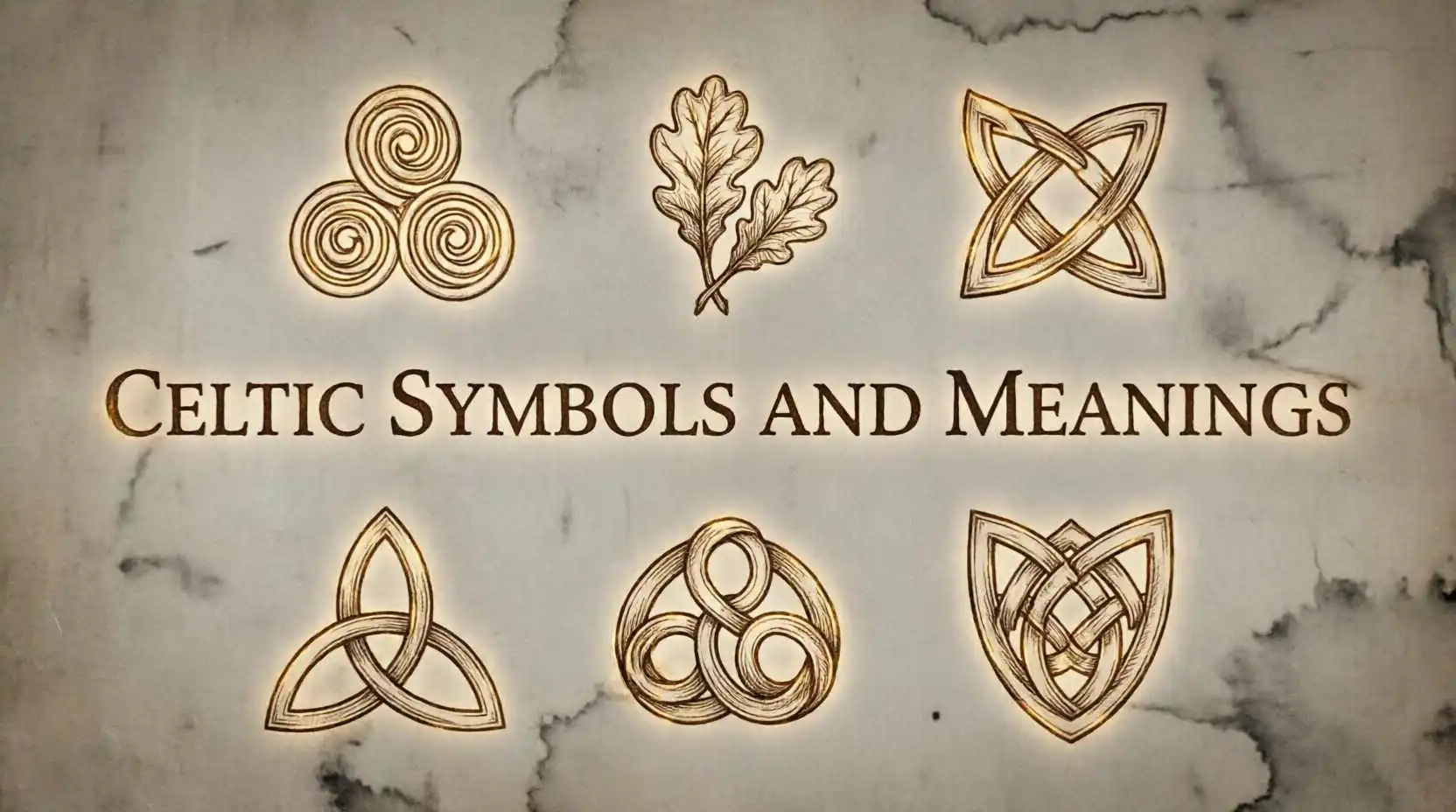
“Celtic symbols and meanings” have fascinated people for centuries because they carry stories of love, eternity, courage and spiritual wisdom hidden inside every curve and knot.
These ancient designs are more than beautiful patterns carved into stone or inked onto skin. They are emotional messages passed through generations of warriors, druids, poets, and dreamers.
From mysterious spirals to endless knots, each symbol reflects the human search for connection, protection, and purpose.
As you explore these sacred signs, you may discover meanings that feel deeply personal and surprisingly timeless.
What Are Celtic Symbols and Meanings?
Celtic symbols are ancient visual designs created by the Celtic people who lived across Ireland, Scotland, Wales, and parts of Europe thousands of years ago. These symbols appeared in stone carvings, jewelry, manuscripts, weapons, and sacred monuments. Many of them used endless lines with no beginning or ending which represented eternity and the cycle of life.
The Celts believed nature carried spiritual power. Rivers, trees, the moon, fire, and animals all held sacred meaning in their culture. Their symbols became a way to express emotions, beliefs, protection, and the invisible connection between humans and the universe.
Today, Celtic symbols remain popular in tattoos, spiritual practices, artwork, and jewelry because their meanings still resonate deeply with modern life. People are drawn to them for strength, healing, loyalty, transformation, and inner peace.
The History Behind Celtic Symbols
The origins of Celtic symbolism date back more than 2500 years. Ancient Celtic tribes spread across Europe long before written language became common in their culture. Instead of recording stories in books, they expressed beliefs through oral storytelling and symbolic art.
The Druids, who served as spiritual leaders and teachers, used symbols to represent wisdom and sacred truths. Many Celtic patterns appeared in famous manuscripts like the Book of Kells which displayed incredibly detailed knotwork and spiritual imagery.
As Christianity spread through Celtic lands, many pagan symbols blended with Christian beliefs. This created unique designs like the Celtic Cross which combined spiritual faith with ancient traditions.
Even after centuries of change, these symbols survived because they spoke to universal human emotions like hope, love, fear, rebirth, and belonging.
Deep Symbolic Meaning of Celtic Symbols
Spiritual Meaning
Spiritually, Celtic symbols often represent eternity, divine connection, and the soul’s journey. Endless knots symbolize life continuing beyond death. Spirals represent growth and spiritual awakening. Many people use these symbols during meditation because they create a sense of harmony and balance.
Ancient Celts believed everything in nature was connected. Their symbols reflected this sacred unity between humans, animals, earth, and the spiritual world.
Psychological Meaning
Psychologically, Celtic symbols comfort people because they express ideas that humans naturally seek. Endless loops create feelings of continuity and stability. Circular designs symbolize emotional wholeness and inner healing.
People often feel emotionally attached to Celtic symbols during times of personal transformation. A person recovering from heartbreak may connect with symbols of rebirth. Someone searching for strength may feel drawn to warrior symbols or protective knots.
Cultural Meaning
Culturally, Celtic symbols preserve the identity and traditions of Ireland, Scotland, and other Celtic regions. They celebrate ancestry, pride, mythology, and artistic heritage. These designs connect modern generations to ancient wisdom and storytelling.
For many families, wearing Celtic jewelry or tattoos represents loyalty to their roots and respect for ancestral traditions.
Most Popular Celtic Symbols and Their Meanings
Celtic Knot
Visual Description
The Celtic Knot features endless interwoven lines without a visible beginning or ending.
Meaning
It symbolizes eternity, interconnectedness, loyalty, and the endless cycle of life and love.
Where It Appears
Celtic Knots appear in tattoos, wedding rings, ancient manuscripts, gravestones, and spiritual artwork.
The endless flow of the knot reminds people that life continues through change, loss, and renewal.
Trinity Knot
Visual Description
The Trinity Knot contains three connected loops forming a triangular pattern.
Meaning
It represents the unity of mind, body, and spirit. In Christian traditions it also symbolizes the Holy Trinity.
Where It Appears
This symbol appears in churches, jewelry, spiritual tattoos, and Celtic art.
Many people wear the Trinity Knot to express spiritual balance and emotional harmony.
Celtic Cross
Visual Description
The Celtic Cross combines a traditional cross with a circular ring surrounding the center.
Meaning
It represents faith, eternal life, and the connection between heaven and earth.
Where It Appears
Celtic Crosses stand in cemeteries, monasteries, churches, and historical sites across Ireland and Scotland.
The circle surrounding the cross symbolizes eternal love and divine unity.
Dara Knot
Visual Description
The Dara Knot resembles a complex pattern inspired by tree roots.
Meaning
It symbolizes inner strength, wisdom, grounding, and resilience.
Where It Appears
The Dara Knot is common in jewelry, tattoos, and spiritual decorations.
Inspired by the mighty oak tree, this symbol reminds people to stay strong during difficult times.
Awen Symbol
Visual Description
The Awen symbol contains three rays flowing upward with dots above them.
Meaning
It represents inspiration, creativity, spiritual illumination, and divine energy.
Where It Appears
The Awen symbol is often connected to modern Druid spirituality and artistic communities.
Writers, musicians, and creative individuals frequently use it as a symbol of inspiration.
Spiral Symbol
Visual Description
The Celtic spiral forms a swirling circular design moving outward or inward.
Meaning
It symbolizes growth, evolution, rebirth, and spiritual expansion.
Where It Appears
Ancient stone carvings and sacred monuments frequently display spiral patterns.
The spiral reflects the journey of personal transformation and constant change.
Celtic Symbols Across Different Cultures
Irish Culture
In Ireland, Celtic symbols are deeply tied to national identity, mythology, and spirituality. Symbols like the harp, Trinity Knot, and Celtic Cross appear in ancient ruins, family crests, and modern Irish art.
Irish legends often connect these symbols to heroes, fairies, and sacred landscapes.
Scottish Culture
Scottish Celtic traditions focus heavily on clan heritage and warrior symbolism. Knotwork patterns decorate kilts, shields, and jewelry.
Many Scottish families use Celtic designs to honor ancestry and family loyalty.
Welsh Culture
Welsh Celtic symbols often emphasize poetry, magic, and storytelling. Dragons and spirals play important roles in Welsh mythology and folklore.
These symbols express wisdom, transformation, and mystical power.
Norse Influence
As Vikings interacted with Celtic societies, some symbols blended together. Knotwork designs from both cultures began influencing each other.
This fusion created powerful artistic patterns representing battle, destiny, and spiritual connection.
Modern Global Culture
Today, Celtic symbols appear around the world in tattoos, fashion, home decor, meditation practices, and spiritual communities.
Many people connect with them emotionally even without Celtic ancestry because their meanings feel universal and timeless.
Celtic Symbols in Art, Movies and Pop Culture
Celtic imagery has become a powerful visual language in entertainment and modern creativity.
Fantasy movies often use Celtic patterns to create magical worlds filled with ancient wisdom and mystery. Films inspired by medieval legends frequently include Celtic knots, spirals, and crosses to symbolize destiny and sacred power.
Books about mythology and fantasy use Celtic symbolism to create emotional depth and spiritual themes. Writers often connect these symbols to heroes on journeys of transformation.
Tattoo culture has embraced Celtic symbols because they combine beauty with personal meaning. Someone may choose a Trinity Knot to honor family bonds or a spiral to represent healing after hardship.
Fashion designers also use Celtic patterns in necklaces, scarves, rings, and clothing because the intricate designs feel elegant and timeless.
In modern art, Celtic symbols often represent humanity’s longing for meaning, identity, and connection in a fast moving world.
Spiritual and Dream Meaning of Celtic Symbols
Many people report seeing Celtic symbols during dreams, meditation, or spiritual experiences. These moments often happen during emotional change or personal reflection.
Dreaming of a Celtic Knot may symbolize an unbreakable emotional bond or an important life lesson repeating itself. It can also represent destiny guiding a person toward healing or growth.
A spiral appearing in dreams may suggest personal transformation and spiritual awakening. It often reflects movement from confusion into clarity.
The Celtic Cross in spiritual experiences can symbolize divine protection, hope, and inner peace during difficult periods.
People practicing meditation sometimes focus on Celtic patterns because their repeating forms calm the mind and encourage emotional balance.
Positive and Negative Meanings of Celtic Symbols
Like many ancient symbols, Celtic imagery can represent both light and darkness depending on context.
Positive Meanings
- Eternal love
- Protection
- Wisdom
- Spiritual growth
- Loyalty
- Rebirth
- Strength
- Harmony
These meanings explain why people often wear Celtic jewelry during important life moments like weddings, healing journeys, or personal milestones.
Negative Meanings
Some Celtic symbols can also represent struggle, endless cycles, obsession, or emotional entrapment.
An endless knot may remind someone of painful patterns they cannot escape. Spirals can symbolize chaos if life feels unstable or emotionally overwhelming.
Ancient Celtic warriors also used certain symbols to inspire fear and power during battle. This shows how the same design can carry beauty and intensity at the same time.
Why Humans Are Attracted to Celtic Symbols
Humans naturally search for patterns that create emotional meaning. Celtic symbols attract people because their flowing lines feel alive and deeply connected to nature.
Psychologists believe circular and repeating shapes create feelings of comfort and stability. The human mind enjoys symmetry because it reflects balance and order.
Emotionally, these symbols speak to universal experiences like love, loss, hope, identity, and transformation. A person may see their own story reflected inside an ancient knot or spiral.
There is also something mysterious about Celtic designs. They seem to carry forgotten wisdom from another world. This mystery sparks curiosity and imagination.
For many people, Celtic symbols become personal reminders of resilience, spirituality, or connection to family and heritage.
Celtic Symbols and Their Connection to Nature
Nature played a central role in Celtic spirituality. Trees, rivers, mountains, animals, and seasons all carried sacred meaning.
The Celts believed humans were part of nature rather than separate from it. Their symbols reflected this deep respect for the natural world.
The oak tree inspired symbols of strength and endurance. Spirals reflected the movement of seasons and life cycles. Animal symbols represented courage, wisdom, and intuition.
This connection to nature still resonates today because modern life often leaves people feeling disconnected from the earth and from themselves.
Celtic symbolism offers a reminder that life moves in cycles and healing often begins by reconnecting with nature and inner balance.
Frequently Asked Questions
What is the most powerful Celtic symbol?
The Trinity Knot is often considered one of the most powerful Celtic symbols because it represents eternity, spiritual unity, and the connection between mind, body, and spirit.
Are Celtic symbols religious?
Some Celtic symbols have religious connections while others are spiritual or cultural. Many ancient pagan symbols later blended with Christian traditions.
What do Celtic knots symbolize?
Celtic knots symbolize eternity, interconnectedness, loyalty, and the endless flow of life because they have no visible beginning or ending.
Why are Celtic symbols popular in tattoos?
People choose Celtic tattoos because the designs are visually beautiful and deeply meaningful. They often represent strength, ancestry, love, or personal transformation.
Are Celtic symbols connected to magic?
Ancient Celtic culture included spiritual beliefs and mystical traditions. Many symbols were believed to offer protection, wisdom, or divine guidance.
What does the Celtic spiral mean?
The Celtic spiral symbolizes growth, rebirth, evolution, and spiritual awakening. It reflects the continuous journey of life and transformation.
Conclusion
Celtic symbols and meanings continue to captivate the human heart because they speak a language deeper than words. Their endless knots, sacred spirals, and ancient patterns remind us that life is connected through love, struggle, memory, and hope.
Across centuries and cultures, these symbols have carried emotional truths that still feel alive today. They invite people to reflect on their own journey, their roots, and the invisible forces shaping their lives. In every curve and sacred line, Celtic wisdom whispers that nothing truly meaningful ever fades away.

Sophia Reed
Hi, I’m Sophia Reed, a storyteller at heart who finds magic in everyday moments. Ever since I could hold a pen, I’ve been weaving tales that explore love, courage, and the unexpected twists of life. Writing allows me to connect with readers on a deeper level, sharing emotions and experiences that resonate across worlds. When I’m not lost in my stories, you can find me wandering through quiet streets, sipping coffee, or dreaming up my next plot twist. I believe every story has the power to inspire, heal, and transport. Through my books, I hope to leave a piece of my imagination with you.
Books:
-
Whispers of the Heart
-
Shadows and Sunlight