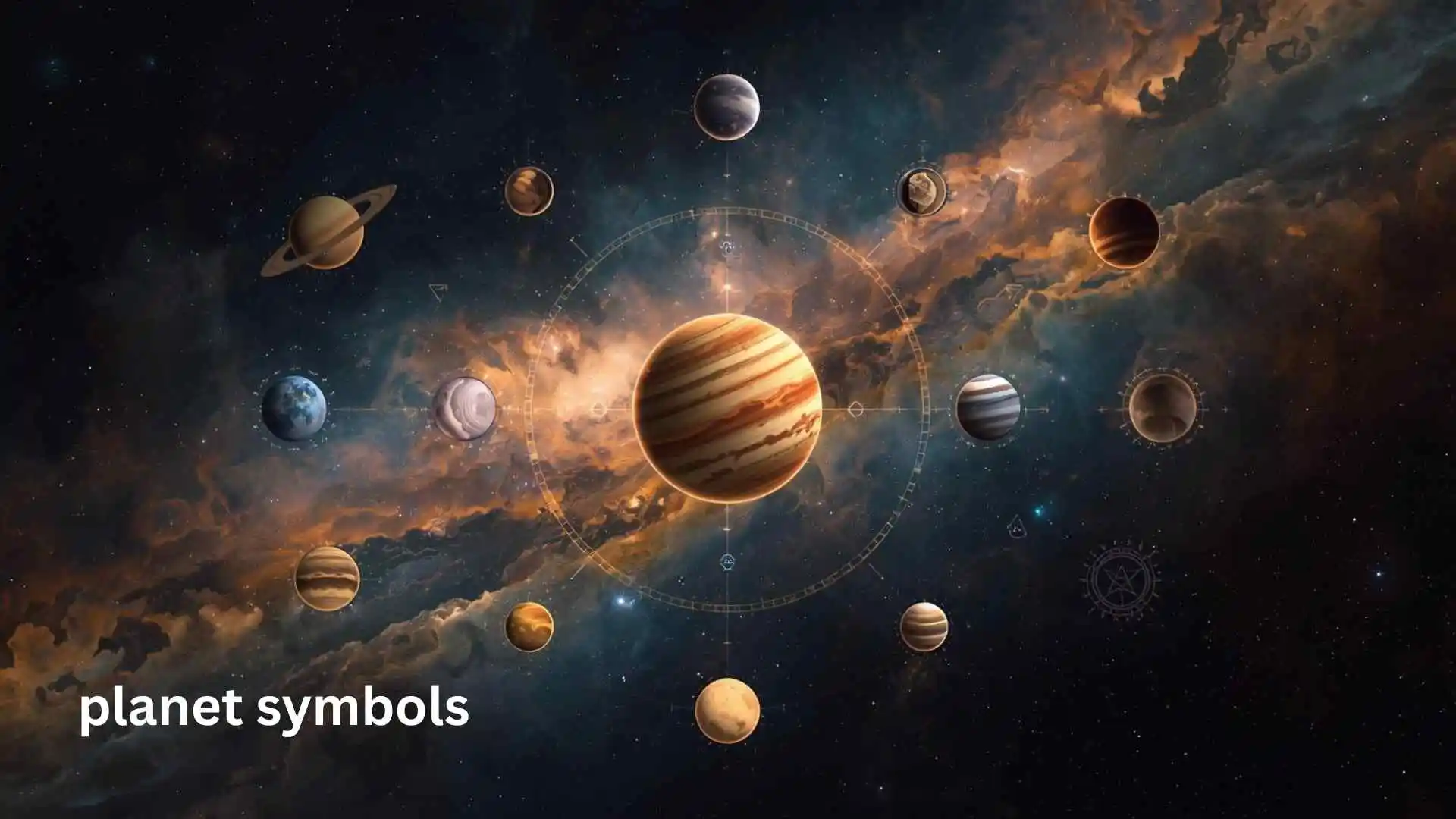
Planet symbols are not mere astronomical shorthand; they are ancient visual prayers etched into human consciousness, carrying the raw energy of gods, archetypes, and cosmic forces.
Every time you glance at the glyph for Mars or Venus, you are looking at a psychological map that has guided emperors, artists, and dreamers for over two thousand years.
These seven sacred marks hold the power to decode your personality, your fears, and your deepest longings, yet most people never learn their true language.
In this journey, you waill not only memorize these planet symbols but feel why your soul already knows them.
What Are Planet Symbols?
Planet symbols, also known as astronomical or astrological glyphs, are graphic representations of the celestial bodies in our solar system. Each symbol combines three universal visual languages: the circle (spirit or wholeness), the crescent (receptivity or the soul), and the cross (matter or physical reality). Together, these simple shapes create a sophisticated code that describes how cosmic energy expresses itself through human experience.
The oldest planet symbols emerged from Greco Roman astronomy and were refined by medieval Arabic and European scholars. Mercury’s caduceus, Venus’s hand mirror, Mars’s shield and spear, Jupiter’s lightning bolt, Saturn’s sickle, and the Sun and Moon’s universal crowns all tell stories of mythology made visible. Later, when Uranus, Neptune, and Pluto were discovered, astronomers created new symbols blending telescopic discovery with hermetic tradition.
But why do these symbols still appear everywhere, from jewelry to corporate logos to tattoo studios? Because they bypass the rational mind. A planet symbol is a sigil, a charged image that your subconscious reads like a native language, whispering truths that words cannot hold.
Deep Symbolic Meaning of Planet Symbols
The Spiritual Level
On a spiritual plane, each planet symbol represents a divine archetype or a cosmic principle. The Sun’s dot inside a circle is the spirit ruling over matter, the gold of enlightenment within every human. The Moon’s crescent is the soul’s receptivity, the vessel that holds dreams, intuition, and ancestral memory. Saturn’s cross beneath a crescent is the spirit bowed under physical limitation, the painful but sacred teacher of time, karma, and discipline. When you meditate on these planet symbols, you are not contemplating distant rocks. You are conversing with living energies that shaped every myth, temple, and prayer humanity ever built.
The Psychological Level
Carl Jung recognized planet symbols as archetypes residing in the collective unconscious. Mars is not just the red planet but your assertiveness, anger, and survival drive. Venus is not love alone but your capacity for harmony, attraction, and self worth. Mercury is the messenger between your conscious and unconscious mind, governing how you learn, speak, and adapt. Modern depth psychology uses planetary archetypes in therapy to help people name their inner conflicts. A person with a wounded Mars may struggle with passive aggression. An overactive Jupiter may chase endless expansion without satisfaction. Planet symbols give form to the invisible forces driving your daily choices.
The Cultural Level
Culturally, planet symbols have been adopted as shorthand for entire value systems. Feminism reclaimed Venus as a symbol of empowered femininity, not passive beauty. Masculinity movements appropriated Mars for strength and protection. LGBTQ+ communities expanded the meaning of Mercury and Uranus to represent fluid identity and rebellious authenticity. In advertising, a Saturn symbol evokes reliability and tradition. A Jupiter symbol suggests luck and abundance. These ancient marks have become global visual language, understood from Tokyo to Toronto, often without a single spoken word.
Types and Variations of Planet Symbols
Each planet symbol carries a unique meaning rooted in mythology, astronomy, and esoteric tradition.
Sun ☉ – A circle with a central dot. Represents the conscious self, vitality, leadership, and creative will. Appears in every solar cult from Egyptian Ra to Roman Sol Invictus. In dreams, the Sun signals clarity, recognition, or ego inflation.
Moon ☽ – A crescent shape, often drawn as a thin curve. Governs emotions, intuition, memory, and the maternal bond. Found in lunar calendars, goddess religions, and water ritual art. A dream Moon can mean hidden fears or sudden psychic opening.
Mercury ☿ – A circle above a cross, topped with two curved horns. Symbolizes speed, communication, trade, and trickery. Mercury’s caduceus appears in medical logos (often mistakenly) and alchemical manuscripts. In dreams, Mercury brings messages, coincidences, or a need to speak your truth.
Venus ♀ – A circle above a cross, often described as a hand mirror. Represents love, beauty, art, money, and sensual pleasure. This symbol appears in feminist logos, romance novels, wedding traditions, and cosmetic branding. A dream Venus can mean self love, jealousy, or a creative breakthrough.
Mars ♂ – A circle with an arrow emerging diagonally. Represents aggression, drive, sexuality, and physical courage. Mars glyphs adorn military insignia, sports team logos, and men’s health products. In dreams, Mars signals anger, initiation, or the need to fight for your life.
Jupiter ♃ – A crescent resting on a cross, resembling a stylized number four. Represents abundance, wisdom, travel, and optimism. Jupiter’s symbol appears in legal and academic seals, luxury branding, and good luck talismans. Dreaming of Jupiter means expansion, excess, or a moral lesson.
Saturn ♄ – A cross beneath a crescent, sometimes drawn as an inverted sickle. Governs restriction, time, aging, discipline, and karma. Saturn symbols appear in architectural carvings of mortality, memento mori jewelry, and stoic philosophy logos. A dream Saturn can mean depression, responsibility, or a profound life lesson.
Uranus ♅ – A cross rising from a circle with two opposing curves. Represents rebellion, innovation, electricity, and sudden change. Uranus appears in tech company logos, avant garde fashion, and astrology of awakening. In dreams, Uranus means surprise, liberation, or dangerous instability.
Neptune ♆ – A trident shape rising from a cross. Governs dreams, illusion, spirituality, addiction, and the ocean’s depth. Neptune symbols adorn psychedelic art, music festival branding, and meditation guides. Dream Neptune can mean artistic inspiration, deception, or spiritual emergency.
Pluto ♇ – A circle above a crescent above a cross. Represents transformation, death, rebirth, hidden power, and shadow work. Pluto appears in gothic jewelry, psychological thriller logos, and crisis intervention symbols. A dream Pluto signals the end of a life chapter, buried trauma surfacing, or immense personal power.
Planet Symbols Across Cultures
In ancient Mesopotamia, each planet was a living deity. Venus as Inanna was written with an eight pointed star, not the mirror glyph, but her energy of love and war remains identical. Babylonians assigned metals, colors, and stones to each planet, traditions that alchemy later preserved.
In Vedic India, planet symbols are called grahas. The Sun (Surya) is a chariot drawn by seven horses, represented by a red circle with a central dot. Moon (Chandra) is a silver crescent seated on a deer drawn chariot. Mars (Mangala) is a red clothed warrior wielding a spear. Vedic yantras use these planet symbols in healing and electional astrology.
In Chinese cosmology, the seven luminaries (Sun, Moon, Mercury, Venus, Mars, Jupiter, Saturn) were celestial bureaucrats. Mercury was the water star governing exams and travel. Mars was the fire star of sudden action and war. Their symbols in calligraphy differ from Western glyphs but carry identical archetypal weights.
In medieval Islamic astronomy, planet symbols were refined into the forms we use today. Al-Biruni’s manuscripts show Mercury, Venus, Mars, Jupiter, and Saturn with symbols nearly identical to modern ones. Islamic astrologers added spiritual layers, teaching that each planet governs a different angelic realm and a different name of God.
In modern Western culture, planet symbols have been democratized. A teenager with a Saturn tattoo may know nothing about Roman mythology but feel deeply the weight of their responsibilities. A bride wearing Venus jewelry may never study astrology but radiates the planet’s harmony. The symbols have become living memes, evolving with each generation while preserving their ancient cores.
Planet Symbols in Art, Movies, and Pop Culture
In paintings, planet symbols appear everywhere. Sandro Botticelli’s “Birth of Venus” shows the goddess emerging from a shell, her symbol hidden in the composition’s golden ratio. Alchemical manuscripts are dense with planetary glyphs, each representing a stage of the magnum opus. Salvador Dalí painted melting clocks with Saturn’s influence, time devouring itself.
In movies, planet symbols are visual shorthand for character psychology. In “Harry Potter,” the Marauder’s Map uses planetary glyphs to represent the characters’ core drives. In “The Matrix,” Neptune’s symbol appears on the Nebuchadnezzar’s hull, hinting at the crew’s dream like mission. Christopher Nolan’s “Interstellar” embeds Saturn’s glyph into the black hole Gargantua’s accretion disk, fusing science and symbol.
In books, planet symbols serve as chapter headings in fantasy series like “The Witcher” and “His Dark Materials.” In poetry, Sylvia Plath’s “Ariel” invokes Mars and Venus as opposing forces in a woman’s psyche. Literary fiction uses planetary archetypes to structure character arcs without naming them directly.
In tattoos and fashion, planet symbols have exploded in popularity. Minimalist Sun and Moon tattoos represent duality and wholeness. Mars and Venus together symbolize partnership or gender reconciliation. Saturn rings tattoos (a modern addition to the ancient glyph) speak of embracing time’s passage. Luxury brands like Cartier and Van Cleef & Arpels release planetary collections each year, selling the symbols’ magic as much as their metal.
Spiritual and Dream Meaning of Planet Symbols
When planet symbols appear in dreams, meditation, or spontaneous visions, they are rarely random. Your unconscious mind selects these images to communicate urgent truths.
Seeing the Sun symbol in a dream often precedes a period of recognition or creative explosion. It can also warn of narcissism, too much heat burning your softer parts.
A Moon symbol glowing in meditation tells you to trust your intuition. If the Moon is dark, you may be hiding from your own emotional nature. If full, expect a cycle of your life to complete.
Mercury appearing as a glyph on a door or letter means a message is coming, often through technology, travel, or a young person. It also suggests you need to negotiate or compromise.
Venus in a dream, especially on a mirror or piece of jewelry, asks you to examine your self worth and your capacity to receive pleasure. Broken Venus symbols mean heartbreak or creative block.
Mars as a tattoo or weapon in a dream signals anger you have not expressed. It can also be a call to physical action, to exercise, to compete, to defend someone weaker.
Jupiter appearing as a throne or a book means you are about to grow beyond your current container. It can be joyful but also chaotic, too much of a good thing.
Saturn in a dream as a clock or an old man indicates a life lesson you cannot avoid. Resisting Saturn brings depression. Yielding to it brings wisdom and long term reward.
Uranus as a lightning bolt or a broken chain means liberation is coming, but so is instability. You may need to leave a situation abruptly.
Neptune as fog or an endless ocean warns of illusion. You may be deceiving yourself or being deceived. It also promises artistic inspiration if you stay grounded.
Pluto as a skull or a phoenix means something in your life must die. This is not punishment but clearing. What collapses now makes space for a truer version of you.
Positive vs Negative Meanings of Planet Symbols
Every planet symbol is a double edged sword, reflecting light and shadow equally.
Sun positive – vitality, leadership, joy. Sun negative – arrogance, burnout, denial of mortality.
Moon positive – intuition, nurture, psychic ability. Moon negative – mood swings, irrational fear, emotional manipulation.
Mercury positive – cleverness, adaptability, communication. Mercury negative – deceit, anxiety, nervous exhaustion.
Venus positive – love, art, abundance. Venus negative – vanity, jealousy, material greed.
Mars positive – courage, drive, protection. Mars negative – violence, rage, destruction of the vulnerable.
Jupiter positive – generosity, optimism, growth. Jupiter negative – excess, gambling, spiritual bypass.
Saturn positive – discipline, wisdom, integrity. Saturn negative – cruelty, depression, rigid control.
Uranus positive – innovation, freedom, awakening. Uranus negative – chaos, rebellion without cause, destructive instability.
Neptune positive – compassion, vision, artistic genius. Neptune negative – addiction, delusion, martyr complex.
Pluto positive – transformation, empowerment, healing of collective shadows. Pluto negative – tyranny, obsession, cycles of abuse.
Learning to work with planet symbols means honoring both poles. You cannot have the Sun’s creative fire without risking its burn. You cannot access Neptune’s spiritual ocean without learning to swim through its depths.
Why Humans Are Attracted to Planet Symbols
Psychologically, humans are drawn to planet symbols because they offer a visual alphabet for the invisible architecture of our lives. We cannot see the force of discipline, but we can draw Saturn’s cross and crescent and suddenly feel its presence. We cannot hold love in our hands, but Venus’s mirror reflects our own longing back to us.
There is also a neurological reason. The human brain processes symbols faster than words. A planet symbol bypasses the left hemisphere’s skepticism and speaks directly to the right hemisphere’s pattern recognition. This is why a child can feel the difference between Mars and Venus glyphs without any training. The shapes themselves encode emotional frequencies.
Culturally, planet symbols give us a shared language for experiences that feel isolating. When you wear a Moon necklace, you announce to other intuitive souls, “I also feel the tides inside me.” When you tattoo Jupiter on your wrist, you say, “I am learning to trust abundance.” These symbols are identity markers for the spiritual but not religious, the curious but not dogmatic.
Finally, planet symbols appeal to our desire for order in chaos. The same sky that spins with terrifying indifference can be mapped into ten meaningful glyphs. Drawing a Saturn symbol when you feel overwhelmed is an act of summoning structure. Tracing a Venus symbol during heartbreak is a prayer for beauty to return. These marks are tiny rituals, and we are creatures who need ritual to survive meaningfully.
Frequently Asked Questions About Planet Symbols
Which planet symbol is most powerful for spiritual growth?
Saturn and Pluto are the most transformative because they govern death and discipline. However, beginners often start with the Sun or Moon, which are gentler teachers.
Can I wear planet symbols even if I don’t believe in astrology?
Absolutely. Planet symbols have transcended astrology. They are now cultural and psychological tools. Wearing Mars can remind you to be brave. Wearing Venus can remind you to love yourself. The meaning is yours to create.
What does it mean if a planet symbol appears randomly in my home?
In spiritual traditions, this is considered a synchronicity, a meaningful coincidence. Pay attention to which planet appeared. Research its shadow and light qualities and ask honestly where that energy is active in your life right now.
Are planet symbols used in any major world religions today?
Not as central worship objects, but they appear in Hindu yantras, Buddhist mandalas, Islamic geometric art, and Christian cathedrals (often hidden in architectural details). They function more as universal archetypes than religious icons.
How do I choose which planet symbol to meditate with?
Look at your current life struggle. If you feel weak, meditate on Mars. If you feel hopeless, meditate on Jupiter. If you feel lost, meditate on the Moon. If you feel afraid of aging, meditate on Saturn. The planet that scares you most is often the one you need most.
Do dwarf planets like Ceres or Eris have symbols?
Yes. Ceres (a circle with a crescent and a cross) represents nurturing and loss. Eris (a circle with a diagonal line and a cross) represents discord and truth telling. They are used mostly by advanced astrologers and mythologists.
Conclusion
Planet symbols are not dead marks on an ancient chart. They are living hieroglyphs etched into your subconscious, waiting to be read. From the Sun’s golden dot to Pluto’s underground key, each glyph holds a conversation about who you truly are beneath your name and your story. The next time you see a planet symbol on a stranger’s skin or a cathedral’s floor, stop. Listen. That shape is speaking a language older than words, and somewhere inside you, you already understand every syllable.

Nora Bennett
Nora Bennett is a storyteller at heart, always finding magic in the everyday moments of life. From a young age, she discovered the joy of weaving emotions into words, creating characters that feel like old friends. Writing, for her, is both an adventure and a sanctuary—a way to explore the world and herself. She loves connecting with readers who share her passion for heartfelt stories and unforgettable journeys. When she’s not crafting her next tale, Nora enjoys quiet mornings with a cup of coffee and a notebook full of ideas. Her stories are meant to inspire, comfort, and spark imagination in everyone who reads them.
Books:
-
Whispers of Yesterday
-
Echoes of Tomorrow