Freedom is not just a word, it’s a feeling that lives deep inside every human heart. It’s the quiet longing to breathe without limits, to live without chains, to choose your own path.
Across centuries, people have searched for ways to express this powerful desire and they’ve done so through symbols.
From soaring birds to broken chains, symbols of freedom tell stories of struggle, hope, rebellion, and triumph.
In this article, you’ll discover the deeper meanings behind these symbols, meanings that go far beyond what meets the eye. Some may surprise you. Others may feel like they’ve always been a part of you.
What Are Symbols of Freedom?
Symbols of freedom are visual, cultural, or conceptual representations that express liberation, independence, and the absence of constraint. These symbols can be found in art, religion, politics, literature, and everyday life.
Historically, symbols of freedom emerged during times of oppression or transformation. When words weren’t enough or weren’t allowed people turned to imagery. A flag, an animal, or even a simple gesture could communicate resistance and hope.
Over time, these symbols became universal. They crossed borders, languages, and cultures, carrying the same emotional weight: the human desire to be free.
Deep Symbolic Meaning
Spiritual Level
On a spiritual level, symbols of freedom represent the soul’s liberation. They point to a state beyond fear, attachment, and limitation. Freedom here is not just physical—it’s inner peace, enlightenment, and the release of ego.
A bird in flight, for example, is not just escaping the ground—it symbolizes the soul rising above earthly burdens.
Psychological Level
Psychologically, these symbols connect to autonomy, identity, and self-expression. Humans are wired to seek control over their lives. When we see symbols of freedom, they trigger emotions tied to independence, courage, and personal power.
A broken chain can instantly evoke a sense of relief, strength, and victory over hardship.
Cultural Level
Culturally, symbols of freedom often emerge from shared struggles—wars, revolutions, and social movements. They become collective memories, reminders of what was endured and what was achieved.
They are not just images—they are stories passed through generations.
Types / Variations of Symbols of Freedom
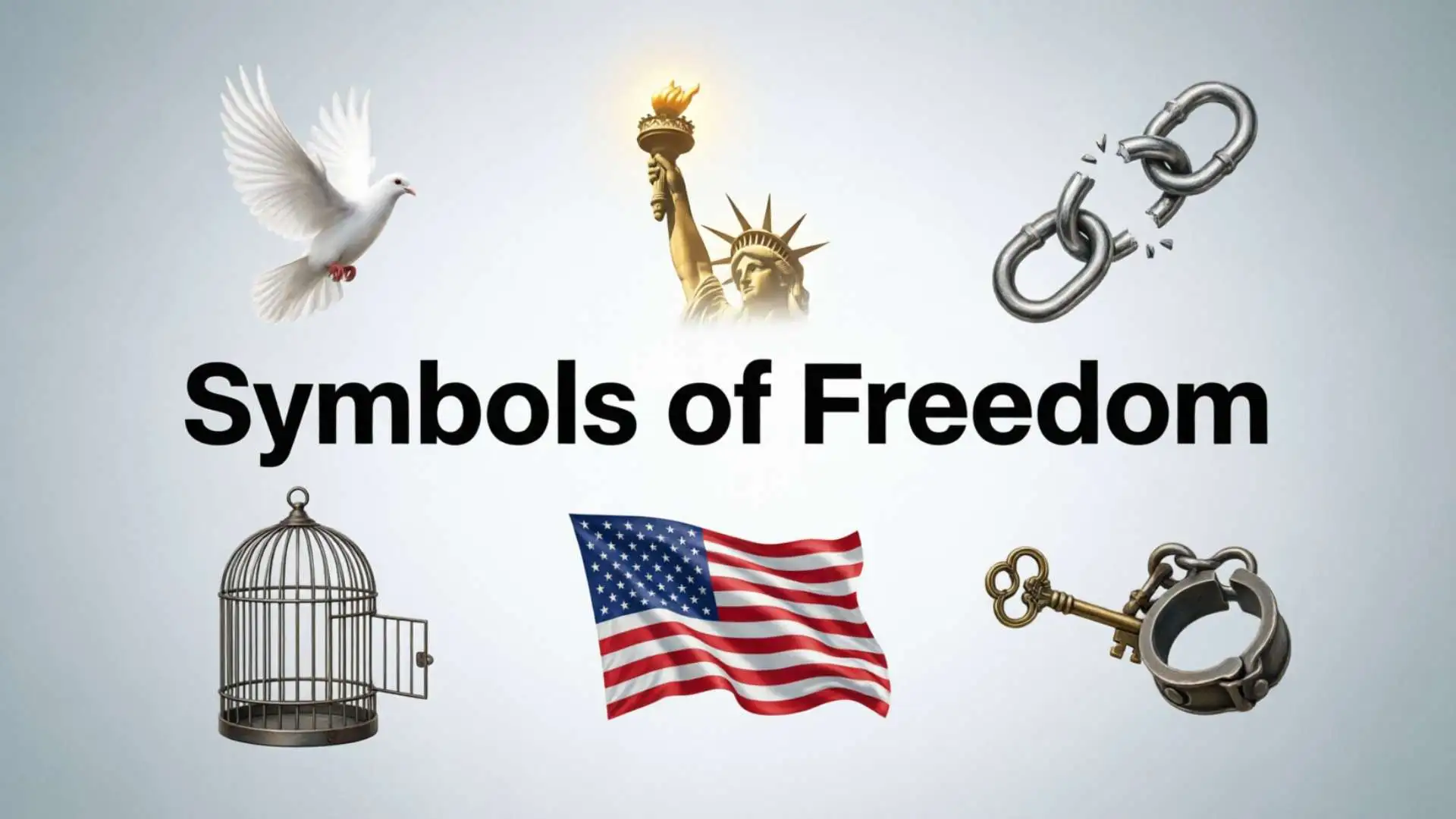
1. The Bird (Especially Eagle or Dove)
Visual: Wings spread wide, soaring in the sky
Meaning: Liberation, perspective, transcendence
Where it appears: Mythology, national emblems, tattoos, dreams
Birds represent the ability to rise above limitations. The higher they fly, the freer they appear.
2. Broken Chains
Visual: Chains snapped or falling apart
Meaning: Release from oppression, victory over control
Where it appears: Political art, historical monuments, literature
This is one of the most direct symbols—freedom earned through struggle.
3. The Open Road
Visual: A long, endless road stretching into the horizon
Meaning: Choice, journey, independence
Where it appears: Films, novels, photography
It represents the freedom to choose your direction in life.
4. The Butterfly
Visual: A delicate insect emerging from a cocoon
Meaning: Transformation, rebirth, personal freedom
Where it appears: Spiritual symbolism, tattoos, art
The butterfly reminds us that freedom often comes after change.
5. The Flag
Visual: A nation’s flag waving in the wind
Meaning: National freedom, identity, unity
Where it appears: Politics, ceremonies, protests
Flags often symbolize the collective freedom of a people.
6. The Key
Visual: A small key unlocking something unseen
Meaning: Access, opportunity, liberation
Where it appears: Dreams, symbolic art, literature
A key suggests that freedom is something you can unlock.
7. The Sky
Visual: Endless blue or star-filled expanse
Meaning: Limitlessness, infinite possibility
Where it appears: Poetry, philosophy, visual art
The sky represents freedom without boundaries.
Symbols of Freedom Across Cultures
Ancient Greece
Freedom was tied to democracy and civic participation. Symbols often included open spaces like the agora, representing public voice and power.
Ancient Egypt
Birds, especially the falcon, symbolized divine freedom and the soul’s journey after death.
Native American Cultures
The eagle represented spiritual freedom and connection to the Creator. Feathers were sacred symbols of honor and liberation.
Medieval Europe
Freedom was often symbolized through broken shackles and rising suns—representing escape from feudal control.
Modern Western Culture
The Statue of Liberty stands as a global symbol of freedom, representing hope, immigration, and new beginnings.
Symbols of Freedom in Art, Movies & Pop Culture
In art, freedom is often depicted through open landscapes, flying figures, or light breaking through darkness. These visuals evoke emotional release and possibility.
In movies, characters seeking freedom often journey across vast spaces—deserts, oceans, or highways. Think of stories where escape equals identity.
In literature, freedom is a central theme. From rebellion against authority to personal awakening, symbols like doors, wings, and fire appear repeatedly.
In tattoos, people choose birds, feathers, or infinity symbols to represent their personal freedom—whether emotional, spiritual, or physical.
In fashion, flowing fabrics, minimal constraints, and bold designs often symbolize freedom of expression.
Spiritual & Dream Meaning of Symbols of Freedom
Seeing symbols of freedom in dreams often signals a desire for change. It may reflect a need to break free from a situation, mindset, or relationship.
- Flying in a dream → Desire for escape or growth
- Breaking chains → Overcoming obstacles
- Open sky → Seeking clarity and peace
Spiritually, these symbols can appear during moments of awakening—when a person is ready to release fear and embrace their true self.
Positive vs Negative Meaning
Positive Meaning
- Liberation
- Empowerment
- Growth
- Hope
- New beginnings
Negative Meaning
- Isolation (freedom without connection)
- Rebellion without direction
- Fear of commitment
- Escapism
Freedom, like any powerful concept, has two sides. Too much freedom without purpose can feel just as limiting as no freedom at all.
Why Humans Are Attracted to Symbols of Freedom
Humans are naturally drawn to freedom because it is tied to survival, identity, and happiness. From childhood, we seek independence—to walk, to speak, to choose.
Symbols of freedom tap into this deep instinct. They remind us of what we want, what we’ve lost, or what we’re fighting for.
There’s also an emotional pull. Seeing a bird fly or a horizon stretch endlessly can trigger a sense of peace and possibility. It feels like something inside us is being called—something ancient and universal.
Freedom is not just a concept. It’s a need.
FAQs
What is the most common symbol of freedom?
The bird, especially the eagle or dove, is one of the most widely recognized symbols of freedom due to its ability to fly freely.
Why do broken chains symbolize freedom?
Because they represent the physical act of escaping bondage or control, making them a powerful image of liberation.
What does a butterfly symbolize in freedom?
It represents transformation and the freedom that comes after personal growth or change.
Are symbols of freedom the same in every culture?
No, but many share similar meanings. While the imagery may differ, the core idea of liberation remains universal.
What does it mean to dream about freedom symbols?
It often reflects a desire for change, independence, or release from stress or limitation.
Can freedom have a negative meaning?
Yes. Without balance, freedom can lead to isolation, lack of direction, or emotional instability.
Conclusion
Symbols of freedom are more than images; they are reflections of the human spirit. They tell stories of courage, resilience, and the endless desire to live without limits.
Whether it’s a bird in flight, a road stretching into the unknown, or chains falling away, these symbols remind us of something deeply personal: the power to choose, to change, and to rise.
And perhaps the most beautiful truth is this freedom is not just something we see in symbols. It’s something we carry within us, waiting to be recognized, claimed, and lived.

Julian Shaw
I’ve always been fascinated by the small, quiet stories that make life feel magical. Writing allows me to explore worlds that exist just beyond the everyday, where imagination meets reality. Over the years, I’ve found joy in creating characters that feel real and stories that stay with readers long after the last page. When I’m not writing, you can usually find me wandering through city streets, notebook in hand, capturing little sparks of inspiration. I believe every story has the power to connect us, to make us feel a little less alone. Sharing these tales is my way of leaving a mark on the world.
Books:
-
Whispers in the Wind
-
Shadows of Tomorrow