High in the misty mountains of the Andes, long before modern alphabets and digital screens, a civilization spoke through symbols.
These weren’t just decorations, they were messages, beliefs, and entire worldviews carved into stone and woven into fabric.
The Inca symbols carry whispers of a lost empire, inviting us to decode meanings that still touch the human soul today.
If you’ve ever felt drawn to ancient patterns or mysterious signs, this journey will reveal why these symbols continue to resonate emotionally, spiritually, and deeply within our collective memory.
What are Inca Symbols?
Inca symbols are visual representations used by the ancient Inca civilization to express ideas, beliefs, power structures, and connections to nature. Unlike many cultures, the Incas did not have a formal written language. Instead, they relied on symbols, textiles, carvings, and systems like quipu (knotted cords) to communicate.
These symbols appeared everywhere—from sacred temples like Machu Picchu to everyday clothing and ceremonial objects. Each shape, animal, and geometric pattern held meaning tied to their understanding of the universe.
At the heart of Inca symbolism was harmony—with nature, the cosmos, and society.
Deep Symbolic Meaning
Spiritual Level
Inca symbols are deeply spiritual. They reflect a universe divided into three realms:
- Hanan Pacha (Upper World) – the heavens
- Kay Pacha (Middle World) – the human world
- Uku Pacha (Lower World) – the underworld
Animals like the condor, puma, and serpent represent these realms, connecting humans to divine forces.
Psychological Level
On a psychological level, these symbols mirror human instincts:
- The condor symbolizes aspiration and freedom
- The puma represents strength and courage
- The serpent reflects transformation and hidden knowledge
They act like archetypes—images that speak directly to the human mind, even today.
Cultural Level
Culturally, Inca symbols reinforced unity and identity. They were used to show social rank, religious devotion, and connection to the land. Every pattern told a story—of ancestry, survival, and cosmic balance.
Types / Variations of Inca Symbols
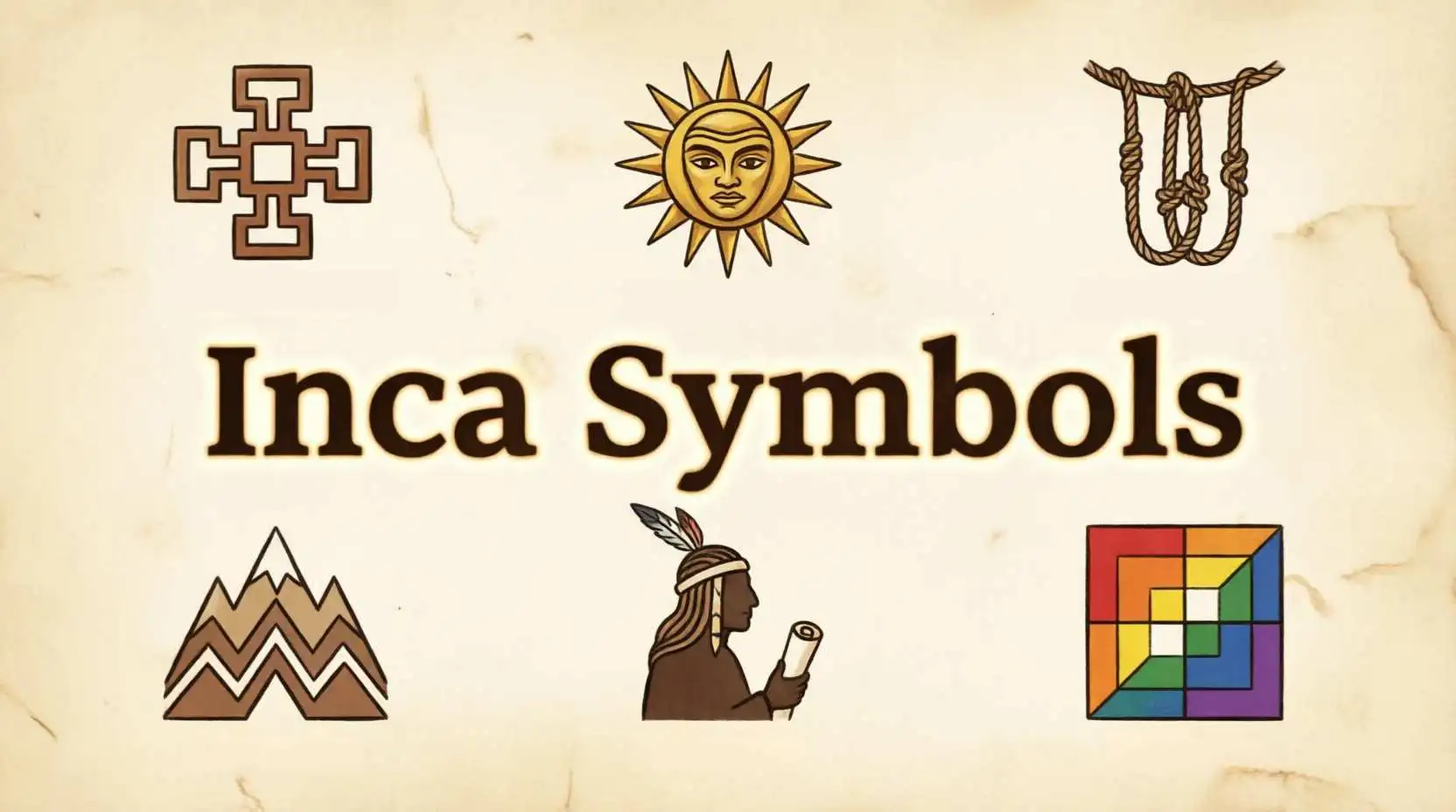
1. Chakana (Inca Cross)
- Visual: A stepped cross with equal arms
- Meaning: Balance, connection between worlds
- Where it appears: Architecture, jewelry, spiritual rituals
2. Inti (Sun Symbol)
- Visual: Radiating sun with a face
- Meaning: Life, power, divine energy
- Where it appears: Temples, especially those dedicated to Inti
3. Condor
- Visual: Large bird with wide wings
- Meaning: Freedom, higher consciousness
- Where it appears: Stone carvings, myths, sky rituals
4. Puma
- Visual: Strong feline figure
- Meaning: Strength, leadership
- Where it appears: City layouts (Cusco was shaped like a puma)
5. Serpent (Amaru)
- Visual: Snake-like creature
- Meaning: Transformation, wisdom
- Where it appears: Underground symbolism, spiritual beliefs
6. Quipu
- Visual: Knotted cords
- Meaning: Record-keeping, communication
- Where it appears: Administrative and cultural systems
Inca Symbols Across Cultures
Ancient Andean Culture
In the Andes, symbols were sacred tools—used to connect humans with nature and the divine.
Mesoamerican Civilizations
Similar symbolic animals appear in Mayan and Aztec cultures, showing shared spiritual ideas across regions.
Medieval Europe
While Europe relied on written language, symbolic imagery in churches also conveyed spiritual meaning—similar intent, different form.
Modern Western Culture
Today, Inca symbols are used in tattoos, logos, and art—often representing spirituality, strength, and mystery.
Indigenous South American Traditions
Descendants of the Incas still honor these symbols in rituals and textiles, keeping the meanings alive.
Inca Symbols in Art, Movies & Pop Culture
Inca symbols have found a second life in modern creativity:
- Movies: Adventure films often use Inca imagery to represent mystery and hidden treasure
- Art: Contemporary artists reinterpret Chakana and animal symbols
- Books: Historical fiction brings symbolic meanings into storytelling
- Tattoos: Many people choose Inca symbols for spiritual identity
- Fashion: Patterns inspired by Andean textiles appear in global designs
These symbols now bridge ancient wisdom with modern expression.
Spiritual & Dream Meaning of Inca Symbols
Seeing Inca symbols in dreams or meditation can feel powerful.
- Chakana: You may be seeking balance in life
- Condor: A desire for freedom or spiritual awakening
- Serpent: Transformation or hidden fears surfacing
- Sun (Inti): Renewal, hope, and energy
Spiritually, these symbols often appear during moments of change—guiding inner growth.
Positive vs Negative Meaning
Like all powerful symbols, Inca imagery carries dual meanings:
Positive:
- Harmony with nature
- Strength and resilience
- Spiritual awakening
Negative:
- Power struggles (symbols of authority)
- Fear of the unknown (serpent imagery)
- Over-reliance on hierarchy
This duality reflects life itself—light and shadow coexisting.
Why Humans Are Attracted to Inca Symbols
Humans are naturally drawn to symbols that feel ancient and meaningful. Inca symbols tap into something deeper:
- Connection to nature in a modern, disconnected world
- Desire for meaning beyond material life
- Visual simplicity with deep complexity
- Archetypal imagery that feels familiar across cultures
Even if you’ve never studied the Incas, these symbols can feel strangely personal—like memories you didn’t know you had.
FAQs
What are the most important Inca symbols?
The Chakana, Inti (sun), condor, puma, and serpent are among the most significant.
Did the Incas have a written language?
No traditional writing system existed; they used symbols and quipu for communication.
What does the Chakana symbolize?
It represents balance and the connection between the three realms of existence.
Are Inca symbols still used today?
Yes, especially in indigenous traditions, art, and modern spiritual practices.
What does the Inca sun symbol mean?
It represents life, energy, and divine power linked to the sun god Inti.
Why are animal symbols important in Inca culture?
Animals represented spiritual forces and different realms of existence.
Conclusion
Inca symbols are more than ancient designs; they are a living language of the soul. They speak of balance, power, transformation, and connection to something greater than ourselves. From the towering stones of Machu Picchu to modern tattoos and art, their meanings continue to evolve while staying rooted in timeless truth.
When you look at an Inca symbol, you’re not just seeing history, you’re witnessing a reflection of human existence itself. And perhaps, in that silent language, you’ll discover something about your own journey too.

Nora Bennett
Nora Bennett is a storyteller at heart, always finding magic in the everyday moments of life. From a young age, she discovered the joy of weaving emotions into words, creating characters that feel like old friends. Writing, for her, is both an adventure and a sanctuary—a way to explore the world and herself. She loves connecting with readers who share her passion for heartfelt stories and unforgettable journeys. When she’s not crafting her next tale, Nora enjoys quiet mornings with a cup of coffee and a notebook full of ideas. Her stories are meant to inspire, comfort, and spark imagination in everyone who reads them.
Books:
-
Whispers of Yesterday
-
Echoes of Tomorrow