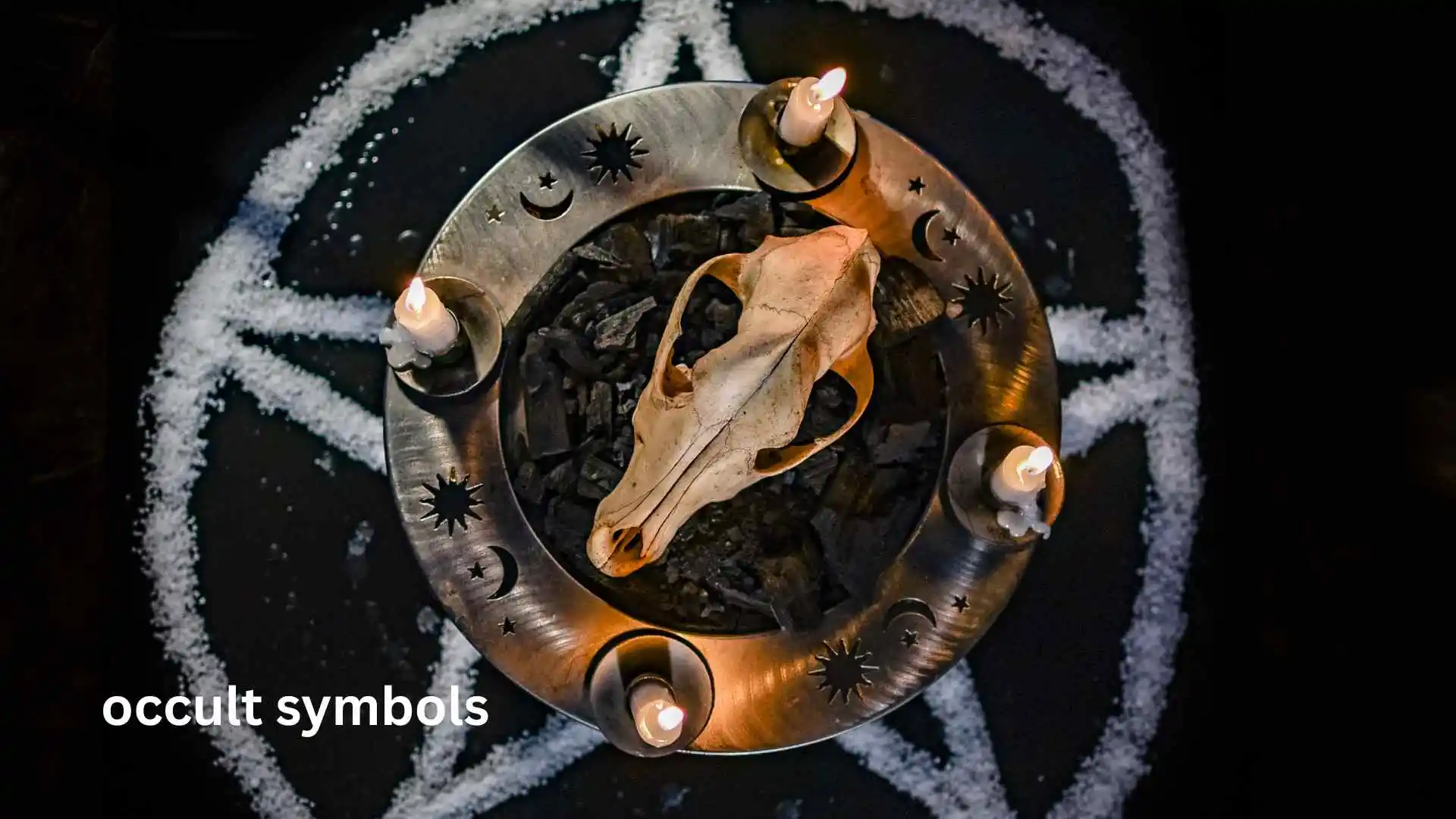
Occult symbols have whispered across millennia, from candlelit caves to Hollywood blockbusters, quietly shaping how we perceive mystery, power, and the invisible threads of fate.
Whether you have glimpsed a pentagram on a necklace, traced an eye on a dollar bill, or felt a strange pull toward an ancient marking in a dream, these symbols speak a language older than words.
This article will not just list occult symbols; it will walk you through their hidden souls, their light and shadow, and why your own mind still recognizes them.
What Are Occult Symbols?
Occult symbols are visual signs used in esoteric traditions to represent hidden forces, spiritual truths, or magical intentions. The word occult simply means hidden from plain view. So these symbols act as keys. They unlock knowledge that is not written in books but felt in rituals, meditations, and secret societies.
Historically, occult symbols appear in ancient Egypt, Greece, India, and medieval Europe. Alchemists used them to encode chemical processes. Mystics used them to map the heavens and the human soul. Today, they appear in tarot cards, grimoires, and even corporate logos, often without the public realizing their deeper origins.
Culturally, these symbols serve a universal human need. We need to represent the invisible. Love, death, fate, protection, transformation, destruction. None of these can be photographed. But all can be drawn.
Deep Symbolic Meaning of Occult Symbols
Spiritual Level
On a spiritual level, occult symbols act as portals. When you gaze at a sacred geometry shape or a sigil during meditation, your brain shifts frequencies. The symbol becomes a bridge between your conscious mind and something greater. Many practitioners believe these signs carry vibrational energy that can be activated through intention and focus.
Psychological Level
Carl Jung called them archetypes. The spiral, the cross, the all seeing eye. These patterns live in the collective unconscious. You do not need to study them to feel their effect. A child drawn to a circle or a labyrinth is responding to the same deep wiring that made ancient cultures build stone rings. Occult symbols trigger primal emotions. Fear, awe, curiosity, protection.
Cultural Level
Every civilization has created its own occult language. But fascinatingly, many symbols repeat across oceans and centuries. The sun wheel. The serpent. The hand. This suggests that human beings, separated by time and distance, arrived at similar visual answers to the same cosmic questions. Occult symbols are a shared inheritance.
Types and Variations of Occult Symbols
1. The Pentagram
Visual description: A five pointed star drawn with one continuous line, often enclosed in a circle. One point faces upward.
Meaning: Protection, balance of the four elements (earth, air, fire, water) with spirit at the top. When inverted, it sometimes represents matter over spirit, but not always evil.
Where it appears: Ancient Babylon, Greek mathematics, medieval Christian symbolism, modern Wicca, and heavy metal album covers.
2. The Sigil of Lucifer
Visual description: A complex geometric diagram with a V, an X, and intersecting lines, sometimes inside a double circle.
Meaning: Enlightenment, forbidden knowledge, and the liberation of the self from dogmatic control. Often misunderstood as purely evil.
Where it appears: 16th century grimoires, modern occult literature, and tattoo art among seekers of personal sovereignty.
3. The Hamsa Hand
Visual description: An open right hand with an eye in the palm, often symmetrical.
Meaning: Protection against the evil eye, blessings, feminine power, and divine luck.
Where it appears: Jewish Kabbalah, Islamic Middle East, North African Berber tribes, and as a popular unisex amulet in fashion jewelry.
4. The Ouroboros
Visual description: A serpent or dragon eating its own tail, forming a circle.
Meaning: Infinity, cyclic nature of life and death, self reflection, and alchemical completion.
Where it appears: Ancient Egyptian funerary texts, Gnostic Christianity, Norse mythology (Jörmungandr), and modern psychology as a symbol of the unified self.
5. The All Seeing Eye
Visual description: A single human eye, sometimes inside a triangle or pyramid, often radiating light.
Meaning: Divine watchfulness, hidden knowledge, surveillance, or spiritual awakening depending on context.
Where it appears: Egyptian Eye of Horus, Christian Eye of Providence, Freemasonry, the Great Seal of the United States, and every conspiracy theory documentary.
6. The Ankh
Visual description: A cross with a teardrop shaped loop at the top.
Meaning: Eternal life, divine breath, sexual union (the cross as masculine, loop as feminine), and resurrection.
Where it appears: Ancient Egyptian temple walls, Coptic Christian churches, gothic fashion, and Afrocentric spiritual movements.
7. The Hexagram
Visual description: Two overlapping triangles, one pointing up, one down.
Meaning: As above, so below. Union of opposites. Male and female. Heaven and earth.
Where it appears: Hindu yantras, Jewish Star of David, Tantric Buddhism, Alchemical diagrams, and Rastafarian symbolism.
8. The Spiral
Visual description: A continuous curved line winding inward or outward.
Meaning: Personal evolution, the journey into the self, cosmic expansion, and the womb of creation.
Where it appears: Celtic carvings at Newgrange, Native American petroglyphs, Minoan palaces, and psychedelic art.
9. The Eye in the Hand
Visual description: An eye floating inside an open palm.
Meaning: Psychic protection, intuition, and the ability to see hidden truths.
Where it appears: Mediterranean folk magic, modern tarot decks (The Star card sometimes contains it), and neo pagan amulets.
10. The Triple Moon
Visual description: A full moon flanked by a waxing crescent on the left and a waning crescent on the right.
Meaning: Maiden, mother, crone. The three stages of feminine life. Lunar cycles. Witchcraft.
Where it appears: Wiccan traditions, feminist spirituality, moon worship in pre Christian Europe, and modern celestial tattoos.
11. The Leviathan Cross
Visual description: A double cross (two horizontal bars) with an infinity symbol at the base.
Meaning: Sulfur, the alchemical soul, protection from evil, and the eternal nature of the spirit.
Where it appears: Alchemical manuscripts, black metal band logos, and as a symbol of the Church of Satan.
12. The Eye of Ra
Visual description: A right eye with a curved brow and a teardrop mark beneath.
Meaning: Solar power, destruction, royal authority, and wrathful protection.
Where it appears: Egyptian mythology, modern Kemetic spirituality, and protective jewelry.
13. The Labyrinth
Visual description: A single winding path that leads to a center and back out, unlike a maze with dead ends.
Meaning: Life journey, spiritual pilgrimage, death and rebirth.
Where it appears: Greek mythology (the Minotaur), medieval Christian cathedrals, Hopi Indian symbols, and modern meditation gardens.
14. The Unicursal Hexagram
Visual description: A six pointed star drawn in one continuous line without lifting the pen.
Meaning: Perfection, the macrocosm, and the unity of opposites without separation.
Where it appears: Thelema (Aleister Crowley), modern chaos magic, and ceremonial talismans.
15. The Black Sun
Visual description: A circle with twelve zigzag sun rays arranged like a broken wheel.
Meaning: Hidden light, the primal source before creation, inner illumination.
Where it appears: Norse and Germanic esotericism, modern occult revival, and unfortunately co opted by certain extremist groups, which obscures its genuine mystical roots.
Occult Symbols Across Cultures
Ancient Egypt used the Ankh, Eye of Horus, and Scarab to encode ideas of immortality and divine protection. Their symbols were not decorative. They were functional. A priest drawing an Ankh on a coffin believed it physically helped the soul breathe again.
Ancient Greece gave us the Hekate’s Wheel, the Rod of Asclepius, and the Gorgon head. Their occult symbols often merged medicine, magic, and mystery cults like the Eleusinian Mysteries. The labyrinth, tied to Crete, became a map of psychological descent.
Hinduism and Buddhism produced the Sri Yantra, the Lotus, and the Bindu (point). These occult symbols are used in meditation to literally reprogram the mind. The Sri Yantra, with nine interlocking triangles, is considered one of the most powerful energy maps ever drawn.
Celtic and Norse cultures favored the Triquetra (three interlocking arcs), the Vegvísir (a runic compass), and the Helm of Awe. These were carved on shields and ships to ensure safe passage through physical and spiritual storms.
Medieval Christian Europe secretly used the Ichthys (fish), the Chi Rho, and the Seal of Solomon. Even the cross itself was once an occult symbol before becoming mainstream. Alchemists mixed Christian imagery with pagan signs to hide their work from persecution.
Modern global culture has blended all of these. A person wearing a Hamsa hand over a yoga mat printed with a Sri Yantra while carrying a tarot deck with Ankhs is not confused. They are syncretic. The human soul borrows symbols freely.
Occult Symbols in Art, Movies, and Pop Culture
Cinema loves occult symbols because they create instant mystery. Stanley Kubrick filled The Shining with hexagons and Native American spiral imagery to suggest hidden violence. The Eyes Wide Shut masked ball is a masterclass in Masonic and Crowleyan symbolism.
In music, Led Zeppelin used the Hermetic symbol for Saturn on their Swan Song label. Jay Z and Beyoncé have worn all seeing eye pendants, sparking endless debate. Is it worship or just aesthetics? The answer is often both. Artists understand that occult symbols carry power even when used ironically.
Fashion brands from Alexander McQueen to Vetements have printed inverted pentagrams and ouija board letters on luxury clothing. Tattoo culture has exploded with occult imagery. A tiny Ankh on a wrist. A large Ouroboros across a shoulder blade. These are not satanic declarations. They are personal mythologies.
Literature from Dante’s Inferno to Dan Brown’s The Da Vinci Code has built entire plots around occult symbols. The secret is that readers want to believe hidden worlds exist just beneath the surface of ordinary life. Occult symbols provide the map.
Spiritual and Dream Meaning of Occult Symbols
Seeing an occult symbol in a dream is rarely random. Your subconscious speaks in images, not words. If you dream of an eye, you are being asked to look closer at something you have been ignoring. A spiral suggests you are circling a problem without resolution. The pentagram in a dream can mean you feel balanced or, if inverted, that your priorities have flipped.
Meditation visions often include the Sri Yantra or the Flower of Life spontaneously appearing in the mind’s eye. Mystics interpret this as kundalini activation or contact with higher dimensional structures. Some report seeing a glowing all seeing eye during deep trance. This is sometimes called the third eye opening.
If a symbol appears repeatedly in your daily life, in coincidence or synchronicity, practitioners of magic would say you have a connection to that energy. You might consider studying it further or even drawing it yourself with focused intention.
Positive vs Negative Meanings of Occult Symbols
Here is the truth that most fear mongering articles avoid. No occult symbol is purely good or purely evil. The cross has been used for healing and for crusades. The pentagram has protected cottages and adorned horror movie posters. The swastika, an ancient Hindu symbol of wellbeing, was stolen and corrupted.
Context determines meaning. Intention determines power. A skull can represent reverence for ancestors or celebration of violence. A black sun can be a meditation tool or a hate symbol depending on who draws it and why.
The most dangerous symbol is not a shape. It is ignorance pretending to know. When people fear occult symbols without understanding them, they hand power to the very extremists who misuse those symbols. Knowledge is the antidote.
Why Humans Are Attracted to Occult Symbols
Psychologically, we are pattern seekers. Our brains evolved to find meaning in randomness because seeing a face in the bushes kept us alive. Occult symbols satisfy that ancient craving. They feel significant because they are often geometric, symmetrical, or biomorphic. They mimic natural forms like stars, flowers, and eyes.
Emotionally, we long for secrecy. Knowing a symbol’s hidden meaning gives a quiet thrill. It feels like being initiated. That is why teenagers draw pentagrams on notebooks and why adults wear subtle Hamsa pendants. We all want to belong to something mysterious.
Spiritually, we sense that words are clumsy. Love cannot be adequately described. But a heart symbol? Everyone understands. Occult symbols do the same for concepts like fate, protection, transformation, and the soul’s journey. They are shorthand for the unsayable.
Frequently Asked Questions
Are occult symbols dangerous to use or wear?
No. A symbol has no power without intention. Wearing an Ankh or a Hamsa for protection is safe and common across many cultures. Even inverted pentagrams or sigils only carry the energy you feed them through belief and ritual. Millions of people wear occult symbols purely as jewelry or personal meaning.
What is the difference between an occult symbol and a religious symbol?
The difference is cultural acceptance. A religious symbol is simply an occult symbol that a large group has normalized. The cross, the Star of David, and the Om were all once esoteric signs. Occult symbols remain hidden or niche. Religious symbols are publicly claimed. But the visual language is the same.
What does the all seeing eye really mean?
It represents divine consciousness, hidden knowledge, and spiritual vigilance. In Freemasonry, it is the Eye of Providence watching over human works. In Egypt, it was Horus healing after loss. In conspiracy theories, it becomes shadow government control. The meaning shifts with the believer.
Can occult symbols appear in dreams without studying them?
Yes. And this is very common. Carl Jung recorded many cases of patients dreaming of mandalas, spirals, and other occult symbols without any prior exposure. He believed these images are part of the collective unconscious, inherited by all humans. Your dream is not copying a book. It is remembering something ancient.
Which occult symbol is best for protection?
The Hamsa hand, the pentagram (point up), and the Seal of Solomon are historically used for protection. The evil eye necklace, often a blue glass eye, is another. Choose the symbol that feels right to you. Protection magic works best when you have a personal emotional connection to the sign.
Do occult symbols have power if you do not believe in them?
No. A symbol’s power comes from focused intention, belief, or cultural consensus. If you draw a pentagram without any belief, it is just lines. But if millions of people have charged that shape with meaning for centuries, it may carry a residual energy regardless of your personal faith. Treat symbols with respect, not fear.
Conclusion
Occult symbols are not gateways to evil or relics of a superstitious past. They are the original poetry of the human soul. They speak in lines and circles where words fail. The eye, the star, the spiral, the hand. These shapes have traveled from ancient caves to your phone screen because they still work. They still make you pause. They still whisper that reality is deeper than it seems. And that whisper, quiet as it is, might be the most honest thing you hear all day.

Freddie Wood
Hi! I’m Freddie Wood, a storyteller at heart and a lifelong explorer of ideas. Writing has always been my way of making sense of the world, turning ordinary moments into stories that linger in your mind. I love blending emotions with adventure, and I’m fascinated by the way words can connect people across distances and experiences. When I’m not writing, you’ll find me wandering through nature, listening to music, or sketching out ideas for my next story. My goal is always to create books that stay with readers long after the last page.
Books by Freddie Wood:
-
The Hidden Path
-
Shadows of Tomorrow