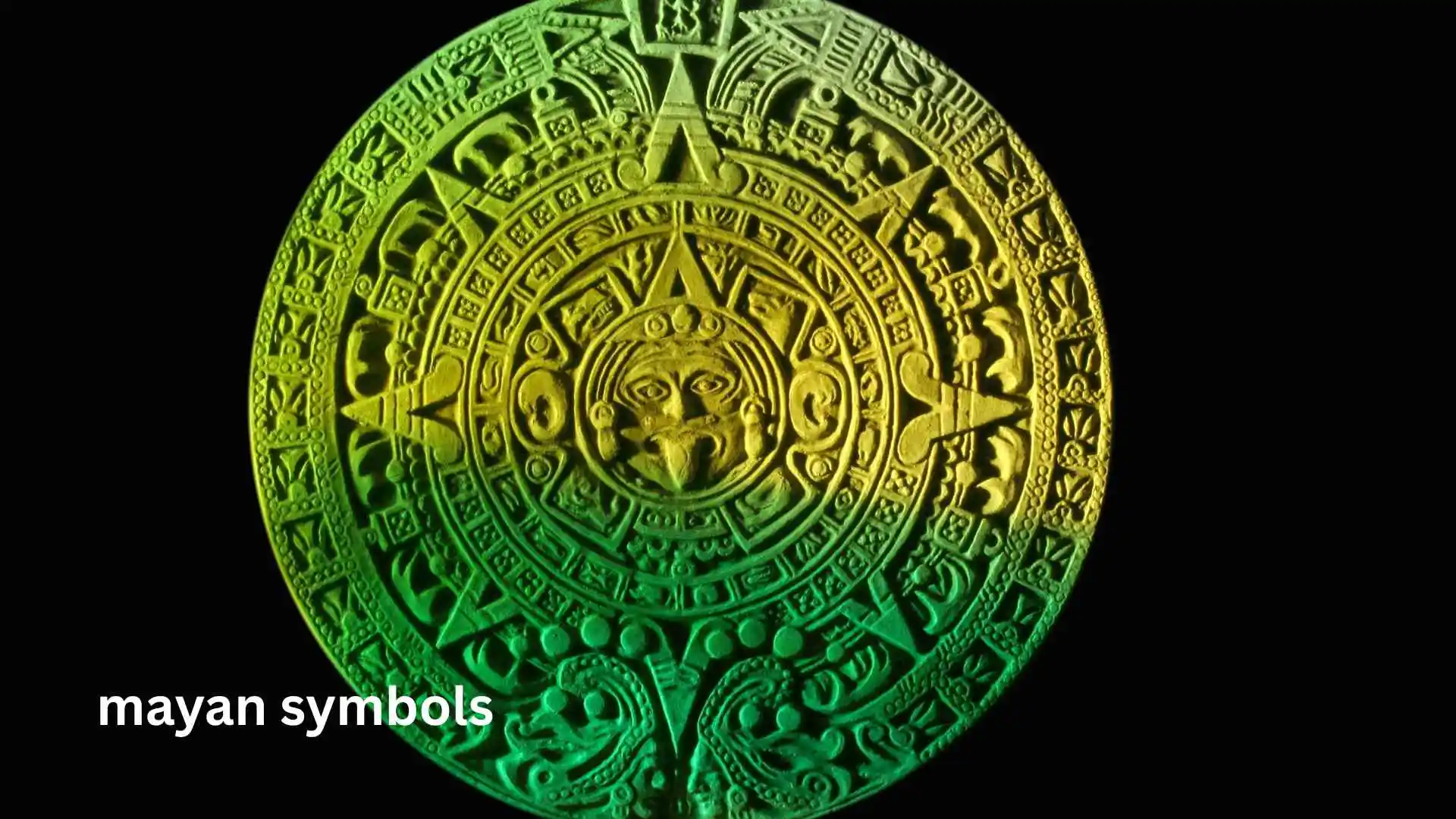
Mayan symbols are not mere scratches on stone; they are living blueprints of a civilization that mapped the stars, the underworld, and the human soul with breathtaking precision.
When you trace the curve of a Mayan glyph, you are touching a language older than fear, older than forgetting, a codex of cosmic belonging that whispers: you are part of something vast. In this article, we will not just list these sacred signs; we will walk inside their meaning, feel their pulse in our own lives, and discover why the Maya still speak to us across fifteen centuries.
What Are Mayan Symbols?
Mayan symbols are the visual language of the Mesoamerican Maya civilization, which flourished from 2000 BCE until the Spanish conquest in the 16th century. Unlike alphabets that simply record sounds, Mayan glyphs (or hieroglyphs) combine logograms (symbols representing whole words) and syllabograms (symbols representing syllables). Think of them as tiny paintings that hold entire stories: a jaguar ear, a shell, a drop of blood, a folded eye.
Historically, these symbols appeared on stelae (stone slabs), temple walls, ceramic vessels, bark paper codices, and even on human skin via ritual tattooing. The Maya wrote about kings, wars, eclipses, births, and the endless dialogue between humans and gods. But more than history, Mayan symbols encode a worldview where time is cyclical, the cosmos is alive, and every creature mirrors a constellation.
Cultural significance runs deep. For the Maya, writing was a sacred act. Scribes were often shamans, and their glyphs carried k’uh (divine energy). To carve a symbol was to summon a force. To read it was to enter a trance. Today, these symbols are recognized by UNESCO as a Masterpiece of the Oral and Intangible Heritage of Humanity, but their true power lies in how they still unlock doors inside us.
Deep Symbolic Meaning of Mayan Symbols
Spiritual Level: Mayan symbols are portals. The Ahau glyph (meaning “lord” or “sun”) represents the face of the divine in each person. When the Maya carved Ahau, they believed the sun god Kinich Ahau looked through the symbol into the world of the living. Spiritually, each glyph repeats the original moment of creation, when the Heart of Sky spoke the world into being. Meditating on a Mayan symbol is like tuning a radio to an ancient frequency.
Psychological Level: Carl Jung would have loved Mayan symbols. They function as archetypes straight from the collective unconscious. The Hanal Pixan (food for the dead) symbols that appear on altars do not just honor ancestors; they force the living to confront mortality, memory, and the shadow self. When you study the Cimi glyph (death), you are not learning about an end but about transformation. Psychologically, Mayan symbols act as mirrors. The Ik glyph (wind/breath) reminds us that our thoughts, like wind, shape invisible realities. Many modern therapists working with depth psychology now use Mayan symbols in dream journals because the symbols bypass linear thinking and speak directly to the emotional brain.
Cultural Level: The Maya built an entire civilization on reciprocity. Their symbols of Chac (the rain god) and Yum Kaax (the maize god) are not deities to worship from below. They are partners in a cosmic conversation. Culturally, every symbol demands action. The K’an cross symbol (precious yellow corn) means not just abundance but the obligation to plant, harvest, share, and celebrate. In a world of passive consumption, Mayan symbols scream a forgotten truth: meaning is something you do.
Types and Variations of Mayan Symbols
Here are the most powerful Mayan symbols you will encounter, each a universe in a frame.
1. Ahau (Sun/Lord)
Visual description: A frontal face with swirling eyes, often framed by two cheek spirals and a forehead ornament resembling a flower or solar ray.
Meaning: Rulership, enlightenment, the divine within. Represents the 20th day sign in the sacred Tzolk’in calendar. It is the moment when a human becomes fully conscious of their own light.
Where it appears: Temple lintels at Tikal, sarcophagus lid of Pacal the Great at Palenque, royal bloodletting bowls, and modern Maya regalia for high priests.
2. Hunab Ku (One God/Movement)
Visual description: A spiral with two circles at its center, often called the “sole giver of movement.” Some compare it to a galaxy or a spinning top.
Meaning: The supreme creator, the measure of all cycles, the atomic hum at the bottom of reality. Hunab Ku is not a separate god but the grid of creation itself.
Where it appears: Colonial era texts (since pre-Columbian Maya rarely depicted a single high god), modern Mayan spiritual movements, tattoos among New Age travelers, and the flag of the modern Maya movement.
3. Cimi (Death)
Visual description: A closed eye with a bone or flint knife below, sometimes a jawless skull profile.
Meaning: Transformation, not annihilation. Cimi marks the passage from one state of being to another. In the Maya view, no one truly dies; they change address. The glyph appears in birth records as often as in tomb inscriptions because every birth is a small death of what came before.
Where it appears: Funerary urns, bloodletting rituals, the underworld section of the Dresden Codex, and modern Day of the Dead altars in Yucatán.
4. Ik (Wind/Breath)
Visual description: A T-shaped symbol with curled ends, resembling lungs or a curving path of air.
Meaning: Spirit, speech, life force, and gossip. Ik is the breath that animates the body and the words that shape society. To curse someone with Ik was to send a hurricane; to bless them was to whisper their soul back into health.
Where it appears: Murals at Bonampak (where rulers blow incense), shaman’s breath bundles, carved into wind temples, and modern prayers for safe childbirth.
5. Chac (Rain/Fertility)
Visual description: A reptilian face with a curled snout, protruding fang, and a glyph for water (squiggly lines) beneath.
Meaning: Life-giving storms, sexual energy, agricultural abundance, and also destructive flood. Chac is the moody lover of the Maya pantheon: generous but jealous.
Where it appears: Doorways of the Puuc region (Uxmal), rain-making ceremonies, cornfield shrines, and modern Yucatec Maya rain petitions.
Mayan Symbols Across Cultures
The Maya did not exist in a vacuum. Their symbols echo, clash, and harmonize with other civilizations.
Olmec Culture (1200–400 BCE): The Olmecs, whom many call the mother culture of Mesoamerica, gave the Maya their early symbols: the were-jaguar, the banded-eye god, and the concept of the axis mundi (world tree). But the Olmecs used symbols more as shamanic signatures, while the Maya turned them into a full grammatical system.
Aztec Culture (1325–1521 CE): The Aztecs borrowed heavily but changed the tone. Their Ollin (movement) glyph resembles the Mayan Hunab Ku but is more angular, more militaristic. Where Maya symbols emphasize cyclic renewal, Aztec symbols often emphasize sacrifice as payment. Both love the feathered serpent (Kukulkan for Maya, Quetzalcoatl for Aztecs), but the Maya see him as a gentle teacher; the Aztecs as a dangerous wind.
Modern Western Culture: Since the 2012 phenomenon, Mayan symbols have exploded in Western consciousness. But here is the twist: Westerners often strip them of their communal meaning and turn them into personal identity badges. A Mayan symbol tattooed on a Silicon Valley CEO means “innovation.” For a Maya village elder, the same symbol means “we harvested together.” The symbol has not changed. The anchor of meaning has.
Hindu Culture (Vedic India): Strangely beautiful parallels exist. The Mayan Ahau (sun/lord) and the Hindu Surya both represent the eye of cosmic law. The spiral of Hunab Ku resembles the Aum visual form in some tantric traditions. No historical contact existed. But both cultures saw the universe as a breathing, rhythmic dance, and their symbols became freeze-frames of that dance.
Ancient Egyptian Culture: Egypt carved hieroglyphs too. But where Egyptian symbols often face forward or walk in profile toward eternity (the afterlife as a straight line), Mayan symbols face each other in dialogue, representing the endless back and forth of time. Egyptians drew the ka (soul) as a pair of upraised arms. Maya drew Ik (breath) as a swirling wind path. Both mean life. Both feel utterly different.
Mayan Symbols in Art, Movies, and Pop Culture
Movies: Apocalypto (2006) directed by Mel Gibson, despite historical controversies, used authentic Mayan symbols on ceremonial banners, body paint, and temple carvings to signal doom and divinity. The Cimi glyph flashes during the eclipse scene, just before the protagonist’s sacrifice is halted. In The Fountain (2006), Darren Aronofsky tattoos Mayan symbols onto Hugh Jackman’s arm: the Ahau over his heart to represent the search for eternal love.
Paintings: Mexican muralist Diego Rivera wove Mayan symbols into his industrial frescoes. In The History of Mexico, the Kan cross (maize) sprouts from a worker’s hand, linking pre-Columbian agriculture to modern labor. Contemporary Maya painter Paula Nicho Cúmez hides Hunab Ku inside her dreamlike scenes of women turning into birds, making the ancient symbol a quiet rebellion against forgetting.
Books: Miguel Ángel Asturias won the Nobel Prize in 1967 for Men of Maize, a novel where Mayan symbols act as chapter markers. Each section opens with a glyph: Ik for the chapter about exile, Cimi for the massacre. More recently, The Lost City of the Monkey God (2017) uses Mayan symbols as plot clues, though the author admits the real mystery is why so few people study them seriously.
Tattoos and Fashion: Walk through any tattoo convention, and you will see stylized Ahau faces on shoulders, Cimi skulls on ribs. High fashion brand Dior’s 2018 Cruise collection featured woven Chac masks on handbags. But here is the ethical question many ignore: Mayan communities have publicly asked that commercial use of sacred symbols require permission and profit sharing. A symbol is not just aesthetic. It is a relative.
Spiritual and Dream Meaning of Mayan Symbols
When you see a Mayan symbol in a dream, meditation, or trance state, do not rush to Google. Sit with it.
In Dreams: A Hunab Ku spinning in a dream means you are about to undergo a major life cycle shift. Clients have reported dreaming this spiral before sudden career changes, unexpected pregnancies, or profound spiritual awakenings. The Ik glyph appearing as a voice without a body suggests you have been ignoring your own breath, your own truth. Cimi in a dream is rarely frightening to those who understand it. It means something is ending so something else can finally arrive.
In Meditation: Meditators who use Mayan symbols as yantras (focus points) often report a sensation of falling upward or hearing distant drums. This is not imagination. The symbols were designed to alter brainwave states. The angular, repetitive structure of the Ahau face triggers the fusiform gyrus (the brain’s pattern recognition center), creating a gentle, trancelike focus.
Spiritual Experiences: During the Mayan New Year (July 26), modern shamans draw symbols in cornmeal on the ground. Participants walk the symbols barefoot. Many describe feeling a “hum” in their bones, a sudden memory of a place they have never been. Neuroscientists call this cryptomnesia. The Maya call it sastun (seeing stone). Both agree: the symbols unlock something already inside you.
Positive vs Negative Meanings of Mayan Symbols
Like fire, a Mayan symbol is neither good nor evil. It depends on the context, the intention, and the heart behind it.
Positive meanings: Ahau brings clarity, justice, and inner royalty. Ik brings inspiration, healing speech, and gentle change. Kan (corn) brings abundance, patience, and community harvest. In temple art, these symbols are often paired with flowers, jade, or the faces of children. They invite.
Negative meanings: The same Ahau glyph, when carved as a way (companion spirit) symbol on a cursed object, becomes a tyrant’s face, representing domination, spiritual pride, and blindness. Cimi in a context of war art means not transition but slaughter: no renewal, only rot. Chac turned negative means drought, crop failure, the gods withholding their intimacy. The Maya understood: every symbol is a door. It can open to a garden or a prison.
Psychological nuance: We are drawn to the “dark” Mayan symbols (like Cimi) not because we love death but because we sense our culture lies about endings. Seeing a death glyph acknowledged in stone feels honest in a world of euphemisms like “passed away” and “closure.” The Maya do not blink at darkness. Neither should we.
Why Humans Are Attracted to Mayan Symbols
We live in a fractured time. Our screens deliver a thousand symbols a minute: logos, emojis, notifications, flags, warning signs. But almost none of them carry weight. Mayan symbols feel different because they were born from a culture that spent 3,000 years refining the relationship between image and soul.
Psychologically, humans crave signature symbols: marks that feel invented and eternal at the same time. Mayan glyphs have perfect balance: complex enough to feel mysterious, simple enough to trace with a finger. When we see Hunab Ku, our brain’s parietal lobe (which processes spatial orientation) lights up alongside the amygdala (emotion). The symbol literally feels like it is moving.
Emotionally, we are lonely for ancestors. Most modern people cannot name their great grandmother. The Maya carved their family lines into stone, every name a glyph, every glyph a breath. When we study these symbols, we borrow their lineage. We pretend, for a moment, that we belong to something longer than our own lifespan.
Spiritually, the attraction is simple: these symbols work. People who sleep with a drawing of Ik under their pillow report more lucid dreams. Farmers who paint Chac on their water tanks say the well stays sweeter longer. Placebo? Maybe. But if a symbol changes your behavior, and changed behavior changes your life, then the symbol is powerful. The Maya never worried about the mechanism. They only asked: does the symbol help you live well?
Frequently Asked Questions About Mayan Symbols
1. Are Mayan symbols still used today?
Yes. Over 6 million Maya people in Mexico, Guatemala, Belize, and Honduras use these symbols in religious ceremonies, textiles, healing practices, and community governance. The Aj Q’ij (day keeper) still reads the sacred calendar using the original glyphs.
2. Can I get a Mayan symbol tattoo?
You can, but ethically, consider commissioning a Maya artist to design it or donating to a Maya cultural center. Many symbols like Ahau and Hunab Ku are not “copyrighted” but are considered sacred. Getting one without understanding its meaning is like wearing a military medal you did not earn.
3. What is the most powerful Mayan symbol?
Most Maya elders would say Hunab Ku because it contains all other symbols within its spiral. But “powerful” depends on your need. For healing? Ik. For protection? Cimi. For leadership? Ahau.
4. Do Mayan symbols have anything to do with the 2012 prophecy?
The 2012 “end of the world” was a Western distortion. The Maya symbol for that date (December 21, 2012) was Ahau, meaning a new cycle began, not an ending. Think of it like a car odometer rolling over. No apocalypse. Just a new page.
5. Can I learn to read Mayan symbols?
Absolutely. Universities like UT Austin and Universidad Autónoma de Yucatán offer online courses. The book Reading the Maya Glyphs by Michael Coe is a beautiful starting point. Expect two years to become conversational, a lifetime to master.
6. Are Mayan symbols the same as Aztec symbols?
No. They share some roots (like the feathered serpent) but have different grammar, different aesthetics, and different cosmological frameworks. Aztec symbols are more angular and militaristic. Mayan symbols are more curved and astronomical. Both are magnificent. Neither is interchangeable.
Conclusion
Mayan symbols are not relics of a dead language. They are living mirrors, carved by hands that knew what we have forgotten: a single line can hold a prayer, a spiral can track a galaxy, and a face can represent the part of you that has always known how to read the sky. The next time you feel overwhelmed by the noise of modern life, trace an Ahau on your palm, close your eyes, and listen. The Maya did not write for museums. They wrote for you. And somewhere between the jaguar’s jaw and the wind’s curl, you will remember that you belong to an ancient, unfinished story that is still, even now, asking you to add your own symbol.

Nora Bennett
Nora Bennett is a storyteller at heart, always finding magic in the everyday moments of life. From a young age, she discovered the joy of weaving emotions into words, creating characters that feel like old friends. Writing, for her, is both an adventure and a sanctuary—a way to explore the world and herself. She loves connecting with readers who share her passion for heartfelt stories and unforgettable journeys. When she’s not crafting her next tale, Nora enjoys quiet mornings with a cup of coffee and a notebook full of ideas. Her stories are meant to inspire, comfort, and spark imagination in everyone who reads them.
Books:
-
Whispers of Yesterday
-
Echoes of Tomorrow