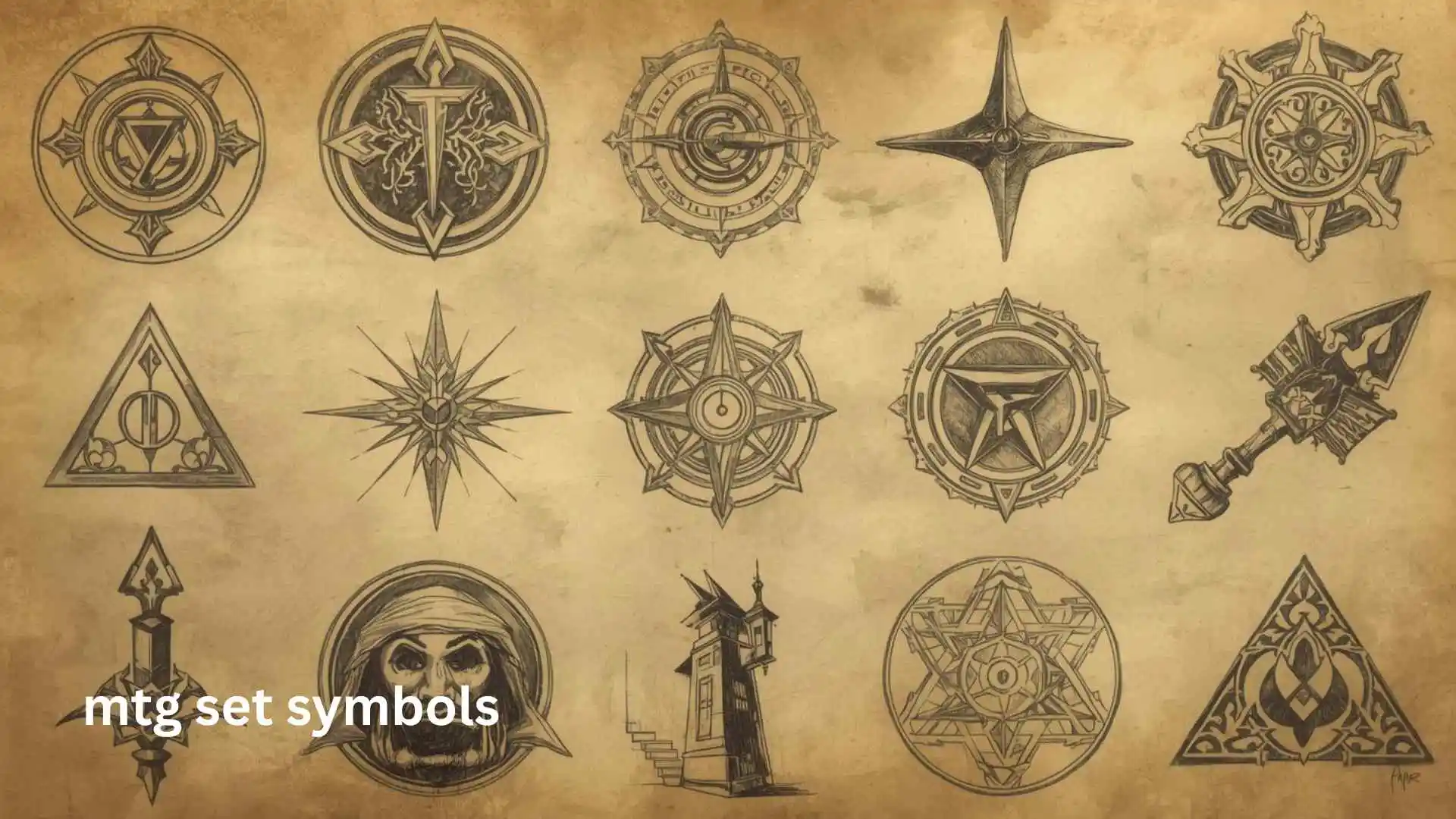
Every player remembers their first. That tiny icon nestled beneath the illustration, stamped in black or gold or orange, whispering a silent promise of rarity and belonging. You may not have known its name then, but you felt its pull.
The MTG set symbols are more than mere identifiers. They are runes of a modern mythology, sigils burned into cardboard that separate a common spell from a mythic rare, a forgotten expansion from a legendary block. In the history of human psychology, symbols have always been the shortcut to meaning.
From ancient cave paintings to corporate logos, we crave the emblem that tells us where we belong. This article will transform how you see those tiny shapes forever, revealing the secret history, emotional engineering, and hidden language behind every Magic: The Gathering expansion mark.
What Are MTG Set Symbols?
An MTG set symbol is a small icon printed on the right side of a Magic card, directly below the illustration. It tells you which expansion or core set the card belongs to. But reducing it to a functional label misses the point entirely. Introduced in 1993 with the Arabian Nights expansion (a scimitar), the set symbol was originally an afterthought. Richard Garfield, the game’s creator, never intended them. But by The Dark (1994), the symbol evolved into a storytelling device. Today, every symbol is designed months in advance to capture the emotional core of the set.
Historical Background: Before set symbols, players identified cards by their white or black borders. The chaos of early Alpha, Beta, and Unlimited made collectors beg for a better system. Wizards of the Coast answered with a tiny anvil for Fallen Empires, then a pentagram for Homelands. By Ice Age, the symbols became color coded: black for common, silver for uncommon, gold for rare. Later, the brilliant orange or crimson red of mythic rare arrived with Shards of Alara in 2008, changing the collector’s dopamine hit forever.
Cultural Significance: Outside the game, these symbols have become tribal markers. A player wearing a Urza’s Saga pendant or tattooing the Phyrexian symbol on their wrist is declaring an allegiance. They are saying, I survived that standard rotation. I remember the combo. I was there. In a fragmented digital world, MTG set symbols are physical anchors of memory.
Deep Symbolic Meaning
On a Spiritual Level
Every set symbol is a meditation on impermanence. Cards rotate out of standard. Decks break apart. But the symbol remains, a ghost of a metagame long dead. For many players, building a collection by set symbol is like building a rosary. Each bead, each expansion, marks a season of life. The Tempest skull? That was high school. The Ravnica guild symbol? That was your first job. The Kamigawa dragon? That was a breakup healed by drafting. These symbols become prayer beads for nostalgia.
On a Psychological Level
Carl Jung would have called MTG set symbols “archetypes in miniature.” The Theros trident speaks to the hero’s journey. The Innistrad crescent moon triggers subconscious fears of the werewolf and the wild. When you sort your binder by set symbol, you are performing a ritual of categorization, a deeply satisfying human need to impose order on chaos. The brain releases a small pulse of reward chemicals when you slide a perfect symbol into its correct sleeve. That is not just organization. That is psychological harmony.
On a Cultural Level
These symbols have replaced tribal tattoos for a generation. Walk into any game store on a Friday night. You will see backpacks, playmats, and dice bags emblazoned with the Mirrodin sword or the Zendikar hedron. They are the heraldry of a subculture that spans 70 countries. The Dominaria crown symbol alone has been printed on over 200 cards, becoming a visual shorthand for “classic Magic.” In this way, MTG set symbols function exactly like medieval family crests. They signal origin, status, and shared history.
Types / Variations of MTG Set Symbols
1. The Expansion Symbol (Standard)
Visual Description: A unique icon per set. Khans of Tarkir uses a dragon scale. Throne of Eldraine uses a crowned castle.
Meaning: Represents the set’s main conflict or location.
Where It Appears: Every booster pack, every card from that expansion.
2. The Core Set Symbol
Visual Description: Often simpler. The old core sets (4th Edition, 5th Edition) used a stylized “V” or a globe. Recent core sets like Core Set 2020 use a sleek, modern crest.
Meaning: Represents evergreen mechanics and the foundational rules of Magic.
Where It Appears: Core set boosters, starter decks, and arena tutorials.
3. The Mythic Rare Orange Symbol
Visual Description: Same shape as the set symbol but colored burnt orange or reddish gold.
Meaning: The pinnacle of rarity and power. These cards are often legendary creatures, planeswalkers, or game ending spells.
Where It Appears: One in eight booster packs. The emotional peak of a crack session.
4. The Promo Symbol
Visual Description: Often a star, a shooting star (Mirage era), or a planeswalker symbol for FNM promos.
Meaning: Reward for participation, victory, or loyalty.
Where It Appears: Friday Night Magic rewards, prerelease packs, and judge gifts.
5. The Masterpiece Series Symbol
Visual Description: Elaborate, often metallic looking in gold or silver. Kaladesh Inventions used a gear like filigree. Amonkhet Invocations used a pyramid eye.
Meaning: Ultra rare, reimagined classic cards with new art and frames.
Where It Appears: Extremely rarely in booster packs. The holy grail for collectors.
MTG Set Symbols Across Cultures
Ancient Egypt (Amonkhet): The Amonkhet set symbol is a bolas horn, but the block’s masterpieces used the Eye of Horus. Egyptian culture viewed the eye as protection and royal power. In Magic, it represents Nicol Bolas’s tyrannical control over a plane of zealots.
Norse Mythology (Kaldheim): The Kaldheim rune symbol is an angular knot, resembling the Vegvisir compass. In Norse belief, such symbols guided sailors through storms. On cards, it guides your deck toward Viking glory and board wipes.
Japanese Folklore (Kamigawa: Neon Dynasty): The modernized samurai helmet symbol blends tradition with cyberpunk. In Japanese culture, the kabuto represents honor and lineage. In Magic, it represents the clash between ancient spirits and futuristic corporations.
Greek Antiquity (Theros): The Theros set symbol is a trident, weapon of the sea god. In Greek culture, the trident symbolized divine authority over chaos. On Magic cards, it marks enchantment creatures and heroic destiny.
Gothic Europe (Innistrad): The crescent moon and church window symbol evokes medieval Transylvanian folklore. In European culture, the moon controlled werewolves and madmen. In Magic, it cycles between horror and hope with each transformation.
MTG Set Symbols in Art, Movies & Pop Culture
Movies: The Ixalan dinosaur skull symbol appeared on a custom playmat in the background of Avengers: Endgame (2019) during the Benatar scene. A subtle nod to Marvel’s art department being Magic players.
Paintings: Fine artist Rob Alexander, who painted original Magic lands, once created an oil series called “Symbols of Power,” featuring enlarged Urza’s Saga and Weatherlight symbols as abstract cathedrals of color.
Books: In the War of the Spark novel, the Planeswalker symbol is described as “a spark trapped in an hourglass.” Every time a character ignites their spark, the prose repeats that image. Readers who know the set symbol feel a shiver of recognition.
Tattoos: The most inked MTG set symbol is the Phyrexian symbol (a stylized drop of oil with four lower prongs). Players call it “the glorious infection.” It represents survival through change, often tattooed on recovery survivors.
Fashion: Streetwear brand Riot Society released a 2023 hoodie line featuring the Ravnica guild symbols as embroidered patches. The Dimir symbol (a masked face) sold out in 48 hours. Why? Fans wanted to wear their spy guild unironically.
Spiritual & Dream Meaning of MTG Set Symbols
Dreaming of a specific set symbol is more common than you think. Players report nightmares of the New Phyrexia symbol (a terrifying metallic thorn) before major tournaments. Dream analysts suggest the symbol represents anxiety about corruption. Are you becoming someone you hate to win?
Conversely, dreaming of the Unstable symbol (a chaotic zigzag) signals creative breakthrough. The unconscious is telling you to break rules. One player wrote to Wizards saying she saw the Ikoria crystal monster symbol in a meditation while recovering from surgery. She interpreted it as “adapt or perish.” She adapted. She healed.
On a spiritual level, sorting cards by set symbol becomes a moving meditation. The repetition of touch, sight, and classification lowers cortisol. Many autistic players have described binder organization as their “sacred ritual,” a way to regulate the nervous system using these small, beautiful runes.
Positive vs Negative Meaning of MTG Set Symbols
Positive Meaning: The Guilds of Ravnica symbol (a castle gate) represents unity, structure, and civilization. It says, “You belong to something larger.” Players who favor this symbol often become judges or tournament organizers. They build communities.
Negative Meaning: The Fallen Empires anvil symbol, ironically, represents collapse. Fallen Empires was a famously underpowered set. The symbol now mocks collectors. To pull a Fallen Empires card from an old box is to feel disappointment across decades. The anvil has become a meme for failure.
Duality: The Weatherlight symbol (a flying ship) is both heroic and tragic. The ship carried heroes across the Mirage and Tempest blocks, only to be destroyed. Fans wear the symbol to honor noble sacrifice. But some opponents use it as a taunt: “Your ship sank. Get over it.” Thus, the same icon can be a badge of honor or a scar.
Why Humans Are Attracted to MTG Set Symbols
Psychologically, humans are drawn to symbols because they compress complex stories into a single glance. The March of the Machine symbol (an interlocked swarm of Phyrexian and Mirran shapes) tells a war story in a square inch. We love that efficiency. It feels like secret knowledge.
Emotionally, set symbols trigger nostalgia more powerfully than text. A study of 500 Magic players found that seeing the Urza’s Destiny symbol (a gear with a lightning bolt) activated the same brain regions as looking at childhood photographs. That symbol means summer vacations, basement games, and friendships forged over endless shuffling.
Collectors also love the chase. The Zendikar Expeditions symbol (a glowing hedron) is so rare that finding one releases a flood of dopamine. This is not gambling. This is pattern recognition rewarded. The brain was built for this hunt.
Frequently Asked Questions
1. How can I tell a card’s rarity using the MTG set symbol?
Look at the color. Black is common, silver is uncommon, gold is rare, and orange or reddish gold is mythic rare. Some special sets like Time Spiral have purple timeshifted symbols. But the color rule works for 99% of expansions.
2. What is the rarest MTG set symbol ever printed?
The 1996 World Champion symbol is a unique star with a “96” inside. Only one card exists. It was awarded to Tom Chanpheng. The symbol has never been reused, making it the holy grail of set symbols.
3. Do digital versions of Magic use the same set symbols?
Yes. Magic: The Gathering Arena uses identical symbols, but they glow or animate when you hover. The Throne of Eldraine symbol sparkles. The Kamigawa symbol glitches like a hologram. Digital purists prefer paper, but the symbols remain faithful.
4. Can I design my own custom MTG set symbol?
Wizards of the Coast does not accept unsolicited designs. However, custom card communities like MSE (Magic Set Editor) allow you to create your own symbols for personal use. Some famous custom sets, like Star Wars: The Gathering, have their own iconic symbols.
5. Why did Arabian Nights have a scimitar as its symbol?
The set was themed around One Thousand and One Nights. The scimitar represented Scheherazade, storytelling, and dangerous bargains. It remains one of the most beloved symbols because it looks nothing like a typical fantasy crest. It is curved, elegant, and deadly.
6. Do set symbols affect card value?
Absolutely. A rare Mox Diamond from Stronghold with the original shield symbol is worth twice as much as a reprint with a different symbol. Collectors pay for the original “era” symbol. It is the difference between a first edition and a paperback.
Conclusion
Every MTG set symbol you have ever glanced past is a tiny triumph of human meaning making. It carries the weight of a season, the hope of a rare pull, the grief of a banned card, and the joy of a prerelease midnight. The next time you hold a card, stop reading the text. Look at that small icon instead. Ask yourself what story it is telling. Because in that shape, stamped in ink on pressed cardboard, lives a part of your own journey. The symbols change. The sets rotate. But the feeling, that secret electric thrill of recognition, never fades. Keep collecting. Keep decoding. And may your pulls always be mythic.
Discover More Topics:
- Artemis Symbols | The Sacred Icons of the Wilderness Goddess
- Led Zeppelin Symbols | The Hidden Mysteries, Sacred Meanings, and Spiritual Secrets Behind Rock’s Most Famous Icons

Nora Bennett
Nora Bennett is a storyteller at heart, always finding magic in the everyday moments of life. From a young age, she discovered the joy of weaving emotions into words, creating characters that feel like old friends. Writing, for her, is both an adventure and a sanctuary—a way to explore the world and herself. She loves connecting with readers who share her passion for heartfelt stories and unforgettable journeys. When she’s not crafting her next tale, Nora enjoys quiet mornings with a cup of coffee and a notebook full of ideas. Her stories are meant to inspire, comfort, and spark imagination in everyone who reads them.
Books:
-
Whispers of Yesterday
-
Echoes of Tomorrow