
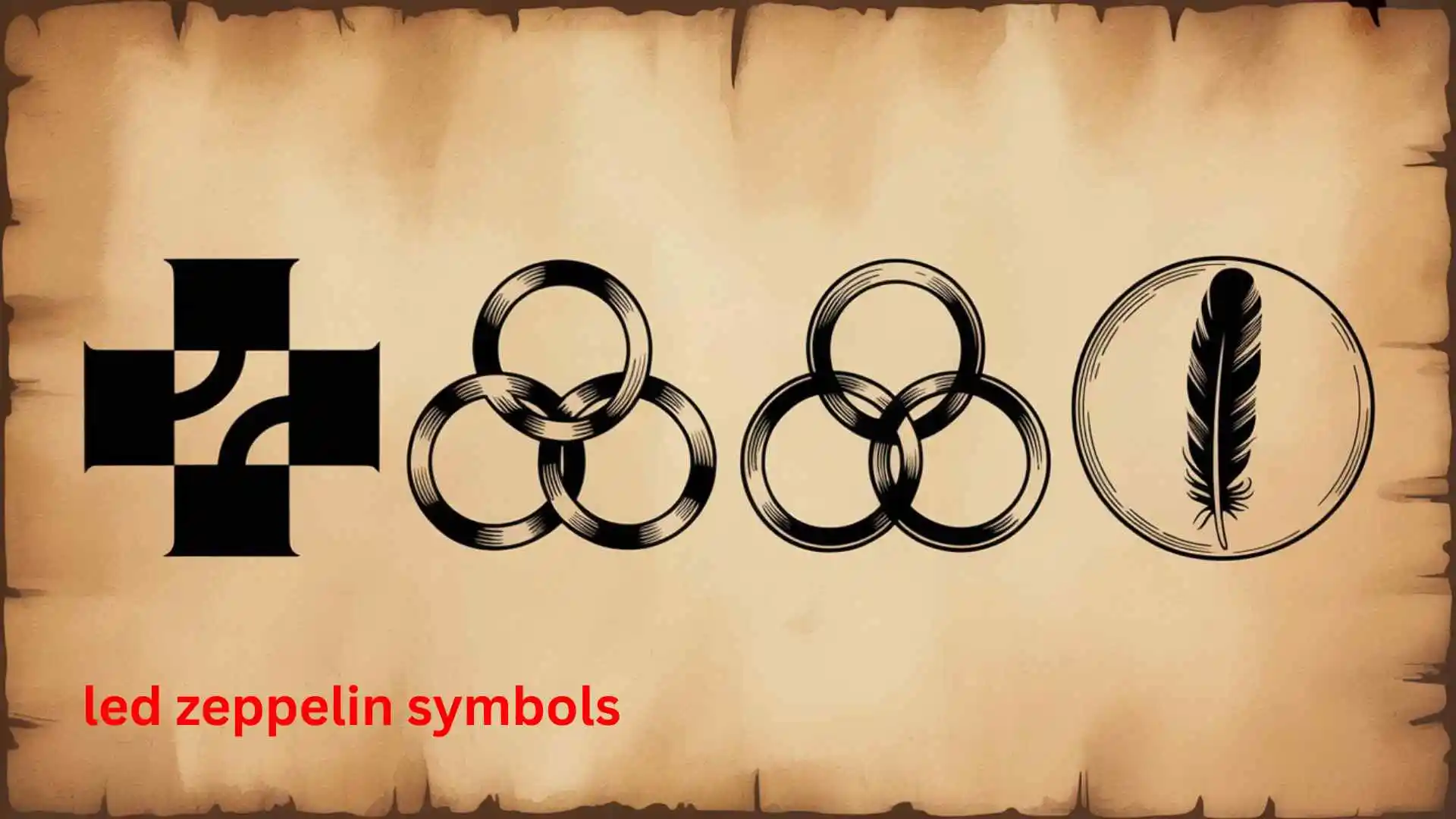
Every time you trace the thick black lines of Led Zeppelin symbols on a t shirt, a vinyl sleeve, or a tattooed forearm, you are touching something far older than the band itself. These four strange glyphs each chosen personally by Jimmy Page, Robert Plant, John Paul Jones, and John Bonham are not random designs or simple logos.
They are mystical signatures drawn from the deep well of human archetypes, alchemical traditions, occult alphabets, and ancient runic languages. When Led Zeppelin unleashed their fourth album in 1971 without a title or a band name, only these four symbols staring back from the inner grooves of the record, they forced millions of listeners to ask a question that still echoes today: what do the Led Zeppelin symbols really mean?
What Are the Led Zeppelin Symbols?
The Led Zeppelin symbols are four distinct custom designed glyphs representing each band member on the untitled fourth studio album, commonly called Led Zeppelin IV. Released on 8 November 1971, the album cover showed a framed Victorian painting of a rural stick gatherer, but inside the gatefold sleeve and on the record label itself, the four symbols stood alone. No words. No explanations. Just iconography.
Historically this was a radical act. In the early 1970s, rock bands built their identities around names, faces, and logos. Led Zeppelin erased all of that. They understood something primal: symbols bypass the rational mind. A symbol speaks directly to the subconscious, to memory, to emotion. The cultural significance of this choice cannot be overstated. It transformed an album into a ritual object. Each buyer became a decoder, an archaeologist of meaning.
Deep Symbolic Meaning
Spiritual Level
On a spiritual level, the Led Zeppelin symbols function as talismans. Jimmy Page, the band’s guitarist and producer, had been studying Aleister Crowley’s Thelema, Hermetic magic, and the works of the occultist MacGregor Mathers for years. Page believed that a symbol properly drawn and charged with intention could act as a key to other dimensions of consciousness. His own symbol, often called ZoSo, was designed to invoke personal power and creative energy. Robert Plant’s feather symbol connects to ancient Egyptian concepts of truth, justice, and the journey of the soul. John Paul Jones’s three interlocking circles represent competence, confidence, and the Trinity found in many spiritual traditions. John Bonham’s three interlocking rings mirror the symbol for the Holy Trinity but also represent his family circle of father, mother, and child.
Psychological Level
Carl Jung would have recognized the Led Zeppelin symbols immediately. Jung argued that certain shapes and images live in the collective unconscious—a layer of the human psyche shared across all cultures and eras. The circle, the triangle, the feather, the rune: these are not invented. They are discovered. When millions of young people in the 1970s felt an unexplained pull toward these symbols, they were responding to archetypes. Page’s symbol resembles a sigil, a condensed magical intention. Psychologically, creating or wearing a sigil allows a person to integrate shadow aspects of the self. It says, “I contain mystery. I am not only flesh.”
Cultural Level
Culturally, the Led Zeppelin symbols arrived at a specific moment. The 1960s dream of peace and love had collided with the Altamont Free Concert disaster, the Manson murders, and the end of the Beatles. Rock music needed new mythology. Led Zeppelin delivered a set of symbols that felt ancient yet urgent, European yet universal. They helped birth the entire genre of heavy metal’s visual language—the runic fonts, the gothic embellishments, the mysterious emblems. Without these four symbols, there would be no Metallica ninja star, no Tool heptagram, no Ghost insignia.
Types / Variations of Led Zeppelin Symbols
1. Jimmy Page’s Symbol (ZoSo)
Visual description: A complex glyph made of a curved vertical line with three smaller horizontal bars extending to the right, topped with a circle and a small angled line.
Meaning: Page never fully revealed its meaning, but researchers found it in The Book of Signs by Rudolf Koch, where it appears as a symbol for Saturn. Saturn represents discipline, limitation, and time. In alchemy, Saturn corresponds to lead—the base metal sought to be transformed into gold. This perfectly mirrors Zeppelin’s own mythology: heavy rock as lead transmuted into artistic gold. Some also see it as a representation of a magician’s wand.
Where it appears: Occult grimoires, alchemical manuscripts, Saturnine talismans in medieval Europe.
2. Robert Plant’s Symbol (Feather Within a Circle)
Visual description: A single feather drawn inside a perfect circle, often described as resembling a peacock feather.
Meaning: Plant based this on the Mu symbol from the ancient civilization he called “the lost continent of Mu” or Lemuria. Feathers in Egyptian mythology represent Ma’at—the goddess of truth and cosmic balance. The circle denotes wholeness, eternity, protection. Plant has said the symbol represents justice, balance, and fairness. It is also deeply maternal, a tribute to the feminine divine.
Where it appears: Ancient Egyptian hieroglyphs, Lemurian mythology, Native American feather symbolism, and modern pagan imagery.
3. John Paul Jones’s Symbol (Three Interlocking Circles)
Visual description: Three overlapping circles arranged in a triangular pattern, creating a central curved triangle.
Meaning: Jones chose a symbol representing a person who is confident and competent. It appears in Robert Fludd’s 17th century occult studies as a symbol of the Trinity and divine unity. In Celtic art, three interlocking circles represent the Triple Goddess—maiden, mother, crone. It also mirrors the Olympic rings, reminding listeners of universal harmony.
Where it appears: Renaissance alchemical drawings, Celtic knotwork, Christian iconography (Trinity), and modern logos for unity.
4. John Bonham’s Symbol (Three Interlocking Rings)
Visual description: Three rings linked together in a horizontal chain, resembling the symbol for the Ballantine beer logo.
Meaning: Bonham’s symbol represents mind, body, and soul—or father, mother, child. It is the symbol of the Holy Trinity but also of family. Bonham, the band’s powerhouse drummer, was deeply rooted in family life. The interlocking nature suggests that each element supports the other. Remove one ring, and the chain breaks.
Where it appears: Christian churches, medieval heraldry, Masonic symbolism, and everyday family crests.
Led Zeppelin Symbols Across Cultures
Ancient Britain: The three interlocking circles appear on Celtic stone carvings as symbols of eternal return and the cycles of nature. Bonham, born in Redditch, Worcestershire, carried this ancestral visual language forward.
Ancient Egypt: Robert Plant’s feather directly connects to the Weighing of the Heart ceremony. The god Anubis would place a feather of Ma’at on one side of a scale and a deceased person’s heart on the other. A balanced heart meant passage to the afterlife. Plant’s fascination with Egyptian mythology is well documented.
Medieval Alchemy: Jimmy Page’s ZoSo symbol appears in alchemical texts as a sign for Saturn lead. Alchemists believed Saturn ruled melancholy, slow transformation, and deep creative gestation. Page, a famously private and intense artist, embodied this Saturnine energy.
Norse Runes: Some scholars link Page’s symbol to a bind rune—two or more runes combined for magical effect. The angular lines resemble the rune Isaz (ice), representing stillness, concentration, and challenges to be overcome.
Modern Global Pop Culture: These symbols have been tattooed on millions of bodies across every continent. They appear in hip hop album art, fashion runways, graffiti murals, and university textbooks on graphic design. They have become universal shorthand for “mystery, power, and great drums.”
Led Zeppelin Symbols in Art, Movies, and Pop Culture
Movies: In Almost Famous (2000), the young protagonist holds up the Led Zeppelin IV album, and the camera lingers on the symbols. The film uses them to represent the forbidden, the sacred, the deeply cool. In The Song Remains the Same (1976), the band’s own concert film, Page performs a mystical sequence on a mountainside dressed as a hermit, and his symbol glows in the sky like a prophecy.
Paintings and Album Art: The artist Barrington Colby Mumford painted the inner gatefold of Led Zeppelin IV, though his work was uncredited for decades. The symbols themselves became fine art. Contemporary artists like Shepard Fairey have cited the Zeppelin symbols as influences on street art iconography.
Books: Dozens of books have been written decoding the symbols, from Led Zeppelin: Heaven and Hell to The Magus of the Stratosphere. Academic papers have analyzed the symbols in journals of religious iconography and musicology.
Tattoos and Fashion: Walk into any tattoo parlor in any country, and you will see flash sheets of the four symbols. Fashion houses from Saint Laurent to Supreme have used the symbols on jackets, bags, and hoodies. They transcend merchandising. They are modern runes.
What they represent in pop culture today: Freedom of interpretation. The band never released an official key. That silence invited every listener to become a co creator of meaning. In a culture addicted to explanation, the Led Zeppelin symbols remain gloriously unresolved.
Spiritual and Dream Meaning of the Led Zeppelin Symbols
When people dream of the Led Zeppelin symbols, or see them during meditation, the experience is rarely neutral. Dreamers report:
- Seeing Jimmy Page’s symbol as a key unlocking a door they could never open before. This represents access to suppressed creativity or hidden knowledge.
- Robert Plant’s feather appearing in dreams of courtroom scenes, graduation ceremonies, or moments of moral choice. The feather symbolizes truth finally spoken.
- John Paul Jones’s three circles appearing in dreams of reconciliation—estranged family members hugging, broken friendships mending. The circles represent unity after conflict.
- John Bonham’s three rings appearing in dreams of birth, especially the birth of a child or a new artistic project. The rings symbolize the soul arriving into physical form.
In spiritual communities, especially among modern pagans and chaos magicians, the symbols are still “charged” by focused attention. Some practitioners draw them on paper, burn the paper, and scatter the ashes as a banishing ritual. Others tattoo them to anchor specific intentions—courage, resilience, musical ability, protection while traveling.
Positive vs. Negative Meanings of the Led Zeppelin Symbols
Positive meanings: Creativity without limit. Brotherhood. Musical telepathy. The courage to release an album with no title and trust the audience to find their own way. Loyalty to mystery. The refusal to explain oneself. These symbols have inspired millions to start bands, write poems, paint canvases, and question authority.
Negative meanings or shadow aspects: Obsession with secrecy. Mystique used as a marketing weapon. The hoarding of meaning so only the initiated can understand. Jimmy Page’s well documented interest in Crowley has drawn criticism from those who see Crowley as a morally complex figure at best. Some have argued that the symbols’ occult roots invite unhealthy fixation on hidden enemies, paranoia, or elitism. The same glyph that empowers a teenager to start a band can also convince a lonely mind that everyone is hiding the truth from them.
The truth, as always, lies in the middle. A symbol is a mirror. It shows you what you bring to it.
Why Humans Are Attracted to the Led Zeppelin Symbols
Psychologically, humans are pattern seeking animals. Our brains evolved to find meaning in chaos because seeing a tiger in the bushes kept us alive. Symbols offer the comfort of order. But the Led Zeppelin symbols offer something more specific: controlled ambiguity.
They are not quite familiar. You cannot glance at them and say “that is a cross” or “that is a star.” They live in the uncanny valley of recognition—close enough to known alphabets to feel meaningful, foreign enough to feel magical.
Emotionally, these symbols arrived during a decade of disappointment. The 1970s brought Watergate, oil crises, and the end of the post war boom. Young people needed symbols that felt older than the mess, older than the lies. These four glyphs seemed to come from a time before politics, before advertising, before betrayal. They felt true because they could not be translated into a single sentence.
And then there is the sound. You cannot separate the symbols from the music. When John Bonham’s drum intro to “When the Levee Breaks” hits—that cavernous, prehistoric sound—you see the three rings. When Robert Plant howls “I want to be your back door man,” you see the feather. The symbols and the songs became one sensory experience.
Frequently Asked Questions
What does Jimmy Page’s ZoSo symbol actually mean?
Jimmy Page has said only that it came from a book on symbols and that it represents Saturn. Researchers identified it in Rudolf Koch’s The Book of Signs as a symbol for the planet Saturn, which in alchemy corresponds to lead, time, limitations, and deep creative gestation. Page has never confirmed or denied specific interpretations.
Why didn’t Led Zeppelin put their name on the fourth album?
Robert Plant explained that they wanted the music to stand completely on its own. No band name, no album title, no interviews about it. The four symbols would become the band’s identity. It was an act of supreme artistic confidence and a rejection of rock star vanity.
Can I get the Led Zeppelin symbols tattooed?
Yes, and millions of people have. Each symbol works beautifully in black ink. Some fans choose their favorite member’s symbol. Others get all four on their forearm, calf, or chest. The symbols hold up well over time because they rely on bold lines rather than fine detail.
Are the Led Zeppelin symbols satanic?
No. Jimmy Page studied occultism, including the works of Aleister Crowley, but Crowley was not a Satanist. Crowley’s philosophy, Thelema, centers on “Do what thou wilt shall be the whole of the law” — roughly meaning discover your true will and pursue it. The symbols draw from alchemy, Egyptian mythology, Celtic Christianity, and family heraldry. There is no Satanic imagery or intent.
What order do the Led Zeppelin symbols appear in?
On the inside gatefold of Led Zeppelin IV, the symbols appear from left to right: Jimmy Page, John Paul Jones, John Bonham, Robert Plant. That order is not alphabetical or age based. It simply reflects the layout the band preferred.
Did each band member invent their own symbol?
John Paul Jones and John Bonham chose existing symbols. Robert Plant adapted a symbol from the Mu civilization. Jimmy Page likely designed his own symbol based on existing alchemical and runic sources, or he selected a rare glyph and personalized it. The exact origin of Page’s symbol remains the most speculated upon.
Conclusion
Four symbols carved into vinyl. No name. No explanation. Fifty years later, they still pulse with mystery. That is the miracle of what Led Zeppelin did. They trusted that a symbol, properly placed and surrounded by thunderous music, could outlive its creators. And it has. Every time a sixteen year old puts on Led Zeppelin IV for the first time, stares at those glyphs, and wonders, that album becomes a living thing again. The symbols are not locked in 1971. They are happening right now, in you, in this moment. Let them mean what they need to mean. That was always the point.

Freddie Wood
Hi! I’m Freddie Wood, a storyteller at heart and a lifelong explorer of ideas. Writing has always been my way of making sense of the world, turning ordinary moments into stories that linger in your mind. I love blending emotions with adventure, and I’m fascinated by the way words can connect people across distances and experiences. When I’m not writing, you’ll find me wandering through nature, listening to music, or sketching out ideas for my next story. My goal is always to create books that stay with readers long after the last page.
Books by Freddie Wood:
-
The Hidden Path
-
Shadows of Tomorrow