
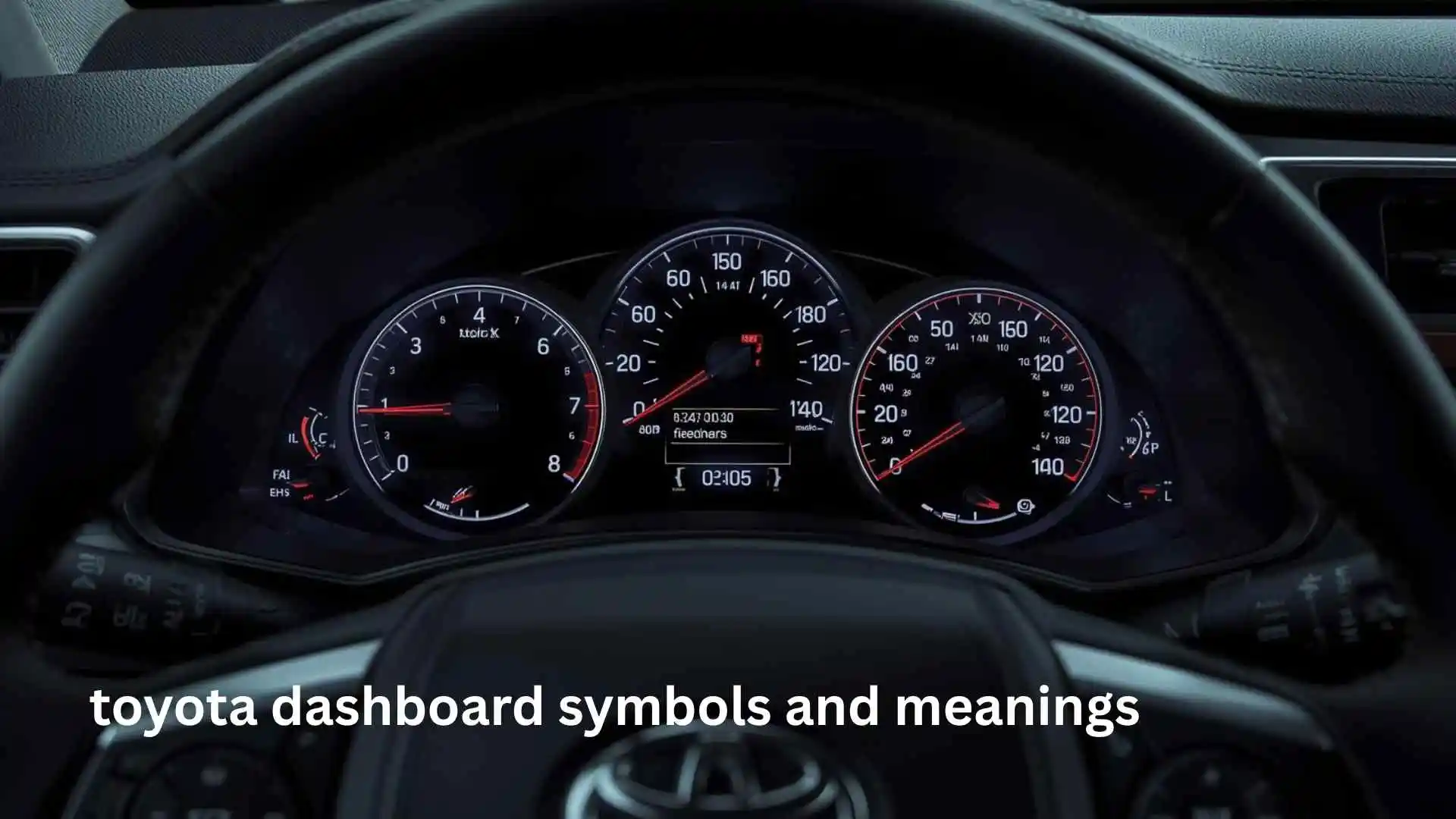
You are sitting in your Toyota, coffee in hand, when suddenly a small glowing icon appears on the dashboard. Your heart tightens. Is it serious? Can you ignore it? Will you make it to work? For decades, these illuminated symbols have sparked quiet anxiety in millions of drivers. But what if these tiny pictograms are not warnings but whispers?
A conversation between machine and human, engineering and emotion, safety and instinct. Welcome to the complete guide to Toyota dashboard symbols and meanings, where we decode every light so you never have to drive in fear again.
What Are Toyota Dashboard Symbols and Meanings?
At their core, dashboard symbols are a communication system. Born from the earliest automotive warning lights in the 1930s, modern Toyota vehicles now feature over 60 unique icons. But culturally, these symbols represent something deeper: trust. Every time you start your engine, a self check happens. Lights flash, systems test themselves, and within seconds, most disappear. This silent ritual mirrors human psychology. We crave reassurance. We fear the unknown. And a glowing amber or red symbol taps directly into our ancient survival wiring, the same part of the brain that alerts us to danger in the wild.
Toyota, as a brand, refined this language over 80 years. From the legendary Land Cruiser to the hybrid Prius, each symbol carries a specific meaning. But beyond engineering, these symbols have become modern hieroglyphics. They represent protection, responsibility, and the quiet promise that your vehicle will speak before it breaks.
Deep Symbolic Meaning of Dashboard Icons
Spiritual Level: A dashboard light is a form of intuition made visible. Your Toyota is telling you what your senses cannot yet feel. Low tire pressure. A failing sensor. Overheating coolant. The light arrives before the breakdown. In spiritual terms, this is a call to pause, to listen, to trust external signals as you would your inner voice.
Psychological Level: Colors matter. Red screams urgency. It activates the amygdala, the brain’s fear center. Yellow or amber asks for caution, not panic. Green or blue simply informs. Toyota engineers understood color psychology long before UX design became a buzzword. A red battery light doesn’t just mean electrical failure. It means “pay attention now or walk home later.”
Cultural Level: In Japan, where Toyota was born, harmony between human and machine is sacred. The concept of omotenashi (selfless hospitality) applies even to dashboard design. A warning light is not punishment. It is service. It is your car bowing respectfully to say, “Please care for me so I may continue to care for you.”
Types and Variations of Toyota Dashboard Symbols
Here are the most common symbols every Toyota owner will encounter. Each one is a character in your car’s story.
1. Check Engine Light
Visual: An orange engine block outline.
Meaning: The onboard diagnostics have detected a fault in the engine, emissions, or transmission system.
Where it appears: On every Toyota model after 1996. In dreams, it symbolizes unresolved mechanical or emotional issues.
2. Master Warning Light
Visual: A red triangle with an exclamation mark.
Meaning: A serious system failure. Often appears alongside another symbol.
Cultural note: In Japanese art, the triangle represents conflict needing resolution. This light demands immediate action.
3. Tire Pressure Warning Light
Visual: A horseshoe shape with an exclamation mark inside.
Meaning: One or more tires are underinflated by 25% or more.
Pop culture: Frequently appears in road trip movies as the moment heroes realize they are unprepared.
4. Brake System Warning
Visual: A circle with a “!” or the word BRAKE in red.
Meaning: Low brake fluid, engaged parking brake, or ABS failure.
Spiritual meaning: In dreams, a brake light represents needing to slow down in life.
5. Oil Pressure Warning
Visual: An old fashioned oil can with a droplet.
Meaning: Dangerous drop in oil pressure. Stop the engine immediately.
Psychological level: This is your Toyota saying, “My heart is starving for lubrication.”
6. Battery Charge Warning
Visual: A rectangle with plus and minus symbols.
Meaning: The charging system is failing. Your car runs on battery power only.
Historical origin: Adapted from early electrical circuit diagrams in the 1920s.
7. SRS Airbag Warning
Visual: A seated person with a large circle (airbag) in front.
Meaning: Airbag system malfunction. May not deploy in a crash.
Emotional weight: This light carries the heaviest responsibility. It guards your life.
8. Anti lock Brake System (ABS) Light
Visual: The letters ABS inside a circle with brake marks.
Meaning: ABS is disabled. Brakes still work but may lock during hard stops.
9. Lane Departure Alert
Visual: Two dashed lines with a car veering left or right.
Meaning: You drifted from your lane without signaling.
Cultural reflection: In modern society, this symbolizes our collective distraction epidemic.
10. Hybrid System Indicator (Prius, Camry Hybrid)
Visual: A car with an arrow recycling inside.
Meaning: The hybrid system is active and energy is flowing between engine, battery, and wheels.
Toyota Dashboard Symbols Across Cultures
Ancient Japan (Edo period): Lanterns and signal fires used color and pattern to warn villages of fire or invasion. Red meant immediate threat. Yellow meant caution. The same logic lives in your dashboard.
Medieval Europe: Cathedral bells and flag systems warned travelers of danger ahead. A red flag meant stop. A yellow flag meant slow. Sound familiar?
Modern America: Dashboard symbols became standardized in 1996 with OBD II regulations. Before that, every brand had unique icons. Toyota led the push for universal understanding.
Indigenous Australia: Aboriginal message sticks used carved symbols to communicate warnings across tribes. The curved line for “dangerous water” mirrors the Toyota coolant temperature icon.
Contemporary China: With the world’s largest car market, Toyota drivers there see the same symbols but culturally interpret red as luck and prosperity. A red warning light causes less anxiety and more immediate action.
Dashboard Symbols in Movies, Art, and Pop Culture
Movies: In The Italian Job (2003), the Mini Coopers never show warning lights. But in real life, Toyota Supra’s iconic orange check engine light became a running joke in Fast & Furious meme culture. “Check engine light? That’s just character.”
Paintings: Edward Hopper’s Gas (1940) features a lonely gas station with an attendant staring at gauges. The unspoken drama of dashboard warnings echoes his theme of modern isolation.
Books: In Haruki Murakami’s Kafka on the Shore, a character drives a Toyota Corolla and obsesses over a flickering oil light as metaphor for his fading memory.
Tattoos: Mechanics and Toyota enthusiasts tattoo the check engine light as a badge of honor. It means “I fix what others ignore.”
Fashion: Streetwear brands like Brain Dead have printed dashboard symbols on hoodies. The tire pressure icon became a symbol of preparedness in uncertain times.
Spiritual and Dream Meaning of Dashboard Symbols
When you see a dashboard symbol in a dream, your subconscious is not predicting car trouble. It is translating life stress into mechanical metaphors.
- Check engine light dream: You feel something is wrong in your life but cannot diagnose it.
- Brake light dream: You need to stop a habit, relationship, or job.
- Battery light dream: Your energy is draining faster than you can recharge.
- Oil light dream: You are running on empty emotionally or physically.
- Airbag light dream: You fear a sudden emotional collision.
In meditation practices, some Toyota owners visualize their dashboard lights turning off one by one as a relaxation technique. Clearing the symbols becomes clearing the mind.
Positive vs Negative Meanings of the Same Symbol
Every dashboard symbol has two faces. Consider the Traction Control Light (a car with squiggly lines behind it).
Negative meaning: Slippery roads. Loss of grip. Danger of skidding.
Positive meaning: Your Toyota is actively saving you. The system is working exactly as designed. You are safer than you feel.
The Low Fuel Light (a gas pump icon)
Negative meaning: You forgot to plan ahead. Impending stop.
Positive meaning: A reminder that limits teach us resourcefulness. You have approximately 30 to 50 miles left. Enough time to reflect.
The Maintenance Required Light (often says “MAINT REQD”)
Negative meaning: Deferred responsibility now demanding attention.
Positive meaning: Your car respects you enough to ask for care. This is relationship, not punishment.
Why Humans Are Attracted to Dashboard Symbols
Psychologists call it signal anxiety. We are biologically wired to scan for warning signs. Our ancestors watched for smoke on the horizon or unusual bird flight patterns. Today, we glance at a dashboard 12 times per minute without realizing it.
But there is a deeper attraction. Certainty. A dashboard light eliminates guesswork. It transforms vague mechanical unease into specific actionable knowledge. This is why Toyota owners form emotional bonds with their cars. The symbols become a shared language.
There is also comfort in pattern recognition. When you memorize your Toyota dashboard symbols and meanings, you gain mastery over your environment. In a chaotic world, a glowing icon that you understand restores a sense of control.
Finally, there is beauty in the design. Toyota’s iconography follows Kaizen (continuous improvement). Each symbol was refined over decades to be instantly readable. Even in peripheral vision, you know red means stop. Green means go. This intuitive design respects human cognition.
Frequently Asked Questions
1. What does a flashing check engine light mean on a Toyota?
A flashing check engine light means a severe engine misfire. Unburned fuel is damaging the catalytic converter. Stop driving immediately and call for service. This is one of the most urgent Toyota dashboard symbols and meanings.
2. Can I drive with the Toyota maintenance required light on?
Yes, but do not ignore it. The light reminds you that an oil change or tire rotation is due within the next 500 miles. Driving past 1,000 miles increases engine wear.
3. Why does my Toyota show a key symbol with a exclamation mark?
That is the Smart Key System Warning Light. It means the key battery is low or the key is not detected inside the vehicle. Replace the key battery or hold the key closer to the start button.
4. What does the snowflake icon mean on a Toyota dashboard?
A snowflake inside a temperature icon means outside air is below 37°F (3°C). It is not a malfunction. It warns of potential icy roads. This is one of the most misunderstood Toyota dashboard symbols and meanings.
5. How do I reset the tire pressure warning light after filling tires?
After adjusting tire pressure to the correct PSI (listed on driver side door jamb), drive over 25 mph for 10 to 15 minutes. The sensor will auto reset. If it stays on, press the TPMS reset button below the steering wheel.
6. What does a yellow steering wheel with an exclamation mark mean?
That is the Electric Power Steering (EPS) warning light. Steering will feel heavier. Drive carefully to a mechanic. Do not ignore this symbol, as power assist may fail completely.
Conclusion
Every glowing symbol on your Toyota dashboard is not an enemy. It is a conversation. A relationship between your awareness and engineering designed to protect you. Next time you see a light appear, do not panic. Breathe. Listen. Your car just spoke. Now you understand its language. Drive forward with clarity, not fear.

Julian Shaw
I’ve always been fascinated by the small, quiet stories that make life feel magical. Writing allows me to explore worlds that exist just beyond the everyday, where imagination meets reality. Over the years, I’ve found joy in creating characters that feel real and stories that stay with readers long after the last page. When I’m not writing, you can usually find me wandering through city streets, notebook in hand, capturing little sparks of inspiration. I believe every story has the power to connect us, to make us feel a little less alone. Sharing these tales is my way of leaving a mark on the world.
Books:
-
Whispers in the Wind
-
Shadows of Tomorrow