
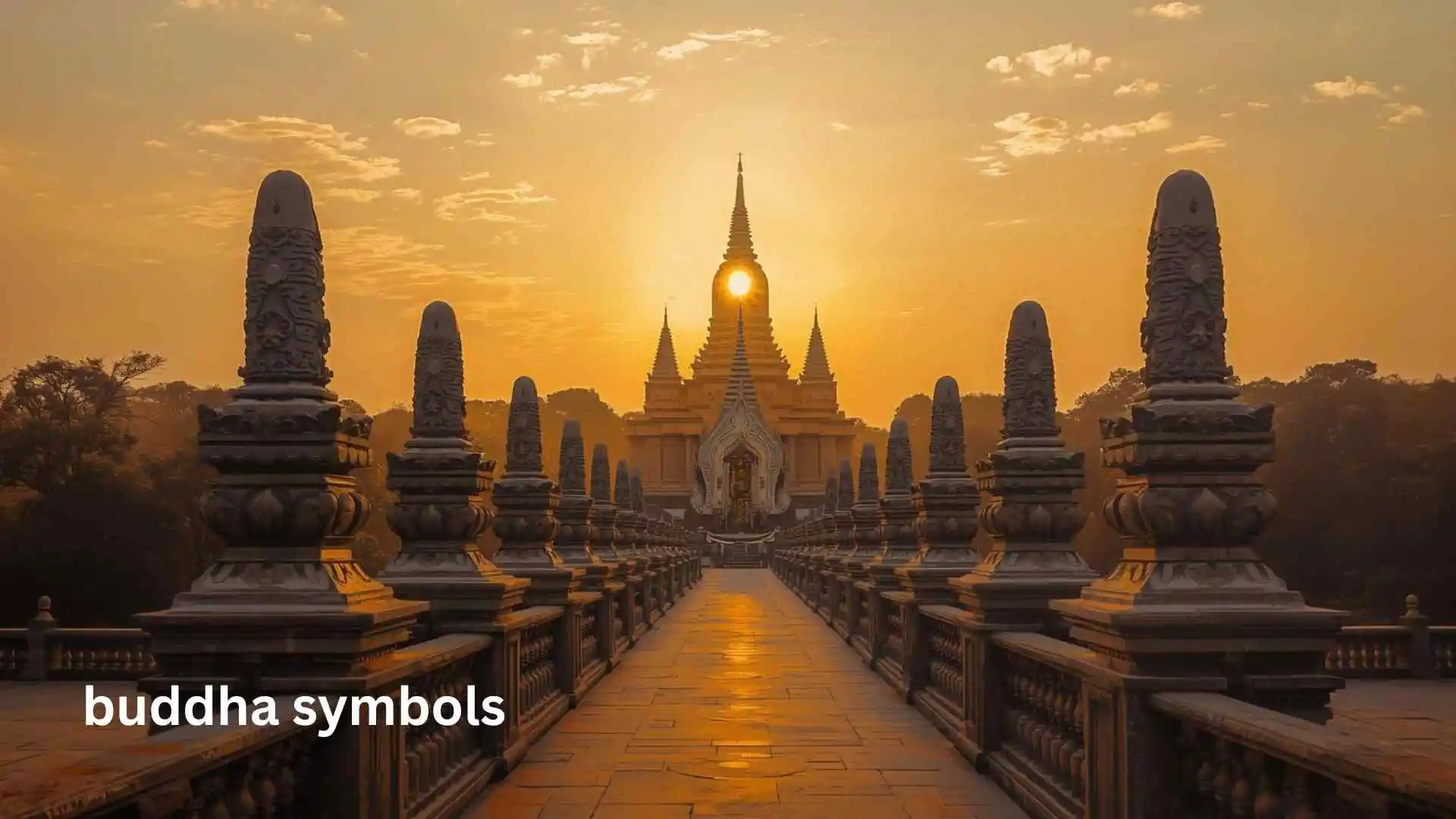
Buddha symbols are not mere decorations or religious relics; they are silent maps to your own soul. Every curve of a lotus petal, every twist of an endless knot, every posture of serenity holds a psychological key that has unlocked human potential for over 2,500 years.
And what if these ancient signs could heal the very restlessness you feel right now, sitting in front of a screen, searching for something you cannot name? Let us walk together through symbols that have comforted emperors, inspired artists, and guided millions toward peace.
What Are Buddha Symbols?
Buddha symbols are visual representations of the Buddha’s teachings, known as the Dharma, as well as qualities of enlightenment such as compassion, wisdom, fearlessness, and inner stillness. Unlike ordinary logos or brand marks, these symbols function as living transmissions. When you truly see them, they begin to see you back.
Historically, early Buddhism avoided depicting the Buddha in human form out of deep reverence. Instead, artists used symbols to tell stories of his life and enlightenment. The empty throne represented his royal lineage and renunciation. The bodhi tree stood for the moment of awakening. The footprints of Buddha reminded followers that enlightenment is a human path.
Culturally, these symbols have traveled from ancient India to Tibet, China, Japan, Sri Lanka, and now into Western yoga studios, meditation apps, and tattoo shops. They have survived because they work. Each symbol bypasses the intellectual mind and speaks directly to the heart. Neuroscientists now suggest that meditating on certain Buddhist symbols can actually rewire neural pathways associated with calm and compassion.
Deep Symbolic Meaning of Buddha Symbols
Spiritual Level
On a spiritual level, Buddha symbols are energetic portals. The Dharma wheel, for example, represents the turning of the teaching, the endless cycle of death and rebirth, and the eightfold path that leads to liberation. Each spoke is a reminder that action leads to consequence. To bow before a Buddha symbol is to bow before your own potential for awakening.
Psychological Level
Carl Jung recognized Buddhist mandalas as archetypes of wholeness. The symbol of the Buddha’s begging bowl, for instance, represents humility and the willingness to receive. Psychologically, it asks you: what are you too proud to accept from life or others? The empty bowl is a mirror of your own inner emptiness, which is not a flaw but the very space where peace can grow.
Cultural Level
Across Asia, Buddha symbols have shaped architecture, festivals, and daily greetings. In Thailand, the lotus position is not just a pose but a cultural memory of dignity. In Japan, the Mani jewel appears in temple gardens and corporate logos alike, reminding society that wisdom is the true treasure. These symbols are identity anchors, holding together communities through shared visual language.
Types and Variations of Buddha Symbols (11 Most Important)
1. The Dharma Wheel (Dharmachakra)
Visual description: A wheel with eight spokes, often with a central hub and a rim.
Meaning: The eight spokes represent the Noble Eightfold Path: right view, right intention, right speech, right action, right livelihood, right effort, right mindfulness, right concentration.
Where it appears: On national flags (India, Sri Lanka), temple gates, Buddhist art, and modern meditation logos.
2. The Lotus Flower (Padma)
Visual description: A blooming pink or white flower emerging from muddy water.
Meaning: Purity rising from impurity. The closed bud represents the potential for enlightenment. The half bloom is the spiritual seeker. The full bloom is total awakening.
Where it appears: Hindu and Buddhist art, yoga studios, tattoos, poetry, and even corporate branding for wellness products.
3. The Bodhi Tree (Ficus religiosa)
Visual description: A large heart shaped tree with drooping branches.
Meaning: The tree under which Siddhartha Gautama attained enlightenment. Represents steadfastness, patience, and the possibility of sudden awakening.
Where it appears: Pilgrimage sites, temple courtyards, and as a symbol in environmental Buddhist movements.
4. The Buddha’s Footprints (Buddhapada)
Visual description: Carved stone feet often marked with smaller symbols like wheels or lotuses on the soles.
Meaning: The Buddha was once human. His journey is possible for you. The footprints are an invitation to walk the path yourself.
Where it appears: Ancient stupas in India, Sri Lanka, and Thailand; rarely in Western art but common in traditional Buddhist homes.
5. The Endless Knot (Shrivatsa)
Visual description: An intertwined geometric knot with no beginning or end.
Meaning: The interdependence of all phenomena. Wisdom and compassion are inseparable. Your suffering and joy are woven into everyone else’s.
Where it appears: Tibetan thangka paintings, jewelry, mandalas, and wedding ceremonies as a symbol of eternal love.
6. The Conch Shell (Shankha)
Visual description: A white spiral shell, often upright.
Meaning: The deep, melodious sound of the Dharma awakening beings from ignorance. In Hindu tradition, it is also a symbol of victory.
Where it appears: Temple rituals, Tibetan Buddhist ceremonies, and as a symbol in Jain art.
7. The Parasol (Chatra)
Visual description: A ceremonial umbrella with a long handle.
Meaning: Protection from harm, heat, and spiritual pollution. Also represents dignity and royal authority in the spiritual realm.
Where it appears: Throne backings of Buddha statues, temple ceilings, and royal Buddhist ceremonies.
8. The Treasure Vase (Kalasha)
Visual description: A rounded pot with a wide mouth, often overflowing with jewels or flowers.
Meaning: The inexhaustible treasures of the Dharma: health, long life, prosperity, and wisdom. Also represents the womb of emptiness from which all good things arise.
Where it appears: Tibetan Buddhist rituals, home altars, and as a common motif in Nepali metalwork.
9. The Two Golden Fish (Suvarnamatsya)
Visual description: Two fish swimming together in a circle.
Meaning: Fearlessness in the ocean of suffering. Fish do not drown; they move freely. Represents happiness, fertility, and spontaneity.
Where it appears: Chinese Buddhist temples, Tibetan gateways, and as a symbol for couples in Buddhist marriage blessings.
10. The Victory Banner (Dhvaja)
Visual description: A cylindrical banner on a long pole, often in four or ten layers.
Meaning: The Buddha’s victory over Mara, the tempter of death and desire. Represents the triumph of wisdom over ignorance.
Where it appears: Monastery roofs, thangka borders, and as a ritual object in Tibetan Buddhist ceremonies.
11. The Buddha’s Alms Bowl (Patra)
Visual description: A simple rounded bowl, often placed before a seated Buddha statue.
Meaning: Renunciation, humility, and the practice of receiving without greed. Also represents the container of the Dharma that holds the nectar of immortality.
Where it appears: Statues of the Buddha begging, meditation halls, and as a symbolic object in Theravada ordination ceremonies.
Buddha Symbols Across Cultures
Ancient India (Gandhara and Mathura schools): Symbols were mostly aniconic. The wheel, the tree, the throne. No human Buddha. This restraint was itself a teaching: the truth is bigger than any face.
Tibet: Symbols exploded into complex mandalas, fierce protectors, and abundant colors. The endless knot and conch shell became central. Tibetan Buddhists added layers of esoteric meaning, linking each symbol to specific meditative deities and tantric practices.
China: Under Chan (Zen) Buddhism, symbols simplified. The empty circle (enso) became a signature Zen symbol for absolute enlightenment. The lotus merged with Taoist imagery of natural perfection. Less decoration, more empty space.
Japan: The Buddha’s footprints became ritual objects for pilgrimage. The Dharma wheel appeared in garden design and samurai banners. Japanese artisans refined the parasol into elegant architectural details on temples like Horyuji.
Southeast Asia (Thailand, Myanmar, Laos): The Buddha’s alms bowl is taken literally in morning alms rounds. The conch shell appears on royal regalia. Symbols remain living, breathing parts of daily religious practice, not just museum pieces.
Modern West: Buddha symbols appear in tattoo art, fashion prints, home decor, and burnout culture memes. Some use them respectfully; others strip meaning for aesthetics. The symbol becomes a question: are you wearing peace or seeking it?
Buddha Symbols in Art, Movies, and Pop Culture
Movies: In Kundun (1997), the endless knot appears as a visual motif representing Tibet’s unbreakable spirit. In The Matrix, the red and blue pill recall the Dharma wheel’s choice between illusion and truth. The lotus position appears in Avatar (2009) as the posture for connecting to the Tree of Souls.
Paintings: Vincent van Gogh’s The Starry Night has been interpreted by art historians as a veiled Buddhist mandala, with swirling skies echoing the endless knot. Modern artist Odd Nerdrum paints Buddha symbols in apocalyptic landscapes, contrasting ancient peace with modern collapse.
Books: Hermann Hesse’s Siddhartha uses the river as a living Buddha symbol, teaching through sound and silence. Jack Kerouac’s The Dharma Bums treats the lotus posture as a rebellious act against 1950s conformity.
Tattoos: The lotus is among the top five most popular spiritual tattoos worldwide. Many get it after surviving trauma. The Dharma wheel and endless knot appear on forearms and spines as daily reminders of connectedness. But some tattoo artists warn: wearing a symbol without understanding it can become a spiritual bypass.
Fashion: High end designers like Issey Miyake and Rick Owens have used Buddha symbols in fabric patterns. Streetwear brands like Maharishi use the conch and wheel to critique war and consumerism. Fast fashion has also co opted these symbols, often disrespectfully printed on cheap synthetic fabrics.
Music: Björk’s Vespertine album cover features a lotus like mandala. The band Tool uses Buddhist symbolism in their complex album art and lyrics, treating the Dharma wheel as a framework for progressive rock.
Spiritual and Dream Meaning of Buddha Symbols
When you see a Buddha symbol in a dream, meditation, or spontaneous vision, it rarely means you are becoming a Buddhist. More often, it means your psyche is ready for peace.
Seeing a lotus in a dream: You are emerging from a difficult emotional period. The mud is real, but so is the flower.
Seeing the Dharma wheel spinning: A major life decision is approaching. The wheel asks you to align with your highest values.
Seeing the Buddha’s footprint: You are being guided. Follow the path you have been avoiding. Someone walked here before you.
Seeing the endless knot: An unresolved relationship or situation in your waking life cannot be untangled by force. Only patience and acceptance will loosen it.
Seeing an empty alms bowl: You are being asked to receive help. Pride is blocking your healing. Let someone fill your bowl.
Meditation practitioners often report seeing geometric mandalas and wheels of light during deep states. Tibetan Buddhists call these nyam (meditative experiences). They are not enlightenment but signposts. Enjoy them without clinging.
Positive vs. Negative Meanings of Buddha Symbols
Every Buddha symbol carries a shadow interpretation. The same sign that comforts one person can disturb another, depending on the heart’s condition.
Lotus: Positive = purity rising from suffering. Negative = spiritual bypassing, pretending you are above messy human emotions while meditating on a cushion.
Dharma wheel: Positive = action and responsibility. Negative = the crushing sense of endless karma, every mistake compounding forever.
Endless knot: Positive = interconnected joy. Negative = inescapable entanglement, toxic relationships you cannot leave.
Conch shell: Positive = awakening sound. Negative = spiritual noise, being shouted at by religious authority.
Parasol: Positive = protection. Negative = isolation, hiding from life in a gilded spiritual bubble.
Victory banner: Positive = overcoming inner demons. Negative = spiritual pride, celebrating victories that never injured your ego.
Alms bowl: Positive = humility. Negative = shame, believing you are worthless and deserve nothing.
The wisest Buddhist teachers remind us: the symbol is neutral. Your relationship with it reveals your own mind.
Why Humans Are Attracted to Buddha Symbols
Psychologists call this symbolic resonance. Carl Jung noted that humans project their deepest longings onto shapes and patterns. The lotus is not beautiful because of its biology. It is beautiful because we need to believe that something pure can grow from our own personal mud.
Neurologically, symmetrical and circular Buddha symbols like the Dharma wheel and endless knot activate the brain’s reward centers. Order feels safe. Order feels meaningful. In a chaotic world, a well proportioned mandala or a calm Buddha footprint offers the promise of inner structure.
Emotionally, we are drawn to these symbols because they promise something no app or purchase can deliver: permission to stop struggling. The Buddha’s alms bowl does not demand you achieve. It just asks you to receive. After a lifetime of hustling, that is revolutionary.
There is also the attraction of the other. For Westerners especially, Buddha symbols represent a lost wholeness, a way of seeing that industrial capitalism erased. The endless knot whispers: you were never alone. The lotus whispers: your pain is not wasted.
But the deepest attraction is simpler than all of that. Look at any Buddha symbol long enough, and you feel held. Not by a god. Not by a religion. But by a truth older than temples: that peace is possible, and it begins with a single sacred shape.
Frequently Asked Questions About Buddha Symbols
1. Is it disrespectful to get a Buddha symbol tattoo?
It depends on intent and placement. In traditional Buddhist cultures, tattoos below the waist are considered disrespectful. But many monks have sacred tattoos. Ask yourself: am I wearing this symbol to learn or to look spiritual? Honest intention matters more than rigid rules.
2. What is the most powerful Buddha symbol?
The Dharma wheel is often considered the most comprehensive because it contains the entire path. But “powerful” depends on your need. For healing, the lotus. For protection, the parasol. For wisdom, the endless knot.
3. Can I use Buddha symbols in my home if I am not Buddhist?
Yes. Millions do. But approach them with reverence, not as decoration. Learn their meaning. Place them respectfully, not in bathrooms or on floors. A symbol used well becomes a teacher. A symbol used carelessly becomes a wall.
4. Do Buddha symbols appear in other religions?
Yes. The lotus and conch appear in Hinduism. The endless knot appears in Celtic and Chinese art. The wheel appears in Jainism and as the Roman sun wheel. Buddhism borrowed and transformed many symbols. Shared symbols remind us that wisdom belongs to everyone.
5. What does the Buddha symbol in my dream mean if I have no interest in Buddhism?
Dreams use universal archetypes. A lotus in a Western dream might simply mean “new emotional growth.” A wheel might mean “life is about to turn.” Do not over intellectualize. Feel what the symbol evokes. That feeling is the real message.
6. Are Buddha symbols the same as good luck charms?
Not exactly. They are reminders, not magic. A Dharma wheel on your wall will not fix your marriage. But looking at it every day and remembering right action and right speech might. The power is in the remembering, not in the object.
Conclusion
Buddha symbols are not ancient artifacts locked in museum glass. They are living invitations carved into stone, painted onto silk, tattooed onto skin, and dreamed into sleeping minds. The lotus does not ask you to be perfect. It only asks you to keep growing through the mud. The endless knot does not promise easy answers. It promises that your confusion is connected to everyone else’s. And the Dharma wheel does not spin without you. You are the spoke. You are the hub. You are the turning. Look at these symbols not as distant mysteries but as mirrors. What they reveal is already within you, waiting to be seen. Peace is not somewhere else. Peace is shaped like a wheel, a flower, a footprint. And it begins right here, right now, with your open eyes.

Sophia Reed
Hi, I’m Sophia Reed, a storyteller at heart who finds magic in everyday moments. Ever since I could hold a pen, I’ve been weaving tales that explore love, courage, and the unexpected twists of life. Writing allows me to connect with readers on a deeper level, sharing emotions and experiences that resonate across worlds. When I’m not lost in my stories, you can find me wandering through quiet streets, sipping coffee, or dreaming up my next plot twist. I believe every story has the power to inspire, heal, and transport. Through my books, I hope to leave a piece of my imagination with you.
Books:
-
Whispers of the Heart
-
Shadows and Sunlight