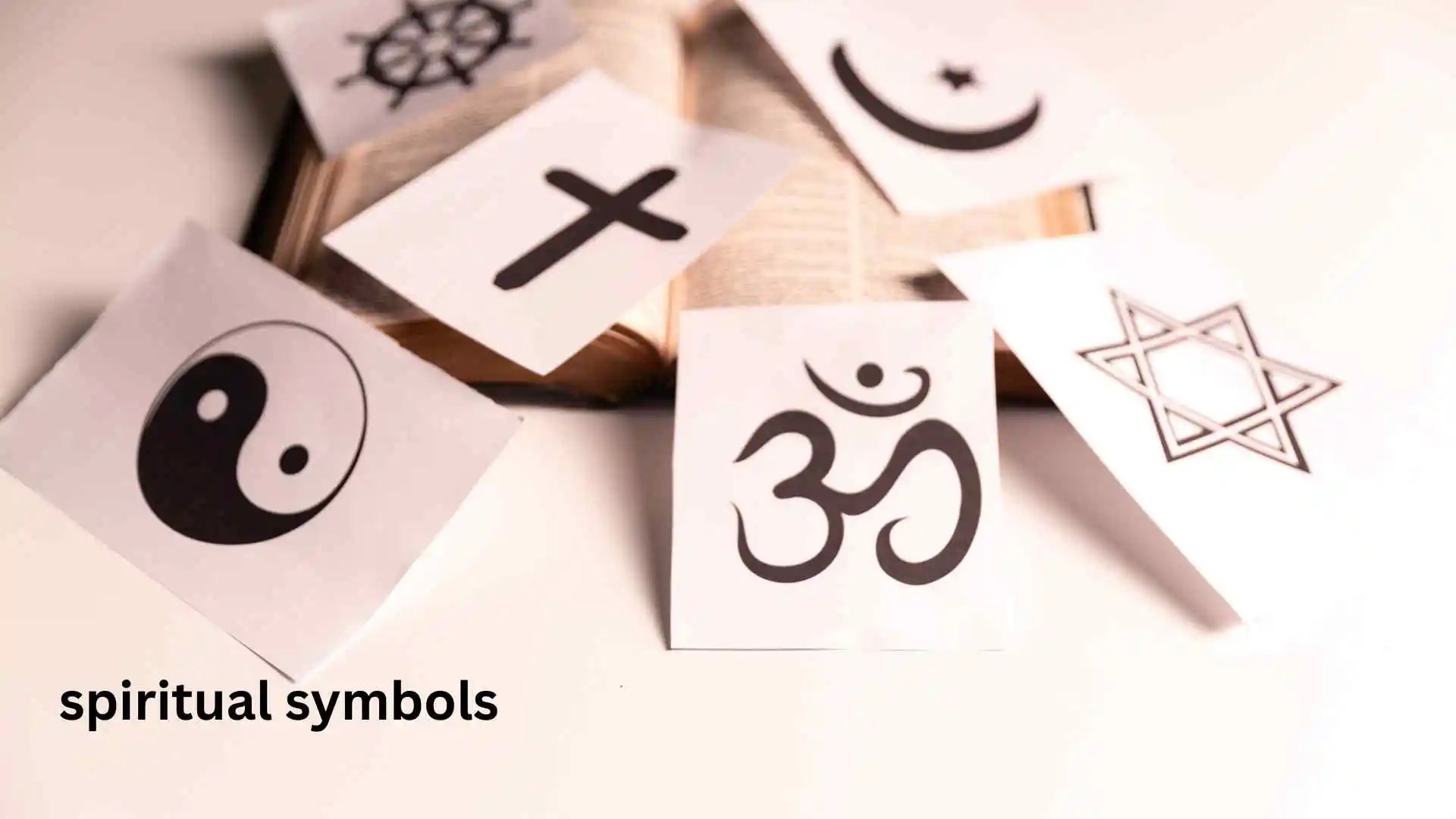
Every human being, regardless of where they are born or what they believe, has felt the quiet pull of a spiritual symbol.
Perhaps it was the peace you felt staring at the intricate lines of a mandala, the inexplicable safety you sensed near an ancient Tree of Life tapestry, or the shiver down your spine when you saw the all seeing eye on a dollar bill. These are not just pretty pictures.
They are architectural blueprints of the soul, maps of the unconscious, and whispers from every ancestor who came before you. In this deep exploration, we are not just looking at shapes; we are decoding the very operating system of human consciousness.
What Are Spiritual Symbols?
Spiritual symbols are visual shorthand for universal truths that language often fails to capture. Derived from the Greek word symbolon, which originally referred to a broken piece of pottery or a token split in half , a symbol was literally the missing piece of a puzzle. Two strangers would break a piece of clay; if the edges matched, they knew they were connected. This origin is beautiful because it suggests that when you see a spiritual symbol you resonate with, you are recognizing the other half of a universal agreement with the divine.
Historically, before the written word was accessible to the masses, the Church, mystics, and shamans used symbols to encode complex metaphysical concepts. They acted as a bridge between the material world and the numinous—the realm of spirit. From the cave paintings of Lascaux to the glowing icons on your smartphone screen, humans have always needed images to process the intangible.
Deep Symbolic Meaning
To truly understand a spiritual symbol, we must look at it through three distinct lenses: the spiritual, the psychological, and the cultural.
The Spiritual Level: Here, symbols act as conduits for energy. When you gaze at a Sri Yantra, you aren’t just looking at triangles; you are theoretically aligning your field of vision with the geometric frequency of the cosmos. Spiritual symbols are “thin places” in visual form, where the veil between heaven and earth is easier to pierce.
The Psychological Level: Carl Jung, the father of analytical psychology, famously argued that symbols are the language of the collective unconscious . He believed that archetypes—the Hero, the Shadow, the Great Mother—speak to us through symbols in our dreams and art. The spiral isn’t just a pretty shape; it is your psyche processing the journey of death and rebirth.
The Cultural Level: Symbols are the glue of society. They create a shared reality. A nation is just a piece of land, but when you overlay a flag—a symbol—it becomes a homeland worth dying for. Similarly, the cross or the crescent organizes millions of lives around shared rituals and ethics.
Types and Variations of Spiritual Symbols
While there are thousands of sacred signs, several major archetypes appear repeatedly across geography and time. Here are the most potent variations that dominate the global spiritual landscape.
1. The Mandala (Circle with Center)
- Visual: A complex, symmetrical geometric design radiating from a central point, often a circle within a square.
- Meaning: It represents the cosmos metaphysically or symbolically; it is a microcosm of the universe. It represents wholeness, unity, and the journey from the outside (material chaos) to the center (enlightenment).
- Origin: Predominantly Buddhist and Hindu tantric traditions, but circular sun symbols appear in Native American and Celtic art.
2. The Hamsa (Hand)
- Visual: An open right hand, often with an eye in the center of the palm.
- Meaning: Protection against the “Evil Eye.” It represents the hand of God (Fatima in Islam, Miriam in Judaism) and embodies patience, loyalty, and strength.
- Origin: Middle East and North Africa. It pre dates Islam and Judaism, used by ancient Phoenicians.
3. The Tree of Life
- Visual: A large, branching tree whose roots spread as wide as the branches, often enclosed in a circle.
- Meaning: The connection between the heavens (branches), the earth (trunk), and the underworld (roots). It represents ancestry, growth, strength, and immortality.
- Origin: Found in Norse mythology (Yggdrasil), Celtic mythology, the Kabbalah, and ancient Mesopotamian reliefs.
4. The Lotus Flower
- Visual: A water lily with petals opening outward, often rising from mud.
- Meaning: Purity, spiritual awakening, and rebirth. The mud represents attachment and material desire; the blooming flower represents the enlightenment of the soul.
- Origin: Ancient Egypt (associated with the sun) and India (Hinduism/Buddhism).
5. The Ouroboros
- Visual: A serpent or dragon eating its own tail, forming a circle.
- Meaning: The cycle of life, death, and rebirth. It represents the infinite return, alchemical transformation, and the unity of opposites.
- Origin: Ancient Egypt (dynastic period), later adopted by Gnosticism and Alchemy.
Spiritual Symbols Across Cultures
No symbol sits in a vacuum. They migrate, transform, and sometimes reverse their meaning entirely. The history of the Swastika (or Gammadion) is the most tragic and instructive example of this migration. For over 5,000 years, stretching from the pottery of ancient Troy to the ruins of the Indus Valley, this symbol meant “well being” and was used in Hindu, Buddhist, and Jain rituals to mark good luck and the eternal sun . It is still used in temples across Asia today. The catastrophic inversion of its meaning in the 20th century proves that a symbol is empty until a culture fills it with intention.
Conversely, the Serpent shows us how one shape can hold deeply dualistic meanings. In the Bible, the serpent is the deceiver tempting Eve to the fall of man. Yet, in ancient Greek culture, the serpent on Asclepius’s staff is the universal symbol for healing and medicine . In Mesoamerican cultures like the Aztec and Maya, the feathered serpent Quetzalcoatl was the god of wind, learning, and the priestly class—a creator of the world, not a destroyer of souls .
In the Celtic tradition, the intricate knot work with no beginning and no end represents the timelessness of the spirit, often used in high crosses. In Shinto (Japan), the simple Torii gate marks the transition from the profane to the sacred, a threshold you must bow to cross. The Egyptian Ankh—a cross with a looped top—represents the key of life and was held to the noses of the dead to ensure they could breathe in the afterlife.
Even the common Egg serves as a universal spiritual symbol across cultures. In Korean shamanism and contemporary art, the egg represents the womb of creation, the cosmos in its primordial state, containing the essence of all life before it is broken open .
Spiritual Symbols in Art, Movies and Pop Culture
You cannot escape spiritual symbolism because directors and artists are often secretly mystics. In the film Inception, the Spinning Top (or totem) is a direct reference to the Buddhist concept of the Bhavacakra—the Wheel of Becoming. It asks the audience: “What is real, and what is maya (illusion)?”
Modern graphic design is obsessed with sacred geometry. The Golden Ratio (Phi), found in the spiral of a nautilus shell (often misattributed to the Fibonacci sequence), is used to design everything from the Apple logo to the layout of Twitter. Art movements like the Bauhaus and De Stijl were deeply influenced by theosophical beliefs, attempting to quantify the spiritual through perfect grids and primary colors.
In literature, the Phoenix rising from the ashes is a symbolic crutch for every hero’s journey, from Harry Potter’s Fawkes to the resurrection of Gandalf the White. Even in fashion, the use of the Evil Eye (Nazar) on jewelry has become a global trend, showing that even in a secular, consumerist world, we still want the psychic protection our ancestors demanded.
The Spiritual and Dream Meaning of These Symbols
When symbols appear in your dreams or during deep meditation, they are not random. According to Jungian dream analysis, these symbols are the purest data from your unconscious mind trying to correct the imbalance of your waking life .
If you see a Ladder reaching to the sky (Jacob’s Ladder), it is rarely about home improvement. Spiritually, it represents the connection between your current self and your higher self—a direct line to the divine. Psychologically, it indicates ambition and the concrete steps needed to climb out of depression or a difficult situation .
Dreaming of a Beating Heart is interpreted as a symbol of charity and vital energy. If you see a Crown, you are likely processing themes of power, sovereignty over your own life, or the pressure of responsibility .
Water is a master symbol. Calm, clear water in a dream signifies the unconscious mind at peace; muddy, raging water signifies emotional turmoil that you have not yet processed. As Jung said: “The symbol is not a sign that disguises a truth universally known, but an image that represents something that is not yet known.”
Positive Versus Negative Meanings: The Duality of the “X”
A fascinating case study in symbolic duality is the simple letter “X”.
- The Dark Side: The X is historically used as an occult symbol representing the crossroads where deals are made with demonic forces. To “cross your fingers” originated as a witch’s gesture to focus demonic power or to create a mockery of the Christian cross to nullify a promise (hence crossing your fingers behind your back when lying) .
- The Light Side: Conversely, the X marks the spot of treasure (hope and discovery). In mathematics, it marks the unknown variable we are trying to solve (curiosity). On a ballot, it marks our civic power (choice). The Red Cross symbol is a rotated X signifying benevolence, humanity, and life saving medical aid .
This duality—one image holding both destruction and salvation—is precisely why these symbols maintain their power. They force us to look within to decide which meaning we are projecting onto the void.
Why Humans Are Psychologically Drawn to Spiritual Symbols
Why do we tattoo the Om on our wrists? Why do we buy crystals and arrange them in specific geometric grids? The answer lies in Neural Priming.
Our brains are prediction engines constantly looking for patterns in chaos. A spiritual symbol is a short circuit to the parasympathetic nervous system. When you look at a symmetrical Mandala, your brain releases dopamine. You feel satisfied because the pattern implies order in a chaotic universe. Furthermore, wearing a symbol is an act of Contagious Magic. By wearing the Eye of Horus, you are not just hoping for protection; you are psychologically asserting that you are protected, which changes your posture, your confidence, and how others perceive you.
We are attracted to them because they offer a shortcut to the sacred. In a 2,000 word article, we can describe gnosis (spiritual knowledge), but a simple Yin Yang symbol can convey the entire philosophy of Daoism in two seconds. That efficiency is addictive to the human mind.
Frequently Asked Questions
1. What is the oldest spiritual symbol known to humanity?
The Criss cross (or zigzag) carving found in the Blombos Cave in South Africa, dating back 70,000 years, is often cited. However, the Sun Cross (a cross inside a circle) is widely considered the oldest coherent religious symbol representing the sun’s movement across the sky, predating the swastika.
2. Are spiritual symbols religious?
Not necessarily. While many originate in organized religion, a spiritual symbol like the Spiral or the Tree of Life often appears in secular and pagan contexts. They are religious when used in worship; they are spiritual when used for personal introspection or meditation.
3. Can wearing a spiritual symbol protect me?
It depends on your belief system. Psychologically, wearing a Hamsa or a Cross acts as a cognitive anchor, reminding you of your boundaries and values. This increased awareness often makes you safer because you are more mindful.
4. What is the symbol for healing?
The Caduceus (two serpents around a winged staff) is often mistaken for healing, but the correct symbol is the Rod of Asclepius (one serpent around a rough staff). The serpent shedding its skin is nature’s metaphor for recovery and renewal.
5. Why do so many spiritual symbols use circles?
The circle is the universal symbol of wholeness, the Self, the cycle of seasons, and the divine nature that has no beginning and no end. It is the shape of the sun, the moon, and the eye.
6. How do I know if a symbol is “right” for me?
You will feel it in your body. You will experience a somatic response—a calmness in your chest, a straightening of your spine, or a deep sigh. If the symbol enlivens you without fear, it is for you.
Conclusion
Spiritual symbols are the ghosts in the machine of reality. They are the fingerprints of our ancestors left on the walls of time, reminding us that we are not isolated atoms floating in the void, but cells in a vast, connected body of meaning. Whether you trace the Ankh in the air or simply catch a glimpse of your own reflection in a puddle that looks like an eye, you are participating in a language older than words. The symbol does not hold the power; you do. But the symbol is the key that unlocks the door, and the door, as always, is you.

Sophia Reed
Hi, I’m Sophia Reed, a storyteller at heart who finds magic in everyday moments. Ever since I could hold a pen, I’ve been weaving tales that explore love, courage, and the unexpected twists of life. Writing allows me to connect with readers on a deeper level, sharing emotions and experiences that resonate across worlds. When I’m not lost in my stories, you can find me wandering through quiet streets, sipping coffee, or dreaming up my next plot twist. I believe every story has the power to inspire, heal, and transport. Through my books, I hope to leave a piece of my imagination with you.
Books:
-
Whispers of the Heart
-
Shadows and Sunlight