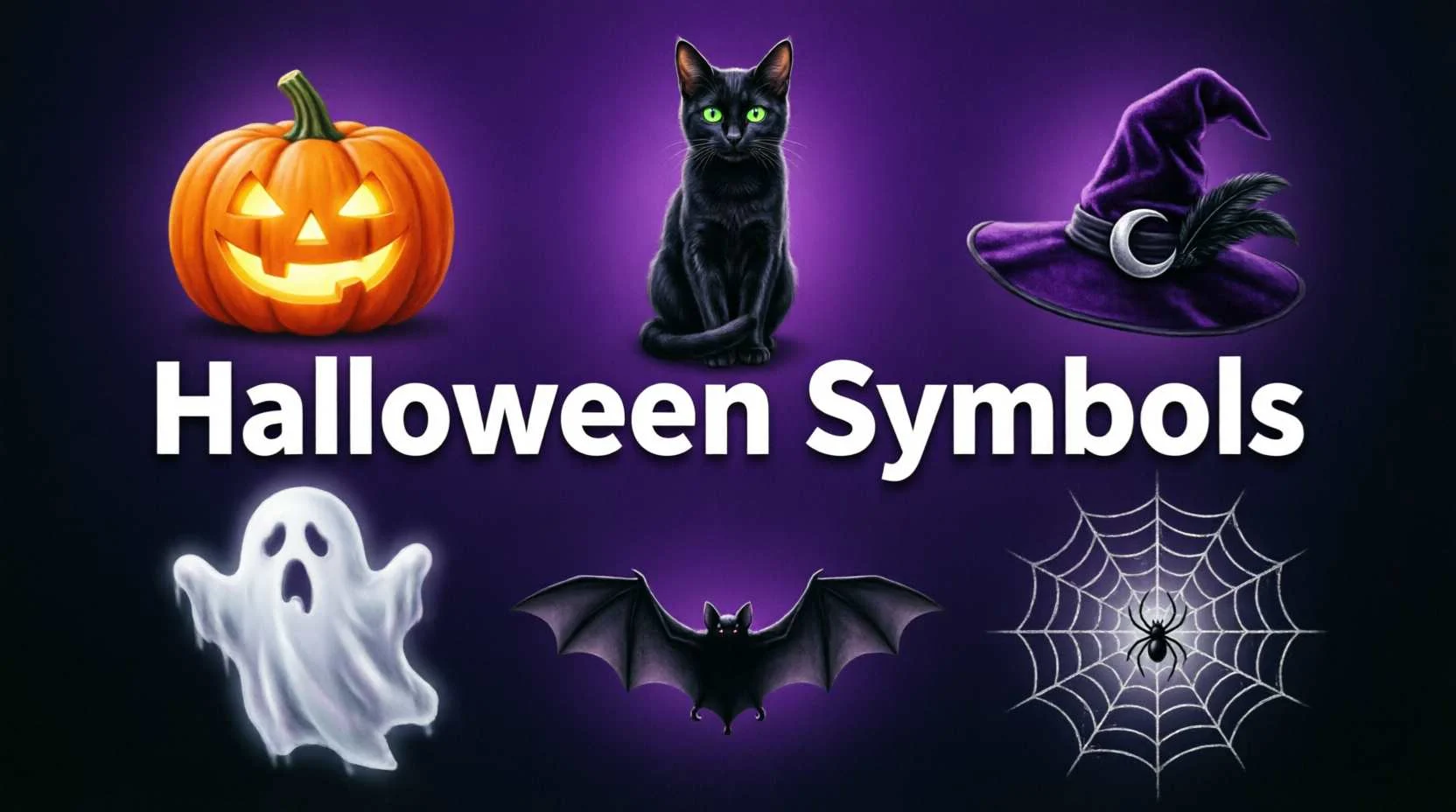
Halloween symbols are more than festive decorations; they are ancient whispers from a time when humanity danced on the knife edge between life and death.
Every carved pumpkin, every fluttering ghost, every grinning skeleton carries a story that reaches back through centuries of fear, faith, and celebration.
This article will guide you through the hidden history, psychological power, and cultural magic behind these iconic images, revealing why they still make your heart beat faster and your imagination soar.
What Are Halloween Symbols?
Halloween symbols are visual representations tied to the holiday of October 31st, rooted in the ancient Celtic festival of Samhain (pronounced “sow win”). On this night, people believed the veil between the living and the dead grew thin enough for spirits to cross over. These symbols served as tools for protection, communication with ancestors, and acceptance of mortality.
Culturally, Halloween symbols have evolved from pagan rituals to Christian observances (All Hallows Eve) and finally into modern secular celebrations. Yet their core remains unchanged: they help us confront fear, honor the cycle of life, and find joy in the macabre.
Deep Symbolic Meaning of Halloween Symbols
Spiritual Level
On a spiritual level, Halloween symbols represent the threshold. They mark the moment when darkness overtakes light in the northern hemisphere, a turning point in nature and the soul. Spirits, ancestors, and supernatural forces are believed to be closest to us. Symbols like candles and lanterns guide wandering souls home, while masks and costumes confuse malevolent entities.
Psychological Level
Psychologist Carl Jung would recognize Halloween symbols as archetypes from the collective unconscious. The skeleton represents the shadow self, the part of us we fear to see. The witch embodies repressed feminine power and societal fears of the outsider. By decorating with these symbols, we perform a ritual of exposure, bringing hidden fears into the light where they lose their grip.
Cultural Level
Culturally, these symbols create a shared language of mystery. They allow entire communities to temporarily suspend disbelief and enter a liminal space where rules bend, children roam at night, and laughter exists alongside spooky stories. This collective ritual releases social tension and strengthens bonds through shared vulnerability.
Types and Variations of Halloween Symbols
1. The Jack o Lantern
Visual description: A hollowed pumpkin or turnip with a carved face, illuminated from within by a candle or light.
Meaning: Originally a carved turnip in Irish folklore, it represents the soul of “Stingy Jack,” a man who tricked the devil and was condemned to wander Earth with only a coal inside a hollowed vegetable. It symbolizes cunning, the light of human awareness in dark times, and hospitality to wandering spirits.
Where it appears: Celtic mythology, American harvest traditions, front porches worldwide.
2. The Skeleton
Visual description: The bony internal framework of a human or animal, often posed as dancing or standing.
Meaning: A reminder of mortality and equality. Under the skin, every human looks the same. In Mexican Day of the Dead traditions, skeletons dance and laugh, showing that death is not an ending but a transformation.
Where it appears: Medieval danse macabre art, catacombs, modern Halloween decorations.
3. The Ghost
Visual description: A white, flowing, translucent figure often with dark eye holes and a mournful expression.
Meaning: The ghost represents the unsettled soul, unfinished business, and the persistence of memory. It asks us: what haunts you? What have you left unsaid?
Where it appears: World folklore, Gothic literature (Dickens, Shakespeare), paranormal documentaries.
4. The Black Cat
Visual description: A sleek, dark feline, often with arched back and glowing yellow eyes.
Meaning: Once revered in ancient Egypt as a guardian of the home, the black cat became associated with witches during medieval witch hunts. It symbolizes intuition, independence, and the fear of the unknown feminine.
Where it appears: European superstition, sailor folklore (black cats on ships brought luck), modern Halloween decor.
5. The Witch
Visual description: Pointed hat, broomstick, cauldron, crooked nose, and tattered black robes.
Meaning: The witch represents forbidden knowledge, healing arts turned sideways, and the power of nature. She is the outsider who sees what others refuse to see.
Where it appears: Salem witch trials, fairy tales (Hansel and Gretel), Wiccan and pagan traditions.
6. The Bat
Visual description: Leathery wings, small body, nocturnal flight, often shown silhouetted against a full moon.
Meaning: Bats navigate by sound in absolute darkness, making them symbols of intuition and inner vision. Their association with vampires ties them to blood, life force, and immortality.
Where it appears: Chinese symbolism (bats mean good fortune), Mayan mythology (camazotz, the death bat), Gothic fiction.
7. The Spider and Web
Visual description: Eight legged arachnid and its intricate, sticky geometric web.
Meaning: The spider weaves fate like the Fates of Greek mythology. Its web traps the careless, yet it is also a symbol of creative patience. The web represents the interconnectedness of all things, including life and death.
Where it appears: African folktales (Anansi the spider), Native American dreamcatchers, Victorian mourning jewelry.
8. The Full Moon
Visual description: A perfectly round, glowing white or yellow sphere in a dark sky.
Meaning: The moon controls tides, menstrual cycles, and harvest times. On Halloween, the full moon amplifies magic, madness, and visibility. It represents the feminine, the subconscious, and the light that guides us through darkness.
Where it appears: Astrology, werewolf mythology, romantic and horror poetry.
Halloween Symbols Across Cultures
Ancient Celtic (Samhain)
The Celts used bonfires, animal hides as costumes, and carved turnips. They believed the dead could return, and offerings of food were left outside doors. Symbolic animals included the crow (a messenger between worlds) and the boar (courage in facing death).
Medieval Europe
With Christianity, many symbols were repurposed. The skull appeared in “Momento Mori” art (“remember you must die”). Bells were rung to comfort souls in purgatory. Soul cakes were baked and given to poor children who would pray for the dead, a direct ancestor of trick or treating.
Mexican Day of the Dead (Día de los Muertos)
Though separate from Halloween, it shares symbols: marigold flowers (guide spirits), sugar skulls (sweet acceptance of death), and altars with photos of ancestors. Here, skeletons smile and wear fancy clothes, showing death as a friend, not a monster.
East Asian Spirit Festivals
In China, the Hungry Ghost Festival uses lanterns, incense, and paper money. Floating water lanterns guide lost spirits home. In Japan, Obon features bonfires and cucumber “spirit horses.” The bat, lucky in China, rarely appears as a Halloween symbol there.
African Diaspora and Hoodoo Traditions
Black cats and spiders feature in protective magic. The “jack o lantern” type gourd appears in African American folk magic as a container for capturing unfriendly spirits. Crossroads (another Halloween symbol) represent places of decision and supernatural meetings.
Halloween Symbols in Art, Movies, and Pop Culture
Movies
From the headless horseman in Sleepy Hollow to the haunted mansion in The Conjuring, Halloween symbols are cinematic shorthand. The ghost in The Others uses light and shadow. The witch in The VVitch reclaims her power. Even children’s films like Coco use skeletons and marigolds to teach about memory and love.
Paintings
Hieronymus Bosch’s The Garden of Earthly Delights is packed with hybrid creatures, owls (symbols of false wisdom), and fires. Goya’s Saturn Devouring His Son uses the skeleton as horror. Modern illustrators like Tim Burton turn pumpkins and ghosts into melancholy heroes.
Books
Shakespeare’s Macbeth opens with witches and a black cat. Mary Shelley’s Frankenstein uses the creature as a mirror of the soul. Neil Gaiman’s Coralie features button eyed ghosts and a spider mother. These symbols give shape to the shapeless fears inside us.
Tattoos
Halloween symbol tattoos are among the most meaningful. A skeleton often marks survival from illness. A black cat represents a beloved pet or a witchy identity. A jack o lantern on the skin says, “I light my own way through dark times.” These tattoos are permanent reminders of impermanence.
Fashion
From high end Alexander McQueen skull scarves to Hot Topic bat necklaces, Halloween symbols have crossed into everyday gothic and alt fashion. They allow people to carry a bit of the mysterious with them, signaling comfort with death and the unknown.
Spiritual and Dream Meaning of Halloween Symbols
When you see Halloween symbols in dreams or meditation, pay attention. These are not random images but messages from your deeper self.
- Seeing a skeleton in a dream often means you are stripping away what is unnecessary in your life. It can also indicate a health wake up call or the death of an old identity.
- A ghost in meditation may represent unresolved grief or a memory that needs closure. Ask yourself: who have I not said goodbye to?
- A black cat crossing your path in a dream suggests you should trust your intuition over logic. Someone around you may not be what they seem.
- A spider web appearing on your third eye during meditation indicates you are caught in overthinking. The web is beautiful but sticky. Time to unweave.
- A jack o lantern glowing without a candle is a powerful spiritual sign of internal light. You have everything you need to face the dark.
Positive vs Negative Meaning of Halloween Symbols
Every Halloween symbol carries a duality. This is what makes them so emotionally rich.
| Symbol | Positive Meaning | Negative Meaning |
| Skeleton | Equality, strength, renewal | Death anxiety, decay, loss |
| Black Cat | Intuition, independence, protection | Bad luck, witchcraft accusation, loneliness |
| Spider | Creativity, patience, fate weaving | Manipulation, entrapment, poison |
| Witch | Healing, nature wisdom, rebellion | Cursing, isolation, deception |
| Bat | Inner vision, community, good fortune (in China) | Vampirism, blood guilt, rabies fear |
| Ghost | Memory, continuity of love | Unfinished business, haunting trauma |
This duality explains why the same pumpkin that makes a child laugh can also make an adult shiver. Halloween symbols hold both light and shadow because we do too.
Why Humans Are Attracted to Halloween Symbols
Psychologically, humans are drawn to Halloween symbols for three reasons.
First, the power of controlled fear. Your brain loves the rush of adrenaline followed by the relief of safety. A fake skeleton cannot hurt you, but it triggers the same survival instinct as a real predator. Then the rational mind steps in and says, “It’s just a decoration.” That victory feels good. It makes you feel brave.
Second, the need to confront mortality. We spend most of the year pretending death does not exist. Halloween forces us to look. By laughing at a dancing skeleton, we shrink death’s power over us. The ancient Stoics practiced “momento mori,” remembering death to live fully. Halloween does the same thing, just with more candy.
Third, nostalgic connection. For many adults, Halloween symbols recall childhood freedom. Running door to door in a ghost sheet, holding a plastic pumpkin bucket, smelling fallen leaves and candle wax. These memories are pure, simple, and safe. Decorating with symbols is a way of inviting that innocent self back.
Emotionally, Halloween symbols give us permission to be mysterious. In daily life, we must be predictable and responsible. But on Halloween, wearing a witch hat or carrying a lantern, we can be strange, powerful, and unknowable. That release is deeply healing.
Frequently Asked Questions About Halloween Symbols
What is the most popular Halloween symbol?
The jack o lantern is the most recognized Halloween symbol worldwide. It originated from Irish myth and now appears on nearly every porch, advertisement, and Halloween themed product in October. Its combination of light, face, and organic material makes it uniquely human.
Why is the color orange associated with Halloween?
Orange represents the autumn harvest, pumpkins, and the changing leaves that signal death and dormancy in nature. Psychologically, orange is warm and energetic, balancing black’s seriousness. Together, orange and black form a perfect visual yin and yang of life and death.
Are Halloween symbols evil or demonic?
No. Most Halloween symbols originated as protective or commemorative tools. Even the skull was used in Christian art to remind believers to live righteously. Modern fears of demonic Halloween come from mid 20th century misunderstandings of pagan traditions. Context matters, a skeleton in a church catacomb is holy art; a skeleton in a cartoon is funny; neither is evil.
What does the witch on a broomstick mean?
The broom (or besom) in European folk magic was used for sweeping negative energy from a home. The image of a witch flying on a broom likely came from pagan fertility rituals where farmers would leap and dance with brooms to encourage crop growth. Medieval witch hunters twisted this into devil worship.
Why do we put up spider webs for Halloween?
Spider webs represent the decay and abandonment of haunted spaces. An undisturbed web suggests no one has entered for a long time, which feels eerie. But positively, webs also represent the weaving of fate and the beauty of patience. Synthetic webs today are safe and reusable.
Can Halloween symbols be used in home decor year round?
Absolutely. Black cat figurines, skeleton keys, moon phase tapestries, and dried spider webs in glass frames are common in gothic, bohemian, and maximalist interior design. The key is to remove the bombastic, temporary look of October plastic decorations and choose higher quality, subtler pieces.
Conclusion
Halloween symbols are not just haunting decorations but ancient mirrors reflecting our deepest fears, hopes, and mysteries. They stand at the crossroads of life and death, inviting us to laugh at what terrifies us and to remember that darkness always carries light within it. As October winds blow and candle flames flicker, these symbols whisper a truth we often forget: we are all just travelers between worlds. So light your jack o lantern. Let the veil grow thin. And walk boldly through the night.

Julian Shaw
I’ve always been fascinated by the small, quiet stories that make life feel magical. Writing allows me to explore worlds that exist just beyond the everyday, where imagination meets reality. Over the years, I’ve found joy in creating characters that feel real and stories that stay with readers long after the last page. When I’m not writing, you can usually find me wandering through city streets, notebook in hand, capturing little sparks of inspiration. I believe every story has the power to connect us, to make us feel a little less alone. Sharing these tales is my way of leaving a mark on the world.
Books:
-
Whispers in the Wind
-
Shadows of Tomorrow