
“Probability symbols” shape how we understand uncertainty, risk, and the invisible patterns guiding life.
From flipping a coin to predicting the future, these symbols quietly influence decisions we make every day. They are not just mathematical marks but reflections of how humans wrestle with chance and destiny.
In this guide, you will uncover the deeper meanings, cultural roots and emotional power behind probability symbols in ways you have likely never considered.
What Are Probability Symbols?
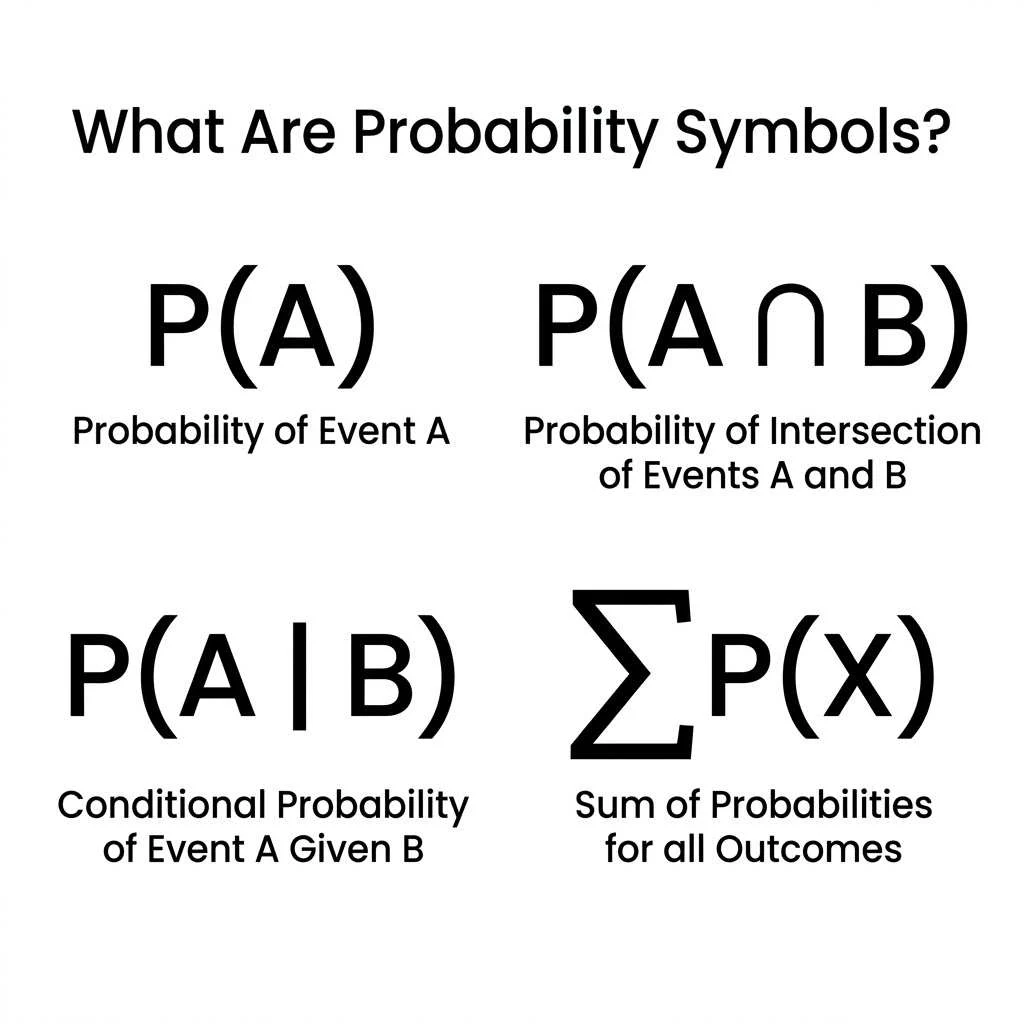
Probability symbols are mathematical notations used to represent the likelihood of events. They allow us to express uncertainty in a clear and structured way. Instead of guessing, we use symbols to measure possibility, predict outcomes, and make informed decisions.
The concept of probability dates back centuries, gaining formal structure during the 17th century through the work of thinkers like Blaise Pascal and Pierre de Fermat. Their correspondence laid the foundation for modern probability theory, transforming gambling questions into a powerful mathematical discipline.
Over time, probability symbols became universal tools in science, economics, psychology, and even philosophy. They represent more than numbers. They capture the human desire to control uncertainty and understand the unknown.
Deep Symbolic Meaning
Spiritual Level
At a spiritual level, probability symbols reflect the balance between fate and free will. They suggest that while life contains uncertainty, patterns still exist beneath the surface. Many see probability as a reminder that not everything is random. There is a deeper order guiding outcomes, even if we cannot fully see it.
Psychological Level
Psychologically, probability symbols represent how the human mind deals with uncertainty. People seek comfort in predicting outcomes. These symbols help reduce anxiety by giving structure to the unknown. When we assign probabilities, we feel a sense of control over unpredictable situations.
Cultural Level
Culturally, probability symbols embody humanity’s long fascination with luck, chance, and destiny. From ancient dice games to modern stock markets, societies have always tried to measure risk. These symbols became the language through which we interpret chance and make sense of life’s unpredictability.
Types / Variations of Probability Symbols
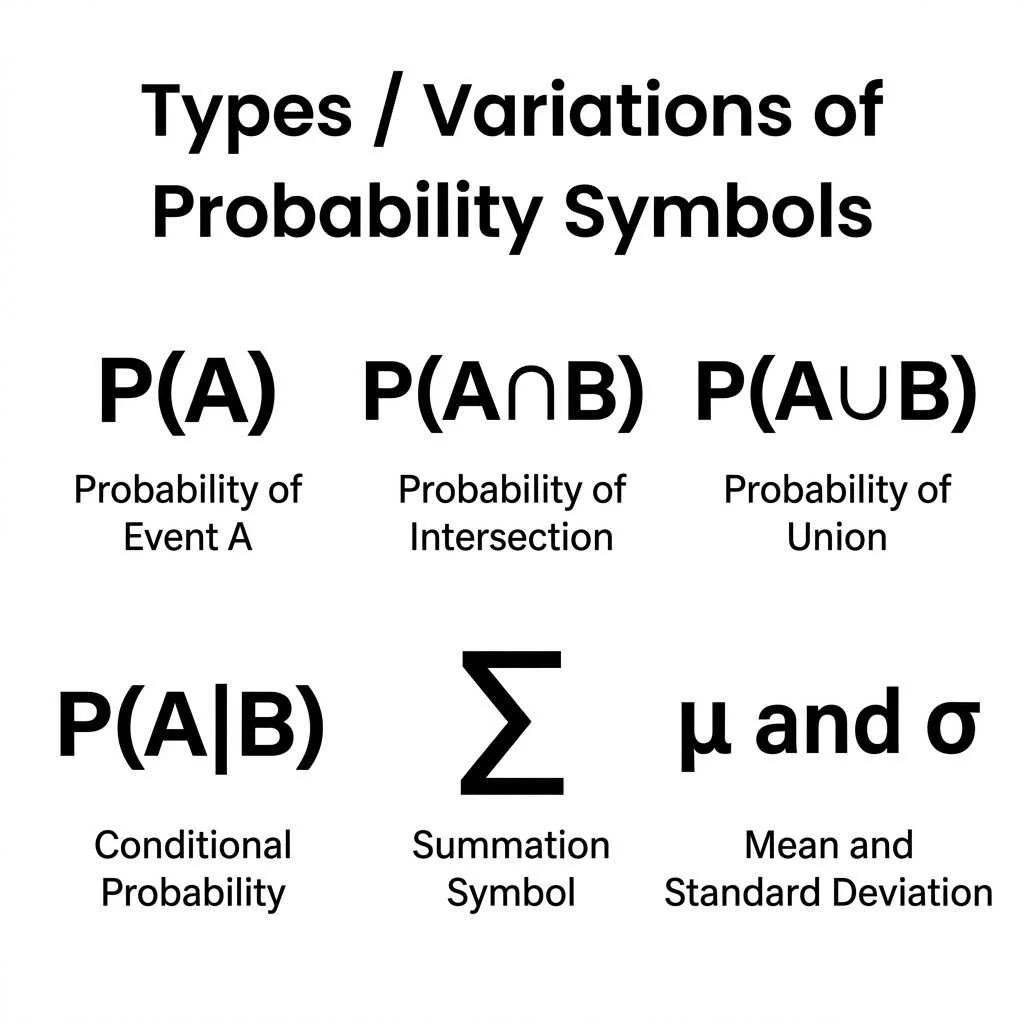
P(A)
Visual Description: A capital P followed by an event in parentheses
Meaning: Represents the probability of event A occurring
Where It Appears: Mathematics, statistics, scientific research
This is the most basic probability symbol. It answers simple questions like, what are the chances of rain tomorrow or winning a game.
P(A ∩ B)
Visual Description: P with A and B joined by an intersection symbol
Meaning: Probability that both events A and B occur together
Where It Appears: Data science, machine learning, real-world decision models
This symbol represents connection. It shows how events overlap, much like relationships in life where outcomes depend on multiple factors.
P(A ∪ B)
Visual Description: P with A and B joined by a union symbol
Meaning: Probability that either event A or B occurs
Where It Appears: Risk analysis, business forecasting
It symbolizes choice and possibility, reflecting how life often presents multiple paths.
P(A|B)
Visual Description: P of A given B with a vertical bar
Meaning: Conditional probability, the chance of A happening given B has occurred
Where It Appears: AI systems, psychology studies, medical research
This symbol reflects dependency. It reminds us that outcomes are often shaped by context and prior events.
∑ (Summation Symbol)
Visual Description: A large sigma symbol
Meaning: Represents the sum of probabilities or values
Where It Appears: Advanced mathematics, probability distributions
It symbolizes accumulation, showing how small possibilities combine into larger outcomes.
μ and σ
Visual Description: Greek letters mu and sigma
Meaning: Mean and standard deviation in probability distributions
Where It Appears: Statistics, finance, scientific analysis
These symbols represent balance and variation, reflecting how life fluctuates around an average.
Probability Symbols Across Cultures
Ancient Greece
In Ancient Greek society, chance was often linked to divine will. While formal symbols did not exist, the concept of probability was tied to fate controlled by the gods. Games of chance were seen as reflections of divine intention.
Indian Civilization
Ancient Indian texts explored randomness through philosophy and logic. Concepts similar to probability appeared in discussions about karma and outcomes, where actions influenced future possibilities.
Islamic Golden Age
Scholars during this era made early contributions to mathematics and statistics. They explored patterns in numbers and uncertainty, laying groundwork for later probability theories.
European Renaissance
During this period, probability became formalized. Gambling problems led mathematicians like Pascal and Fermat to develop symbolic representations, turning chance into a measurable science.
Modern Global Culture
Today, probability symbols are universal. They are used in everything from weather forecasts to artificial intelligence. They represent humanity’s ongoing attempt to understand and predict complex systems.
Probability Symbols in Art, Movies and Pop Culture
Probability symbols often appear subtly in storytelling and visual art. In films like The Matrix, the idea of probability is central. Characters navigate a world driven by patterns and predictions, reflecting how probability shapes reality.
In literature, probability themes appear in works like The Black Swan, where rare events challenge our understanding of chance.
In modern fashion and tattoos, symbols like intersecting sets or mathematical notations are used to represent complexity, destiny, and intellectual identity. They signal a deeper connection to logic and the hidden structure of the universe.
Spiritual and Dream Meaning of Probability Symbols
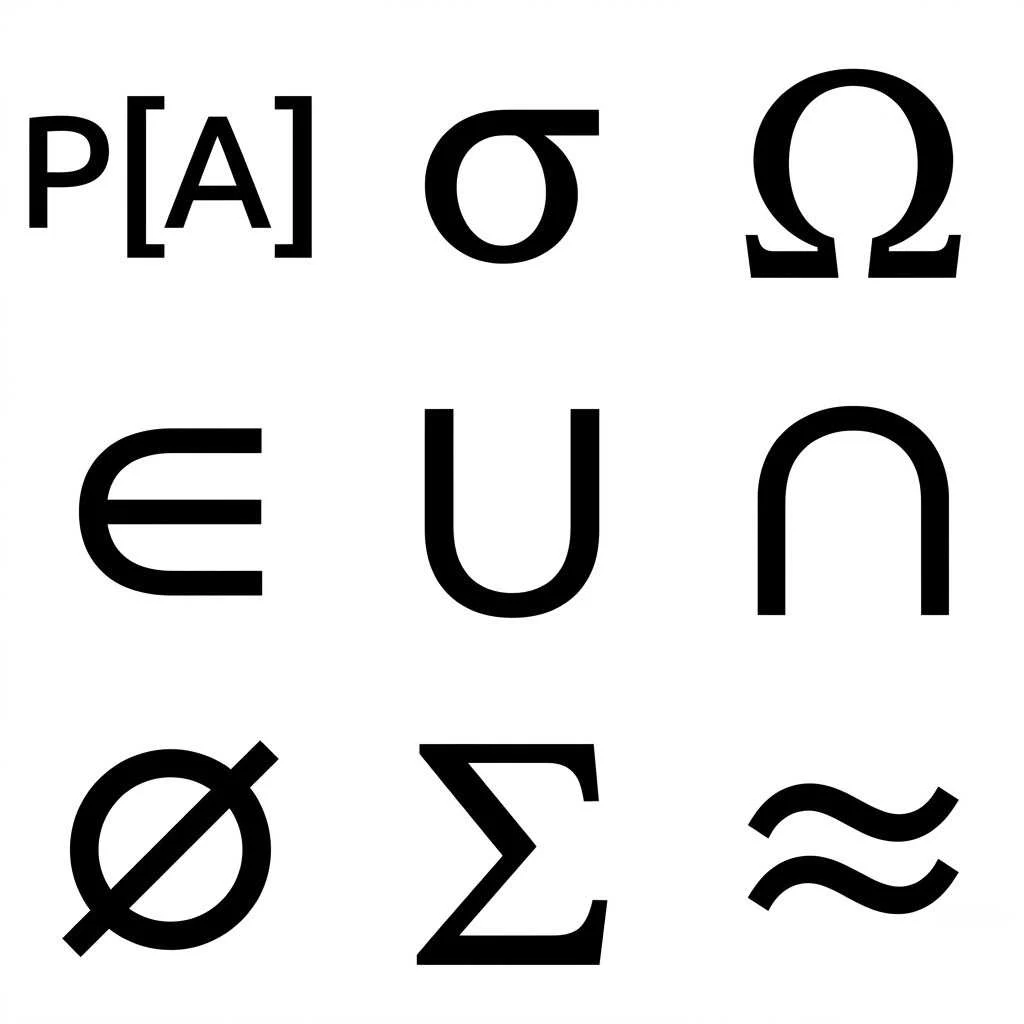
Seeing probability symbols in dreams can be powerful. It often reflects uncertainty in waking life. You may be facing a decision or feeling unsure about the future.
Spiritually, these symbols suggest awareness. They indicate that you are beginning to understand patterns in your life. Dreams involving probability may encourage you to trust both logic and intuition.
For example, dreaming of overlapping symbols like P(A ∩ B) may represent relationships or situations where outcomes depend on multiple factors. It can signal the need to consider all aspects before making a choice.
Positive vs Negative Meaning
Positive Meaning
Probability symbols can represent clarity, logic, and control. They empower people to make informed decisions. They bring order to chaos and help predict outcomes with confidence.
Negative Meaning
On the other hand, they can also represent uncertainty and fear. Not everything can be predicted. Overreliance on probability may lead to anxiety or a false sense of control.
This dual nature reflects life itself. Probability symbols remind us that certainty is never guaranteed.
Why Humans Are Attracted to This Symbol
Humans are naturally drawn to probability symbols because they promise understanding. The unknown can be unsettling. These symbols offer a way to navigate uncertainty.
From a psychological perspective, people seek patterns. The brain is wired to detect order even in randomness. Probability symbols satisfy this need by turning chaos into something measurable.
Emotionally, they provide reassurance. Even when outcomes are uncertain, having a system to evaluate possibilities makes people feel more secure.
FAQs
What is the most common probability symbol?
The most common symbol is P(A), which represents the probability of an event occurring.
Why are probability symbols important?
They help us measure uncertainty, make predictions, and take better decisions in daily life and science.
Are probability symbols used outside mathematics?
Yes, they are widely used in psychology, economics, artificial intelligence, and risk management.
What does P(A|B) mean?
It represents conditional probability, meaning the likelihood of event A occurring given that event B has already happened.
Conclusion
Probability symbols are far more than abstract mathematical tools. They are a language of uncertainty, a bridge between logic and mystery. They reveal how humans try to understand chance, predict outcomes, and find meaning in randomness.
In every decision, every risk, and every hope for the future, probability quietly shapes our world. When you look at these symbols again, you may no longer see simple notation. Instead, you will see a reflection of life itself, uncertain yet full of possibility.

Nora Bennett
Nora Bennett is a storyteller at heart, always finding magic in the everyday moments of life. From a young age, she discovered the joy of weaving emotions into words, creating characters that feel like old friends. Writing, for her, is both an adventure and a sanctuary—a way to explore the world and herself. She loves connecting with readers who share her passion for heartfelt stories and unforgettable journeys. When she’s not crafting her next tale, Nora enjoys quiet mornings with a cup of coffee and a notebook full of ideas. Her stories are meant to inspire, comfort, and spark imagination in everyone who reads them.
Books:
-
Whispers of Yesterday
-
Echoes of Tomorrow