
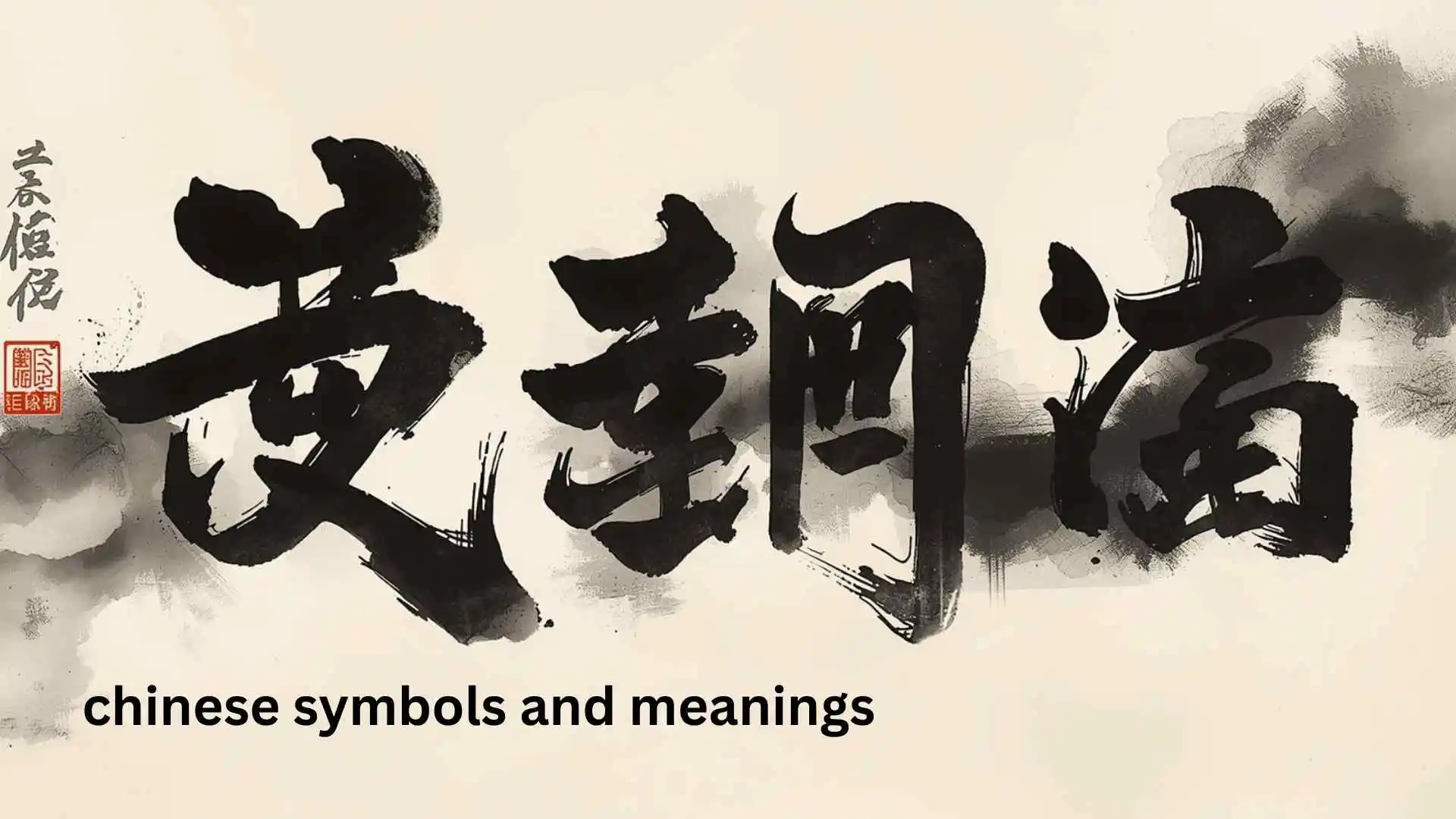
Chinese symbols and meanings carry whispers of an ancient civilization where every brushstroke held a universe of wisdom.
The first time you trace the curl of a dragon or the delicate petals of a plum blossom, you are not merely looking at art; you are decoding a language older than the Great Wall, a visual poetry that has guided emperors, warriors, and lovers for millennia.
These symbols do not just decorate temples and tattoos; they live inside the human longing for protection, luck, love, and transcendence.
In this journey, you will discover why a single character or image can transform your understanding of life itself.
What Are Chinese Symbols and Meanings?
Chinese symbols are visual representations—ranging from written characters (Hanzi) to mythological creatures, flora, fauna, and abstract motifs—that carry layered cultural, spiritual, and psychological significance. Unlike alphabetic letters, each symbol is a compressed story. The character for home (家) combines a roof and a pig, representing stability and prosperity. The dragon is not a monster but a benevolent force of nature.
Historical Background: The earliest Chinese symbols appear on oracle bones from the Shang Dynasty (1600–1046 BCE), used to communicate with ancestors and predict the future. Over centuries, Confucianism, Taoism, and Buddhism enriched these symbols with moral and metaphysical meanings. During the Tang and Song dynasties, symbols became central to poetry, painting, and architecture. Today, they thrive in global pop culture, tattoos, and feng shui.
Cultural Significance: In Chinese society, symbols are living tools. A wedding invitation might feature a double happiness character (囍). A business often displays a laughing Buddha for prosperity. Grandparents gift jade pendants carved with longevity symbols to newborns. Understanding these symbols means understanding the soul of Chinese civilization.
Deep Symbolic Meaning
Spiritual Level
Chinese symbols act as bridges between the visible and invisible worlds. The Bagua (eight trigrams) maps the flow of cosmic energy (Qi). The Yin-Yang symbol teaches that darkness contains light, death holds rebirth, and chaos births order. Meditation on these symbols aligns the practitioner with universal rhythms.
Psychological Level
Carl Jung studied Chinese symbols deeply, recognizing them as archetypes of the collective unconscious. The dragon represents the shadow self—powerful, dangerous, yet transformative when tamed. The lotus mirrors the human journey: rising from muddy struggles to bloom in pure awareness. These symbols help us process fear, ambition, grief, and hope without words.
Cultural Level
Symbols unify over 1.4 billion people across dialects and borders. Whether you speak Mandarin, Cantonese, or Hokkien, the red envelope (红包) means luck. The bat (蝠) sounds like “blessing” (福), so five bats mean the five blessings: longevity, wealth, health, virtue, and natural death. This shared visual dictionary binds generations.
Types and Variations of Chinese Symbols
1. The Dragon (龙 – Lóng)
Visual description: Serpentine body, five claws (imperial), antler-like horns, pearl under chin.
Meaning: Power, strength, good fortune, yang energy, imperial authority.
Where it appears: Emperor’s robes, temple roofs, Chinese New Year parades, dynasty flags, martial arts legends.
2. The Phoenix (凤 – Fèng)
Visual description: Bird with five-colored feathers, long tail, often paired with dragon.
Meaning: Yin energy, virtue, grace, rebirth, empress and feminine power.
Where it appears: Weddings (harmony of dragon and phoenix), palace decorations, poetry of the Tang court.
3. The Lotus (荷花 – Héhuā)
Visual description: Pink or white flower rising from muddy water, broad green leaves.
Meaning: Purity, enlightenment, detachment, spiritual perfection.
Where it appears: Buddhist art, temple murals, scholar paintings, tea ceremonies.
4. Double Happiness (囍 – Shuāngxǐ)
Visual description: Two combined “happiness” characters (喜喜).
Meaning: Marital joy, union, shared celebration.
Where it appears: Wedding invitations, red envelopes, bridal chambers, wedding cakes.
5. Fu (福 – Fú)
Visual description: Square character often written with a rounded brushstroke.
Meaning: Blessing, happiness, good luck, fortune.
Where it appears: Displayed upside down on doors (pronounced “fu dao le” meaning “blessing has arrived”), New Year scrolls, amulets.
6. Bagua (八卦 – Bāguà)
Visual description: Octagonal diagram with eight trigrams of broken and solid lines.
Meaning: Cosmic order, change, protection, feng shui alignment.
Where it appears: Taoist temples, mirrors above doors (ward off evil), martial arts (Tai Chi philosophy).
7. Bat (蝠 – Fú)
Visual description: Small flying mammal with outspread wings.
Meaning: Blessings (homophone with 福), prosperity, happiness.
Where it appears: Ming dynasty porcelain, embroidery on robes, New Year paper cuts.
Chinese Symbols Across Cultures
Ancient China (Shang to Han Dynasties)
Symbols were oracular and animistic. Tortoise shells inscribed with weather signs or harvest predictions. The Fang Ding bronze vessels featured Taotie (gluttonous mask) to scare away evil spirits. Ancestors were honored with jade Bi discs shaped like the sky.
Medieval China (Tang to Yuan Dynasties)
Buddhism introduced the endless knot (eternal love) and the dharma wheel (truth). Taoism contributed the He Tu and Luo Shu magic squares for divination. The crane became a symbol of immortality, often flying alongside gods in paintings.
Modern China (Qing to Present)
After the Cultural Revolution’s destruction of many symbols, a revival began. The 2008 Beijing Olympics used the “Beijing Seal” carved from jade, blending ancient script with modern branding. Today, young Chinese use symbols ironically on social media while preserving their core meanings.
East Asian Adaptations (Japan, Korea, Vietnam)
Japan adopted the dragon (Ryū) as water gods. Korea’s Sam Taegeuk (three-colored yin-yang) differs from China’s two-color version. Vietnam preserves Chinese symbols most faithfully, especially the Chữ Nôm script and the Lac bird origin myth.
Western Interpretations
19th-century Western collectors romanticized Chinese symbols as exotic mysticism. Today, Western psychology uses the I Ching hexagrams for decision-making. Fashion brands like Gucci and Louis Vuitton feature Chinese zodiacs, though sometimes stripped of original meaning.
Chinese Symbols in Art, Movies, and Pop Culture
Movies: In Crouching Tiger, Hidden Dragon, the green destiny sword symbolizes unfulfilled passion and moral duty. The dragon in Mulan (Mushu) is comedic but still represents ancestral protection. Shang-Chi (Marvel) centers on the Ten Rings, each engraved with ancient symbols of power.
Paintings: Traditional ink wash paintings like “Along the River During Qingming Festival” hide symbols in everyday life—a hanging lantern means a boy born, a pair of mandarin ducks means faithful marriage. Contemporary artist Ai Weiwei uses the porcelain sunflower seed as a symbol of mass individuality.
Books: Amy Tan’s The Joy Luck Club uses mahjong tiles (bamboo, circles, characters) as metaphors for mother-daughter bonds. The Three-Body Problem by Liu Cixin uses the tri-solar symbol as an alien warning.
Tattoos: Chinese character tattoos remain popular, though caution is needed (a famous case: a woman tattooed “soup” thinking it meant “strength”). Dragons on back symbolize overcoming struggle. Lotus on wrist often represents surviving trauma.
Fashion: Vivienne Tam’s Mao jacket with peony prints. Shanghai Tang’s Qi Pao dresses embroidered with cranes and clouds. Streetwear brand CLOT uses the knot symbol for unity.
Spiritual and Dream Meaning of Chinese Symbols
Dreaming of a dragon: You are on the verge of a breakthrough. The dragon represents raw power rising from your subconscious. If the dragon flies, you will achieve recognition. If it sleeps, patience is needed. If it attacks, you fear your own ambition.
Dreaming of a broken yin-yang: Your life is unbalanced. Too much work (yang) without rest (yin). Or emotional giving without receiving. The dream asks you to recenter.
Seeing the character Fu in meditation: A message that blessings are already present. You do not need to chase happiness; you need to recognize it.
Dreaming of a red envelope: An unexpected gift or inheritance approaches. Emotionally, you may receive validation or forgiveness from someone.
Meditating on the lotus: Visualize the flower closing at night (withdrawal into self) and opening at dawn (emergence into joy). This practice helps with depression and creative blocks.
Positive vs Negative Meanings of Chinese Symbols
| Symbol | Positive Meaning | Negative or Warning Meaning |
| Dragon | Power, success, protection | Tyranny, greed, uncontrollable anger |
| Phoenix | Rebirth, grace, virtue | Vanity, pride before downfall |
| Lotus | Purity, enlightenment | Detachment turning to coldness |
| Bat | Blessings, prosperity | Disease, darkness (rarely used negatively) |
| Yin-Yang | Balance, harmony | Stagnation, no movement (overbalanced) |
| Tiger (虎) | Courage, protection | Cruelty, violence, loss of control |
Example from history: The last Ming emperor used the dragon seal to command armies but lost his throne when the dragon symbol became hollow propaganda. A symbol without inner truth becomes a curse.
Why Humans Are Attracted to Chinese Symbols
Psychologically, humans crave compression. We cannot hold 10,000 words in our mind, but we can hold one image that contains 10,000 words. The Tai Chi symbol simplifies every philosophical debate about good and evil into two swirling commas. This visual economy relieves cognitive overload.
Emotionally, symbols offer safety. A child holding a jade pendant shaped like a longevity peach feels protected. A businessman with a Caishen (god of wealth) figurine on his desk feels hopeful. Symbols are transitional objects, like a childhood blanket, but for adults navigating chaos.
Spiritually, symbols bypass the skeptical mind. When you see the endless knot, you do not argue about eternal love. You feel it. This direct transmission explains why Chinese symbols have survived revolutions, wars, and globalization.
Neurologically, Chinese characters activate the right brain’s pattern recognition and the left brain’s linguistic processing simultaneously. Reading Shou (longevity) stimulates both analytical and intuitive thought. No alphabet does this.
Frequently Asked Questions
1. What is the most powerful Chinese symbol for luck?
The Fu (福) character is considered most powerful. When displayed upside down on red paper, it invites blessings directly into your home. Many combine it with the Lu (prosperity) and Shou (longevity) symbols for triple luck.
2. Can I get a Chinese symbol tattoo if I am not Chinese?
Yes, but deep respect is essential. Research the exact character meaning, stroke order, and cultural context. Avoid random calligraphy from unverified sources. Consult a native speaker or a scholar. The tattoo industry has many horror stories of incorrect or offensive symbols.
3. What does the yin-yang symbol really mean?
It means that opposites are not enemies but dance partners. Light defines dark. Movement creates rest. Joy without sorrow is shallow. Sorrow without joy is unbearable. The small dot of opposite color in each swirl reminds us that nothing is pure.
4. Are Chinese symbols the same as Japanese or Korean symbols?
Many overlap because of shared Chinese character roots (Hanzi in Chinese, Kanji in Japanese, Hanja in Korean). However, meanings can differ. For example, 手紙 means “toilet paper” in Chinese but “letter” in Japanese. Always specify which cultural context you mean.
5. What is the saddest or most tragic Chinese symbol?
The broken jade (玉碎 – Yù suì). Jade is unbreakable symbol of virtue. A broken jade ring represents a person who died rather than compromise their honor. It appears in war poetry and mourning rituals. It is beautiful and heartbreaking.
6. How do I use Chinese symbols in my daily life for positive energy?
Place a Bagua mirror outside your front door reflecting away negative energy. Hang a calligraphy of He (harmony) in your living room. Wear a red string bracelet with a miniature pi yao (wealth guardian). Most importantly, learn one symbol deeply rather than collecting many superficially.
Conclusion
Chinese symbols and meanings are not museum artifacts; they are living breathing companions that have walked beside humans through joy, grief, war, and peace. Every time you trace a dragon’s claw or whisper the sound of Fu, you join a chain of ancestors who looked at the same curves and found courage, hope, and belonging. May the symbols you carry remind you that chaos always swirls toward order, that mud always births the lotus, and that a single honest brushstroke can change everything. Let them speak to you not as foreign shapes, but as the oldest language your heart already knows.

Freddie Wood
Hi! I’m Freddie Wood, a storyteller at heart and a lifelong explorer of ideas. Writing has always been my way of making sense of the world, turning ordinary moments into stories that linger in your mind. I love blending emotions with adventure, and I’m fascinated by the way words can connect people across distances and experiences. When I’m not writing, you’ll find me wandering through nature, listening to music, or sketching out ideas for my next story. My goal is always to create books that stay with readers long after the last page.
Books by Freddie Wood:
-
The Hidden Path
-
Shadows of Tomorrow