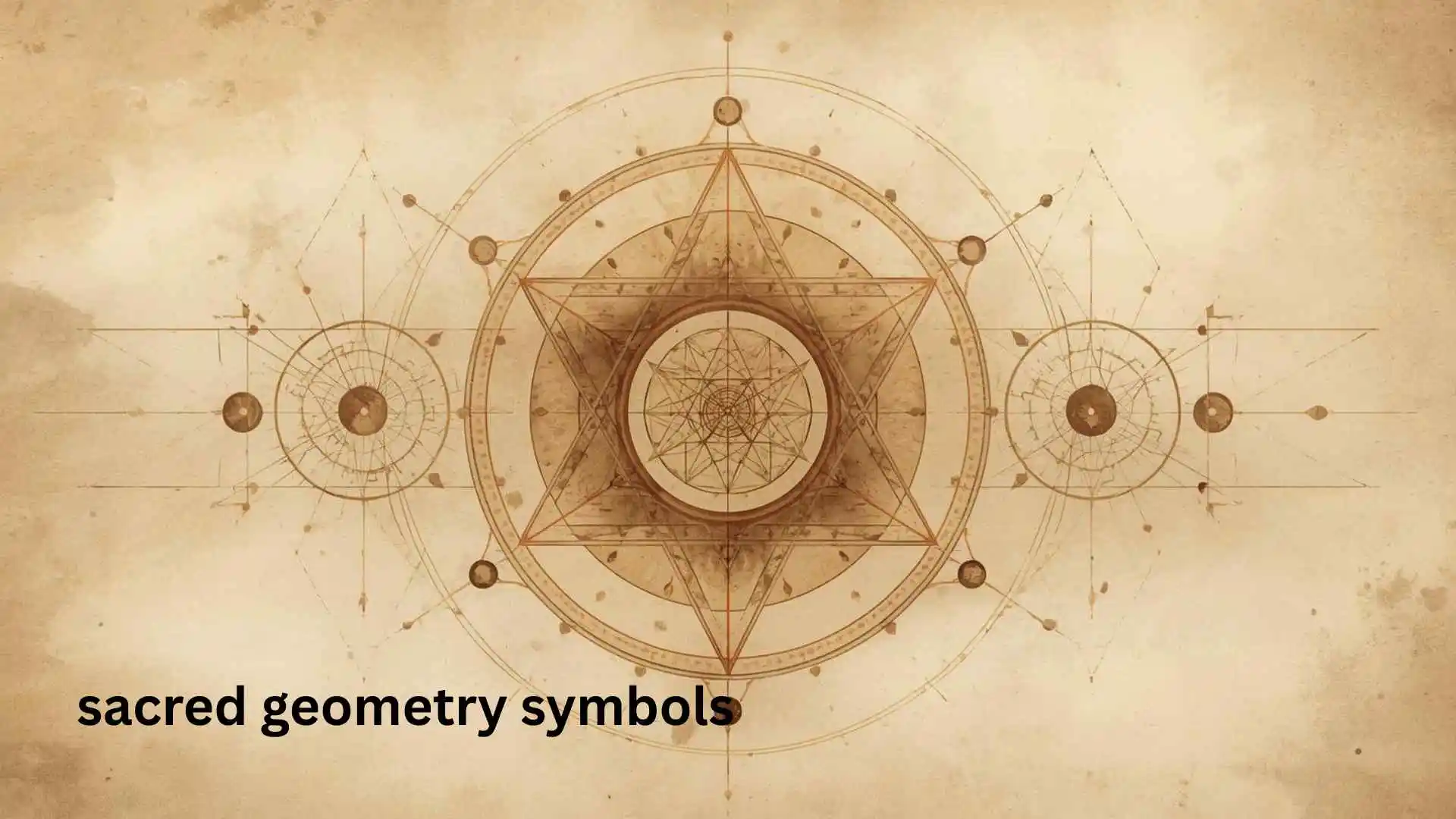
Sacred geometry symbols are not mere drawings; they are blueprints of creation itself, etched into the fabric of every atom, flower, galaxy, and cathedral you have ever loved.
Have you ever felt an unexplainable stillness while staring at a snowflake, a honeycomb, or the spiral of a seashell? That quiet awe is your soul recognizing a language older than human speech.
This article will not just define these symbols but will walk you through their hidden power, revealing why ancient priests, modern physicists, and artists alike have bowed before their truth.
What Are Sacred Geometry Symbols?
Sacred geometry symbols are geometric patterns and shapes that hold spiritual, philosophical, and mathematical significance across nearly every culture. They represent the invisible laws of order behind apparent chaos. The term itself fuses “sacred” (worthy of reverence) with “geometry” (earth measurement), suggesting that measuring the earth is also measuring the divine.
Historically, these patterns appear in the temple walls of ancient Egypt, the mandalas of Tibetan Buddhism, the rose windows of Gothic cathedrals, and even the proportions of Stonehenge. Plato argued that God “geometrizes continually.” Pythagoras taught that numbers and shapes were the essence of all existence. In the 20th century, Carl Jung noticed that these same symbols surfaced spontaneously in his patients’ dreams, calling them archetypes of the collective unconscious. Culturally, they bridge science and spirit. A physicist sees the Fibonacci sequence in a nautilus shell; a mystic sees the breath of God. Both are correct.
Deep Symbolic Meaning
Spiritual Level: Sacred geometry symbols act as portals. When you meditate on a shape like the Sri Yantra, you are not just looking at lines. You are mapping your own consciousness. These forms are said to resonate with the universe’s frequency, helping you align with higher realms. They remind you that separation is an illusion. The circle inside a square inside a triangle? That is your soul housed in a body, living on a planet, floating in infinity.
Psychological Level: Why does a spiral calm an anxious mind? Because your neural pathways follow spiral patterns. Your heartbeat, your breathing, even the way your thoughts unwind in sleep are spiral motions. Sacred geometry symbols speak directly to the limbic system, bypassing language. They offer the brain a kind of visual mantra. When you feel “at peace” looking at a flower of life, your mind is actually experiencing harmonic resonance with mathematical truth. This is not magic. This is neurogeometry.
Cultural Level: These symbols are humanity’s shared inheritance. Before the written word, we carved concentric circles and zigzags into bone and rock. They appear in Aboriginal dreamtime paintings and Celtic high crosses. They are democracy of the soul. No matter your religion, a hexagon in a honeycomb or the golden ratio in a sunflower speaks a truth that needs no translation. They remind us that our ancestors were not primitive. They were geometry’s first poets.
Types / Variations of Sacred Geometry Symbols
Let us walk through the most important ones. Each is a universe in miniature.
1. The Circle
- Visual: A perfect loop without beginning or end.
- Meaning: Wholeness, unity, the divine feminine, time, eternity. In many traditions, the circle is the void pregnant with potential.
- Appears in: Mandalas (Tibet), stone circles (Celtic), halos (Christian art), dream catchers (Ojibwe), clock faces, wedding rings.
2. The Flower of Life
- Visual: Overlapping circles arranged in a hexagonal pattern, resembling a flower.
- Meaning: The cycle of creation. Each circle births the next, representing the first seven days of existence. It contains the blueprint for every molecule, life form, and atom.
- Appears in: Temple of Osiris (Egypt), ancient synagogues (Israel), Leonardo da Vinci’s notebooks, modern tattoos representing interconnectedness.
3. Sri Yantra
- Visual: Nine interlocking triangles radiating from a central point (bindu), surrounded by lotus petals.
- Meaning: The union of masculine (Shiva, upward triangles) and feminine (Shakti, downward triangles). A map of spiritual evolution from material to divine.
- Appears in: Hindu meditation chambers, Tibetan thangkas, New Age altar art, yoga studio logos.
4. The Golden Ratio Spiral (Fibonacci Spiral)
- Visual: A logarithmic curve that grows wider while maintaining its shape.
- Meaning: Dynamic balance, growth without chaos, the path of least resistance. Nature’s algorithm for efficiency and beauty.
- Appears in: Nautilus shells, hurricane formations, galaxy arms, Parthenon architecture, credit card designs, and even Radiohead album covers.
5. The Hexagon
- Visual: Six-sided polygon.
- Meaning: Balance, harmony, efficiency, and the union of opposites (the six points can represent spirit and matter meeting).
- Appears in: Honeycombs, basalt columns (Giant’s Causeway), Islamic geometric art, snowflake crystals, football patterns.
6. The Vesica Piscis
- Visual: Two equal circles overlapping so the center of each lies on the circumference of the other.
- Meaning: The womb of creation, the intersection of heaven and earth, the birth of light from darkness. Also the mathematical root of the Fish symbol (Ichthys) in early Christianity.
- Appears in: Chartres Cathedral stained glass, medieval illuminated manuscripts, pagan fertility symbols, modern logos for cooperative organizations.
Sacred Geometry Symbols Across Cultures
No civilization has been immune to the call of these forms.
Ancient Egypt: The Egyptians used sacred geometry symbols to align pyramids with Orion’s belt. The ankh (a looped cross) is a geometric representation of eternal life. Temple floors were cosmic maps. To walk through a hypostyle hall was to walk through the stars.
Ancient Greece: Plato’s “Platonic Solids” (cube, tetrahedron, octahedron, icosahedron, dodecahedron) mapped the five classical elements. The golden ratio (Phi) was considered the key to beauty. The Parthenon’s facade is a living lesson in Phi rectangles. Greek mystery schools taught geometry as the highest spiritual training.
Islamic Golden Age: Because figurative art was limited, Islamic scholars poured genius into geometric tiling. Fourfold patterns represent the four elements and four cardinal directions. Eightfold patterns symbolize the throne of God. Alhambra Palace in Spain is a sacred geometry encyclopedia in stone.
Indigenous Australian: Dreamtime “songlines” are not abstract. They map water sources and ceremonial sites using geometric patterns woven into sand paintings. The circle is a campsite. The wavy line is a snake ancestor. These are living, navigational sacred maps.
Modern Western (New Age & Science): Today, sacred geometry symbols appear in crop circles (whether man made or not), sacred architecture like the Bahá’í House of Worship, and even in quantum physics diagrams. String theory’s Calabi-Yau manifolds are essentially modern platonic solids. Carl Sagan used the flower of life to argue for cosmic consciousness in Cosmos.
Sacred Geometry Symbols in Art, Movies & Pop Culture
You have seen them a thousand times. Now you will never unsee them.
Movies: In Interstellar, the tesseract inside the black hole is a hypercube. A sacred geometry symbol representing higher dimensions. In Doctor Strange, the mandala-like shields are directly inspired by the Sri Yantra. The Lion King’s Pride Rock? The golden ratio spiral governs every frame of the sunrise scene.
Paintings: Leonardo da Vinci’s “Vitruvian Man” is the most famous sacred geometry illustration in history. It overlays a circle and square on the human body. Salvador Dalí’s “The Sacrament of the Last Supper” is framed inside a perfect dodecahedron.
Books: Dan Brown’s The Lost Symbol revolves around the Washington D.C. street layout as a giant pentagram and other geometric codes. Paulo Coelho’s The Alchemist uses the desert’s circular oasis as metaphor for returning to one’s center.
Tattoos: The flower of life on a forearm is the 21st century’s most popular spiritual tattoo. It says: “I believe everything is connected.” The Metatron’s cube (a 3D flower of life) is common among engineers and artists who see God in structure.
Fashion: Alexander McQueen’s collections frequently used Fibonacci spirals and hexagon prints. Iris van Herpen’s 3D printed dresses mimic sacred geometric forms like the vesica piscis. Even Supreme and Off-White have released geometry-heavy logos that tap into the human love for pattern.
Spiritual & Dream Meaning of Sacred Geometry Symbols
Imagine closing your eyes in meditation and seeing a glowing blue hexagon. Or dreaming of an infinite spiral pulling you upward. What does it mean?
When sacred geometry symbols appear in dreams or trance states, they are rarely random. Jung would say they are messages from the Self. A circle in a dream often means you are seeking closure or wholeness. A spiral suggests you are undergoing deep psychological transformation. A cube implies stability but also limitation. A star tetrahedron (Merkaba) often appears during intense spiritual awakening or before out of body experiences.
In shamanic traditions, seeing a seed of life pattern during plant medicine ceremonies means you are witnessing the beginning of your own soul’s regeneration. In Christian mysticism, a hexagon in a dream may represent the sixth day of creation when humans were formed.
If you see these symbols spontaneously, do not dismiss them. Draw them. Meditate on them. They are your unconscious mind speaking in the oldest language known to your cells.
Positive vs Negative Meaning of Sacred Geometry Symbols
Here is a truth most articles avoid. Sacred geometry symbols are morally neutral. They are tools. A knife can slice bread or wound flesh. The same is true here.
Positive Meanings: Healing, alignment, protection, manifestation, unity, cosmic harmony. Amulets with the flower of life are worn for pregnancy and creativity. The hexagram (Star of David) has protected Jewish communities for millennia. Sri Yantras placed under beds attract harmonious relationships.
Negative or Shadow Meanings: The same hexagon can become the “endless knot” of obsession if misused. The pentagram (five pointed star) was a symbol of health in Greece, but medieval fear mongering twisted it into “satanic” meaning. The swastika is an ancient sun symbol found in Hindu, Buddhist, and Native American art. In its positive form, it represents well being. In its corrupted Nazi version, it means genocide. The shape did not change. Humanity’s intention did.
Even the beautiful golden ratio can be used to design manipulative advertising that preys on subconscious desires. Casinos are built using disorienting geometry to keep you inside. Sacred geometry without ethics becomes a cage.
So remember: the symbol is a key. What door you open is entirely your choice.
Why Humans Are Attracted to Sacred Geometry Symbols
This is the emotional heart of it all. Why do we stop scrolling when we see a perfect mandala? Why do children draw spirals before they write letters?
Because you are made of geometry. Your DNA coils into a double helix (a spiral). Your retinas are wired to recognize radial symmetry as “safe” and “beautiful.” Your heart’s electromagnetic field pulses in toroidal (donut shaped) waves. When you look at sacred geometry symbols, you are literally looking at a mirror of your own biology.
Psychologically, we crave order when life feels chaotic. A chaotic divorce, a global pandemic, a loss of purpose. Then we place a flower of life on our phone case. We draw a circle on foggy glass. We trace the lines of a Sri Yantra with our finger. This is not superstition. This is self soothing using the most reliable pattern of all: the pattern of existence itself.
Emotionally, these symbols give us permission to believe that there is a hidden order. That the universe is not random. That our suffering has shape and our joy has symmetry. That we belong to something vast and beautifully structured. That is the deepest attraction. Not magic tricks. Not superstition. Just the quiet, powerful truth: I am part of the pattern.
Frequently Asked Questions About Sacred Geometry Symbols
1. Can sacred geometry symbols really heal you?
They do not replace medicine. But studies in environmental psychology show that viewing geometric patterns reduces cortisol levels. Meditating on mandalas lowers anxiety. In that sense, they heal by calming the nervous system and reconnecting you to natural order.
2. What is the most powerful sacred geometry symbol?
The circle. Every other shape is born from it. Without the circle, there is no spiral, no triangle, no flower of life. The circle represents the dimensionless point from which all creation expands.
3. Are sacred geometry symbols mentioned in the Bible?
Not by that name. But the “New Jerusalem” is described as a perfect cube (Revelation 21:16). The Ark of the Covenant used golden ratio proportions. The Tabernacle’s layout follows vesica piscis geometry. The Bible is soaked in sacred geometry whether it names it or not.
4. How do I start using sacred geometry symbols in daily life?
Wear a small pendant of the flower of life. Place a printed Sri Yantra where you meditate. Draw a circle before you write your daily intentions. Use a golden ratio ruler when arranging your desk. Start small. The symbols will meet you where you are.
5. Is sacred geometry scientifically proven?
The golden ratio and Fibonacci sequence are empirically observed in nature. Crystals form repeating platonic solids. The mathematics are real. Whether that implies “sacredness” is a matter of personal belief, not laboratory proof. Science and spirit can walk together here.
6. Why do some people fear sacred geometry symbols?
Misinformation and religious trauma. Some evangelical traditions label anything non biblical as “occult.” A hexagram is just six lines. Fear comes from story, not from shape.
Conclusion
You came here curious about lines and circles. You leave with something rarer. A reminder that you are not separate from the universe. The spiral in your fingerprint matches the spiral in a galaxy. The hexagon of a snowflake is the same geometry inside your cells. Sacred geometry symbols are not relics of a superstitious past. They are living, breathing maps of your own deepest structure. Look at the world now. See the circles. Trace the spirals. You have always been part of the pattern. You just forgot the language. Now you remember.

Julian Shaw
I’ve always been fascinated by the small, quiet stories that make life feel magical. Writing allows me to explore worlds that exist just beyond the everyday, where imagination meets reality. Over the years, I’ve found joy in creating characters that feel real and stories that stay with readers long after the last page. When I’m not writing, you can usually find me wandering through city streets, notebook in hand, capturing little sparks of inspiration. I believe every story has the power to connect us, to make us feel a little less alone. Sharing these tales is my way of leaving a mark on the world.
Books:
-
Whispers in the Wind
-
Shadows of Tomorrow