
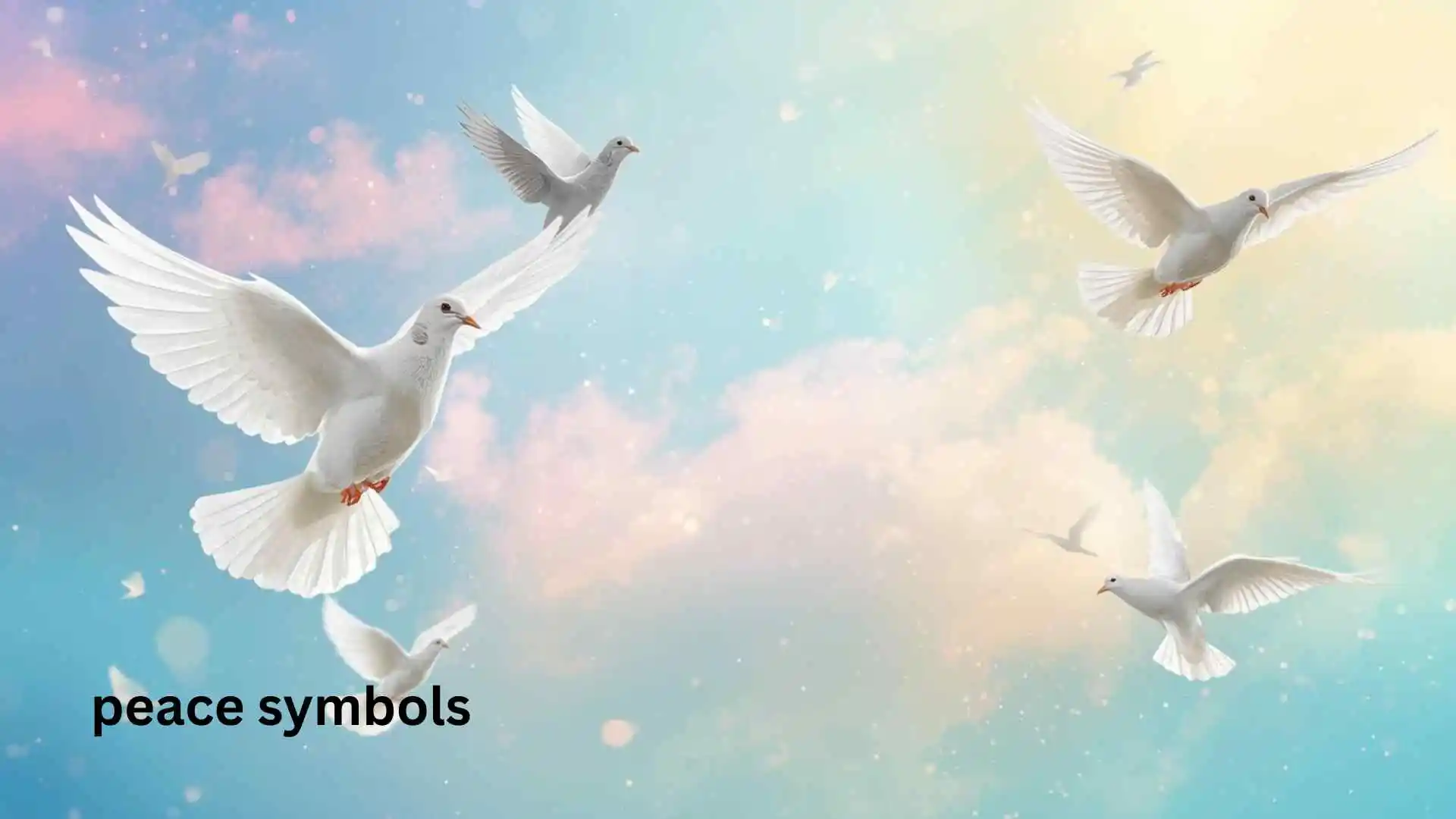
Peace symbols surround us on necklaces, protest signs, car stickers, and even military uniforms, yet few people understand their true depth.
That simple circle with three lines inside carries a story of nuclear fear, ancient spirituality, and human hope that stretches back thousands of years.
In this deeply researched guide, you will discover why these quiet marks speak louder than any weapon and how they have secretly shaped your own psyche without you even realizing it.
What Are Peace Symbols?
Peace symbols are visual representations of the human longing for harmony, non violence, and the absence of conflict. Unlike corporate logos or traffic signs, these symbols carry an emotional weight that transcends language, culture, and religion. They appear in moments of collective grief, hope, and resistance.
The most recognized modern peace symbol was born from desperation. In 1958, British designer Gerald Holtom created the iconic circle with three lines for the Campaign for Nuclear Disarmament (CND). He combined the semaphore signals for the letters N (nuclear) and D (disarmament): a person with arms down at 45 degrees and another with arms stretched upward. Inside a circle, these lines formed what we now call the peace sign.
But Holtom later admitted a darker inspiration. He told Peace News in 1973 that the symbol also represented an individual in despair, with arms outstretched downward, like Goya’s painting of a peasant before a firing squad. The circle became the womb of rebirth, suggesting that even from absolute hopelessness, peace could be born.
Before 1958, humanity had already drawn hundreds of peace symbols. The olive branch, the white dove, the broken rifle, the V sign, the lotus flower, the yin yang, and the upside down cross of Saint Peter all carried peaceful meanings across different civilizations. Each one tells a different story about how humans imagine safety and unity.
Deep Symbolic Meaning of Peace Symbols
Spiritual Level
On a spiritual level, peace symbols represent the still point at the center of chaos. In Buddhist traditions, the endless knot symbolizes the intertwining of wisdom and compassion, the two forces that end suffering. In Christianity, the dove descending represents the Holy Spirit bringing divine calm after the storm of judgment. The peace symbol’s circle mirrors the mandala, a spiritual tool for meditation that contains the entire universe inside a protective ring. When you wear or draw a peace symbol, you are literally drawing a protective boundary around your spirit, saying “here, conflict ends.”
Psychological Level
Psychologist Carl Jung would have called the peace symbol an archetype, a universal image embedded in the collective unconscious. When someone draws a peace sign or displays an olive branch, their brain releases oxytocin, the bonding hormone. Studies in behavioral psychology show that simply viewing peace symbols reduces cortisol levels and lowers defensive body language. The symmetrical, enclosed shape signals safety to the ancient part of your brain that still watches for predators. A circle with no sharp edges means no attack is coming.
Cultural Level
Culturally, peace symbols become rebellion against normalized violence. In the 1960s, the CND symbol crossed from British nuclear protests to American anti war marches. It appeared on Woodstock merchandise, Vietnam War veterans’ jackets, and Black Panther posters. Today, it remains the most recognized symbol in the world after the Christian cross and the Islamic crescent. Yet its meaning has softened. Many people wear it as fashion without knowing its nuclear roots. This dilution is both a loss and a victory. A symbol that once screamed “stop radioactive death” now whispers “choose kindness.” The whisper may be more sustainable.
Types and Variations of Peace Symbols
The CND/Nuclear Disarmament Symbol (The Circle with Three Lines)
A circle containing a vertical line with two diagonal lines branching downward at 45 degrees. It represents the semaphore letters N and D inside a womb like circle. Appears globally on flags, jewelry, street art, and government buildings during protests. Its meaning has expanded from nuclear disarmament to general anti war and environmental justice.
The Olive Branch
A leafy branch from the olive tree, often carried by a dove. In ancient Greece, olive wreaths crowned Olympic victors who had paused wars for the games. In the Hebrew Bible, a dove returns to Noah’s ark with an olive leaf, signaling that God’s flood of destruction had ended. Today, the United Nations flag features a world map inside olive branches. It represents peace after survival.
The White Dove
A pure white pigeon often shown in flight with an olive branch. In Christianity, it represents the Holy Spirit and the soul’s return to God. In secular culture, releasing white doves at weddings, funerals, and political ceremonies symbolizes letting go of hatred and wishing harmony into the unknown future.
The Broken Rifle
A rifle snapped in two, often carried by a helmet or a hand. This symbol belongs to War Resisters’ International and appears at anti conscription rallies. It means “we refuse to participate in organized killing.” Unlike the passive dove, the broken rifle is aggressive in its rejection of aggression.
The V Sign (Palm Outward)
Two fingers raised in a V shape with the palm facing the viewer. Winston Churchill popularized it during World War II to mean “Victory.” But in the 1960s anti war movement, American protesters reversed the meaning to “Victory over violence” or simply “Peace.” In the UK and Australia, the palm inward version remains an insult, proving that context changes everything.
The Peace Flag (Rainbow Stripes)
The Italian “Pace” flag shows a rainbow with the Italian word “PACE” (peace) in white letters. It originated in 1961 during peace marches from Perugia to Assisi. Today, it flies from balconies across Europe during wars. Each color represents a different hope: red for courage, orange for creativity, yellow for joy, green for nature, blue for water, purple for spirit.
The Lotus Flower
A pink or white blossom emerging from muddy water. In Hinduism and Buddhism, the lotus symbolizes rising above suffering without being stained by it. Meditating on the lotus brings inner peace before outer peace is possible. Many non religious peace activists tattoo the lotus to represent personal transformation as the foundation of social change.
The Yin Yang Symbol
A circle divided into swirling black and white halves, each containing a dot of the opposite color. From Taoist philosophy, it represents the interdependence of conflict and harmony. Without darkness, light has no meaning. Without war, peace is just boredom. True peace symbols for Taoists include the tension, not erase it.
Peace Symbols Across Cultures
Ancient Greece and Rome
The Greeks worshipped Eirene, the goddess of peace, who held the infant Ploutos (wealth), showing that prosperity follows harmony. Romans worshipped Pax, building the Altar of Peace (Ara Pacis) in 13 BCE. Both cultures used laurel and olive wreaths to crown generals who ended wars, not just won them. A general who prolonged war was shamed. This is the opposite of modern military culture.
Native American Traditions
The Iroquois Confederacy used the “Tree of Peace,” a white pine where five nations buried their weapons beneath the roots. Leaders sat under this tree to resolve disputes before they became wars. The Great Law of Peace, still recited today, says: “In the tree of peace, there shall be no anger, no forgetting, no envy.” The bald eagle above the tree watches for threats, but the roots hold the past violence underground.
Christian Medieval Europe
The Pax et Bonum (Peace and Goodness) greeting of Saint Francis of Assisi became a symbol in itself. Franciscan monks drew simple crosses with circles, representing the world embraced by divine peace. Cathedral labyrinths, such as the one at Chartres, served as walking meditations where pilgrims traced a single path to the center (God) and back out without crossing previous lines. The labyrinth symbolizes life as a peaceful journey, not a battle.
Japanese Culture
The tsuru (origami crane) became a global peace symbol after Sadako Sasaki, a young girl who survived the Hiroshima bombing, developed leukemia from radiation. She folded over 1,000 paper cranes, believing the legend that doing so grants a wish. She wished to live but died at 12. Her classmates folded the remaining cranes, and today, the Children’s Peace Monument in Hiroshima holds thousands of crane garlands. The crane represents peace as a gift passed from the dying to the living.
Islamic Golden Age
The Arabic word “Salaam” (peace) shares a root with “Islam” (submission to God). Geometric star patterns in mosques, such as the eight pointed star, represent the harmony of creation. Unlike Western peace symbols that stand against violence, Islamic peace symbols stand for divine order. A perfectly repeating tile pattern means that if you find your place in God’s design, conflict naturally stops.
Modern Globalized Culture
Today, peace symbols have merged. The CND symbol appears in Palestine and Pakistan as much as in Portland and Paris. The white dove flies over Tibetan prayer flags and Ukrainian churches. This blending is controversial. Some argue it waters down specific struggles. Others say it proves that all humans, regardless of enemy, dream the same dream of waking up without fear.
Peace Symbols in Art, Movies, and Pop Culture
Movies
In V for Vendetta, the anonymous hero wears a Guy Fawkes mask, but his subway hideout is covered in CND symbols. The film argues that destroying a corrupt system requires violent revolution, yet the peace symbols suggest that the revolution’s goal is quiet, not chaos. In Watchmen, the smiley face badge with a blood spatter inverts the peace symbol’s innocence. The smiling peace activist who gets murdered asks: “Can peace survive the people who want it?”
Paintings
Picasso’s La Colombe (The Dove) from 1949 became the official symbol of the World Peace Council. He drew a simple white dove on a black background after seeing doves outside his studio window in Paris. Unlike his cubist nightmares, this dove is soft, maternal, and almost childish. It says that peace is not sophisticated. Peace is the first thing children draw.
Books
John Lennon and Yoko Ono’s book Peace Baby (1971) features their baby Sean’s face inside a peace symbol. More seriously, Elie Wiesel’s Night never draws a peace symbol but describes the absence of one. When a young boy is hanged by the Nazis, a prisoner whispers “Where is God?” Another answers: “He is hanging there on the gallows.” The book argues that after such evil, peace symbols must be remade from scratch by survivors.
Tattoos
The peace symbol tattoo ranks among the top ten most popular tattoos worldwide, according to a 2022 survey of 5,000 tattoo artists. Most common placements are the inner wrist (for self reminder), the chest over the heart (for sincerity), and behind the ear (for hidden rebellion). Women get peace tattoos twice as often as men, suggesting that those who have experienced domestic or societal violence seek the symbol as armor.
Fashion
In the 2010s, high fashion houses like Comme des Garçons and Vetements printed peace symbols on $500 t shirts. Critics called it “peace washing” because the companies using child labor in Bangladesh profited from pacifist imagery. Supporters argued that any normalization of peace symbols, even commercial, reduces the stigma of wearing anti war messages in military friendly towns.
Spiritual and Dream Meaning of Peace Symbols
When you see a peace symbol in a dream, it rarely means the world is at peace. Instead, dream analysts from the Gestalt tradition interpret it as your subconscious telling you that you are ready to lay down a private weapon. That weapon could be resentment toward a parent, jealousy of a coworker, or perfectionism that tortures your body.
Meditation practitioners report seeing the CND symbol spontaneously during deep states. Tibetan Buddhists call this a “nyam” or meditative experience. The symbol appears rotating, dissolving, or glowing. It usually precedes a breakthrough in forgiveness. One practitioner in a 2019 study described: “I hated my ex husband for seven years. During a silent retreat, I closed my eyes and saw a flashing peace sign. I started crying. The next day, I wrote him a letter apologizing for my half of the war.”
In near death experiences, some survivors report floating toward a circle of light that resembles the CND symbol’s three lines as paths. They interpret this as the soul’s choice between reincarnating back into conflict or dissolving into universal peace. Whether real or neurological, the symbol appears at life’s edge.
Positive vs Negative Meanings of Peace Symbols
The same peace symbol that saved lives also corrupted. The Nazi party in 1940s Germany inverted the peace sign by rotating the CND symbol 45 degrees and calling it a “broken cross” or “witch’s foot.” They used it in propaganda to mock pacifists as witches who should be burned. Today, white supremacists sometimes tattoo the peace sign with a gun barrel through the center, claiming “peace through superior firepower.”
The olive branch also carries a dark history. In ancient Rome, conquered tribes had to present olive branches to the Senate while their leaders were publicly strangled. The branch meant “we surrender to your peace,” which was actually your annihilation. A peace symbol given by the powerful to the weak is a leash. A peace symbol exchanged between equals is a promise.
Even the white dove has a violent shadow. Homing pigeons, a type of dove, carried messages during both World Wars that led to bombings. The same bird that symbolizes the Holy Spirit also served military intelligence. This paradox teaches that no symbol is pure. Every peace symbol has blood on its wings. The question is whether we use it to honor the blood or to hide it.
Why Humans Are Attracted to Peace Symbols
Psychologically, humans are drawn to peace symbols because our brains evolved to detect safety cues. A circle has no points of attack. Symmetry signals health and predictability. Soft rounded shapes trigger the same neural pathways as a mother’s face. When you see a peace sign, your amygdala (fear center) calms down, and your prefrontal cortex (reasoning center) activates. You think more clearly near peace symbols.
Emotionally, we crave peace symbols because we live in the most peaceful century yet the most anxious one. Global violence has declined since World War II, but news coverage of violence has exploded. Your phone shows you ten wars before breakfast. Wearing a peace symbol is a tiny rebellion against the algorithm. You are saying “I choose to see hope” while the screen screams despair.
Spiritually, the attraction is even deeper. Every major religion predicts a final peace, an end to history’s cruelty. The peace symbol is a down payment on that promise. You wear it because you cannot wait for God or the government to fix everything. You become the symbol yourself. And that, more than any design, is the real peace symbol: a human being who refuses to pass along the pain they received.
Frequently Asked Questions About Peace Symbols
What does the peace symbol actually mean in semaphore?
The peace symbol combines the semaphore signals for N (two flags held downward at 45 degrees) and D (one flag straight up, one straight down). Together inside a circle, they spell “Nuclear Disarmament.” This was Gerald Holtom’s original design for the British CND in 1958.
Is the peace symbol upside down?
No. The peace symbol has no official upside down or right side up. However, some conspiracy theorists claim the symbol is an inverted cross or a broken crucifix. Historians reject this. Holtom was not anti Christian; he was anti nuclear. The design came from naval flag signaling, not religious rebellion.
Why do people wear peace symbols during war?
Wearing a peace symbol during active war is an act of moral witness. It says “I refuse to celebrate violence even when my side is winning.” During the Iraq War, American soldiers sometimes wore peace patches inside their helmets to remind themselves that Iraqi civilians were not enemies. The symbol becomes a prayer for restraint.
Can peace symbols be copyrighted?
The original CND symbol is not copyrighted. Holtom deliberately placed it in the public domain in 1958. However, specific commercial designs (like a peace sign inside a heart logo) can be trademarked by companies. You can draw the basic circle and lines anywhere, anytime, without permission.
What does a broken peace symbol mean?
A peace symbol with a crack, a missing line, or a gun through the center usually represents “peace is fragile” or “peace through violence is a lie.” Anti war punk bands in the 1980s used cracked peace symbols to protest Reagan’s nuclear buildup. They meant “peace is injured, not dead.”
Why do some Christians reject the peace symbol?
A small minority of evangelical Christians claim the CND symbol is a “broken cross” or the “sign of the anti christ.” This belief originated in 1970s conspiracy literature like The Peace Symbol Hoax. Mainstream Christian denominations, including the Pope, have endorsed the symbol. The Vatican’s own Justice and Peace Department uses it on letterhead.
Conclusion
Peace symbols are not magical charms that stop bullets or erase hatred. They are mirrors. When you look at a white dove, an olive branch, or that simple circle with three lines, you see your own longing for a world where no mother buries her child. The symbol works because you work. Every peace sign you wear, every origami crane you fold, every time you choose silence over screaming, you become the symbol. And that is the only peace that has ever worked: one person at a time, refusing to pass along the pain.

Freddie Wood
Hi! I’m Freddie Wood, a storyteller at heart and a lifelong explorer of ideas. Writing has always been my way of making sense of the world, turning ordinary moments into stories that linger in your mind. I love blending emotions with adventure, and I’m fascinated by the way words can connect people across distances and experiences. When I’m not writing, you’ll find me wandering through nature, listening to music, or sketching out ideas for my next story. My goal is always to create books that stay with readers long after the last page.
Books by Freddie Wood:
-
The Hidden Path
-
Shadows of Tomorrow