
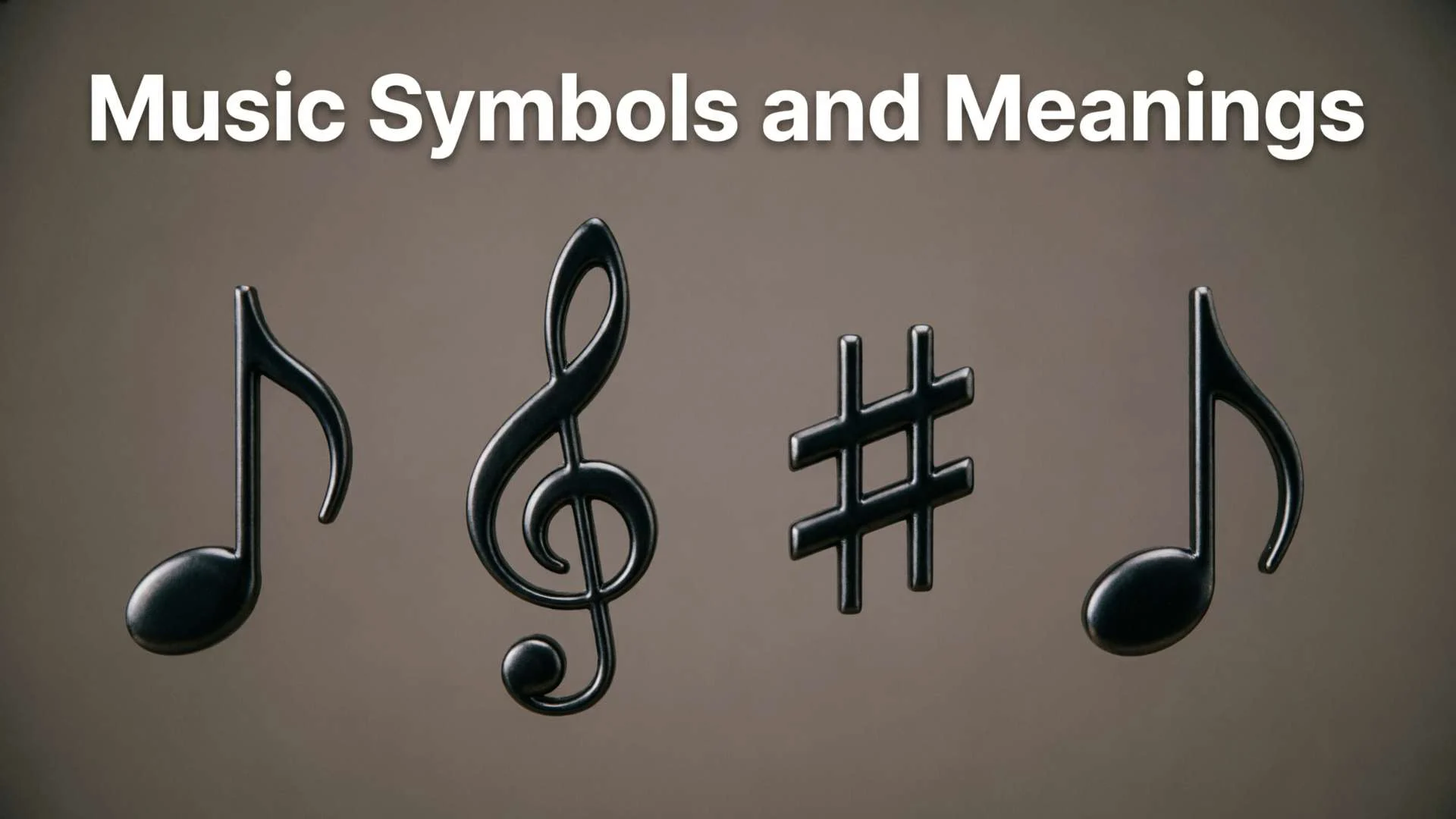
Close your eyes for a moment and imagine your favorite song. Before the melody touched your heart, before the lyrics gave it meaning, there were some quieter symbols.
Tiny marks on paper that somehow carry emotion, memory, and human expression across centuries.
Music symbols are more than technical signs. They are a secret language one that has guided composers, inspired artists, and moved entire civilizations.
In this article, you’ll discover not just what these symbols mean, but why they feel so deeply familiar… almost like they’ve always been a part of you.
What are Music Symbols and Meanings?
Music symbols are visual signs used in written music to represent sound, rhythm, timing, and expression. These symbols allow musicians to read and perform compositions accurately—even if they were written hundreds of years ago.
The system of musical notation as we know it today evolved over centuries. Early forms appeared in ancient Greece and medieval Europe, but modern notation developed during the Renaissance and became standardized over time.
At their core, music symbols serve one purpose:
👉 To turn invisible sound into something visible, shareable, and timeless.
But beyond function, these symbols carry deeper meanings. They represent order, creativity, discipline, and emotion—all woven into a universal language understood across cultures.
Deep Symbolic Meaning
🌌 Spiritual Level
On a spiritual level, music symbols represent harmony—the idea that the universe itself operates in rhythm and balance. Just like notes come together to form a melody, life’s experiences come together to create meaning.
Many believe music is a bridge between the physical and the divine. Symbols like the treble clef or notes are often seen as representations of cosmic flow and divine expression.
🧠 Psychological Level
Psychologically, music symbols give structure to emotion. They transform abstract feelings—joy, sadness, tension—into something understandable.
When we see or hear music, our brain processes patterns, rhythm, and repetition. These symbols help us make sense of emotional chaos, turning it into something beautiful and manageable.
🌍 Cultural Level
Culturally, music symbols are a shared language. A musician in Pakistan, Italy, or Japan can read the same sheet music and understand it.
They symbolize unity—proving that despite language barriers, humans share a deep connection through sound and expression.
Types / Variations of Music Symbols
🎼 Clefs
- Treble Clef (G Clef)
- Visual: Elegant, swirling symbol
- Meaning: Represents higher pitches
- Appears in: Vocal music, violin, flute
- Bass Clef (F Clef)
- Visual: Dot with two surrounding dots
- Meaning: Represents lower pitches
- Appears in: Piano (left hand), bass guitar
🎵 Notes
- Whole Note
- Visual: Hollow circle
- Meaning: Long, sustained sound
- Half Note
- Visual: Hollow circle with stem
- Meaning: Half the duration of a whole note
- Quarter Note
- Visual: Filled circle with stem
- Meaning: Basic beat in most music
⏸️ Rests
- Represent silence
- Symbolize pauses and breathing space in music
- Remind us that silence is as important as sound
🔼 Sharps (#) and 🔽 Flats (♭)
- Sharp: Raises pitch
- Flat: Lowers pitch
- Symbolically represent change, tension, and adjustment
🔁 Time Signatures
- Example: 4/4, 3/4
- Show rhythm structure
- Represent order and predictability in life
🎶 Dynamics Symbols
- p (piano): Soft
- f (forte): Loud
- Represent emotional intensity and expression
Music Symbols Across Cultures
🏛️ Ancient Greece
Music was tied to philosophy and mathematics. Symbols represented harmony in the universe.
🏰 Medieval Europe
Early notation (neumes) guided religious chants. Music symbols were deeply spiritual and connected to worship.
🕌 Islamic Golden Age
Scholars explored music theory and mathematics. While notation differed, the concept of structured sound was highly valued.
🏯 East Asian Traditions
In China and Japan, music notation used characters and symbols unique to their instruments, reflecting cultural identity.
🌎 Modern Global Culture
Today’s music symbols are universal. From classical orchestras to digital music production, they connect artists worldwide.
Music Symbols in Art, Movies & Pop Culture
Music symbols have escaped sheet music and entered everyday life:
- Movies: Often used to show creativity, passion, or emotional depth
- Paintings: Represent harmony and artistic inspiration
- Books: Symbolize hidden meaning or emotional journeys
- Tattoos: Treble clefs and notes represent love for music or personal memories
- Fashion: Used as stylish icons of creativity and individuality
They’ve become more than symbols—they’re identity markers.
Spiritual & Dream Meaning of Music Symbols
Seeing music symbols in dreams or meditation often carries deep meaning:
- 🎵 Notes → Expression of hidden emotions
- 🎼 Clefs → A new beginning or direction
- ⏸️ Rests → Need for pause or reflection
Spiritually, they may suggest alignment—your life finding its rhythm.
Positive vs Negative Meaning
✨ Positive
- Harmony
- Creativity
- Expression
- Balance
🌑 Negative
- Chaos (if rhythm is broken)
- Emotional overwhelm
- Lack of direction
Just like music can be soothing or intense, its symbols reflect both light and shadow.
Why Humans Are Attracted to This Symbol
Humans are naturally drawn to music symbols because they represent something deeply human: expression.
From childhood lullabies to emotional songs, music shapes our memories. These symbols become anchors—tiny reminders of feelings we can’t always explain.
Psychologically, we love patterns. Emotionally, we crave connection. Music symbols offer both.
They tell us:
👉 You are not alone. Your feelings have a rhythm. Your story has a melody.
FAQs
1. What are the most common music symbols?
Treble clef, bass clef, notes, rests, sharps, flats, and time signatures are the most common.
2. Why are music symbols important?
They allow musicians to read, write, and share music accurately across time and cultures.
3. What does the treble clef symbolize spiritually?
It often represents harmony, creativity, and connection to higher energy or expression.
4. Are music symbols universal?
Yes, modern music notation is understood globally, though some cultures have unique systems.
5. What does it mean to dream about music notes?
It usually reflects emotional expression, creativity, or unspoken feelings.
Conclusion
Music symbols may look small and simple but they carry the weight of human emotion, history, and connection. They are proof that something invisible sound can be captured, shared, and felt across generations.
When you see a music symbol next time, don’t just think of it as notation. See it as a whisper from the past… a message from the soul… a reminder that life, like music, is meant to be felt as much as it is understood. And maybe, just maybe, you’ve been reading this language all along without even realizing it.

Freddie Wood
Hi! I’m Freddie Wood, a storyteller at heart and a lifelong explorer of ideas. Writing has always been my way of making sense of the world, turning ordinary moments into stories that linger in your mind. I love blending emotions with adventure, and I’m fascinated by the way words can connect people across distances and experiences. When I’m not writing, you’ll find me wandering through nature, listening to music, or sketching out ideas for my next story. My goal is always to create books that stay with readers long after the last page.
Books by Freddie Wood:
-
The Hidden Path
-
Shadows of Tomorrow