
There are symbols that decorate history… and then there are symbols that haunt it.
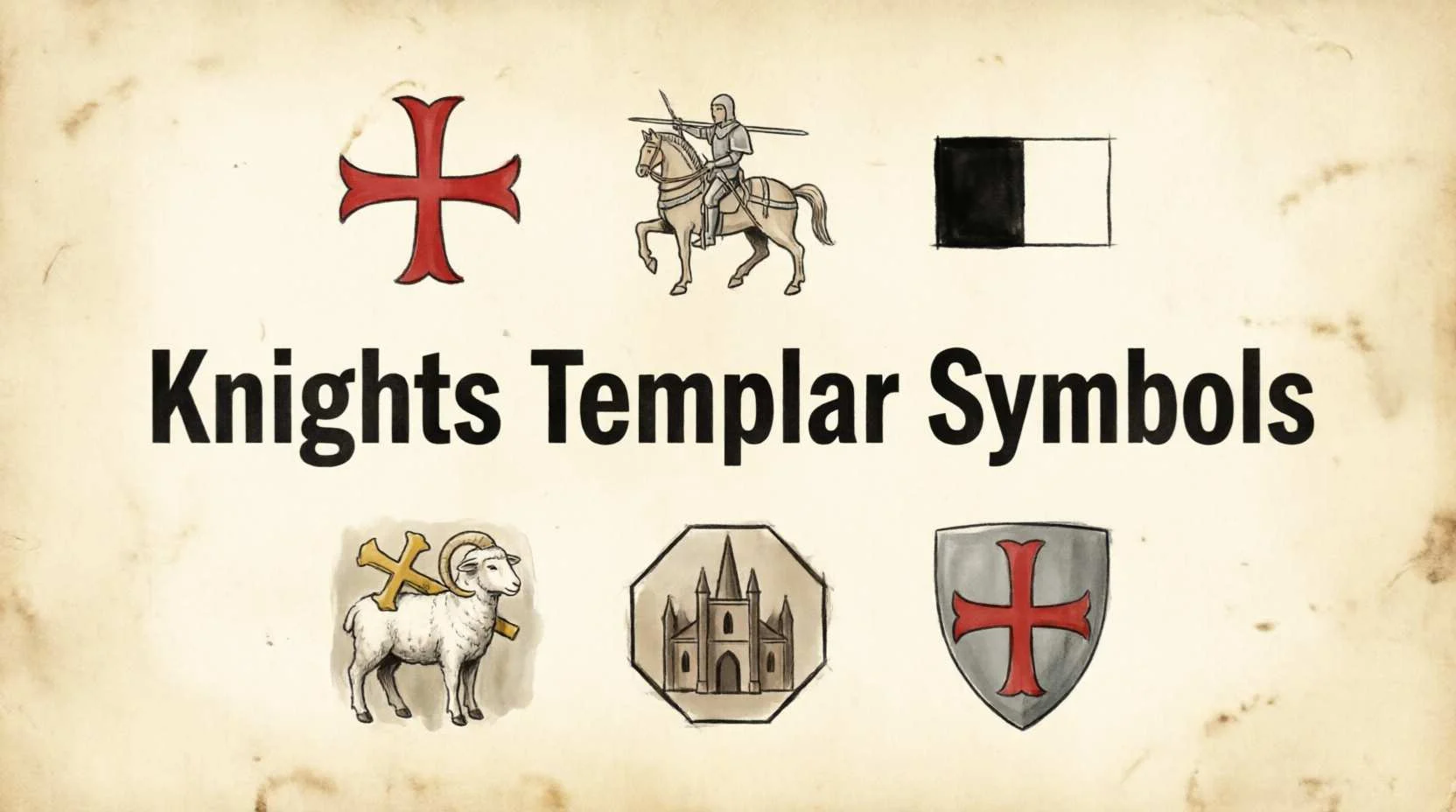
The Knights Templar symbols belong to the second kind etched into stone, carried into battle, and whispered about in secret societies centuries later.
These symbols are more than marks of identity. They are emotional anchors, spiritual codes, and powerful reflections of human belief, fear, and purpose.
If you’ve ever felt drawn to a cross, a seal, or an ancient emblem without knowing why this is where that mystery begins to unfold.
What are Knights Templar Symbols?
The Knights Templar symbols are visual emblems used by the Knights Templar, a medieval Christian military order founded around 1119 during the Crusades. Their mission was simple but dangerous: protect pilgrims traveling to the Holy Land.
But over time, they became far more than soldiers. They turned into bankers, strategists, and a powerful brotherhood surrounded by mystery.
Their symbols served many purposes:
- Identification in battle
- Representation of faith
- Codes of unity and secrecy
- Spiritual reminders of their vows
These symbols weren’t random decorations—they were deeply intentional, often carrying layered meanings connected to Christianity, sacrifice, and divine protection.
Deep Symbolic Meaning
Spiritual Level
At a spiritual level, Knights Templar symbols represent devotion, sacrifice, and divine protection. The Templars believed they were warriors of God, and their symbols acted as a bridge between earthly struggle and heavenly purpose.
The famous red cross, for example, wasn’t just a sign—it was a promise:
To fight, to serve, and if necessary, to die for faith.
Psychological Level
Psychologically, these symbols tap into something powerful:
- The desire to belong to a higher cause
- The need for identity and purpose
- The courage to face fear
When people see these symbols today, they often feel strength, mystery, or even a sense of destiny because these symbols are tied to archetypes of warriors, protectors, and seekers.
Cultural Level
Culturally, Knights Templar symbols represent mystery and authority. They are often associated with secret knowledge, hidden treasures, and conspiracies.
From medieval Europe to modern internet theories, these symbols continue to evolve—yet never lose their aura of power.
Types / Variations of Knights Templar Symbols
1. The Red Cross (Cross Pattée)
Visual: A broad cross with arms that widen at the ends, usually red on a white background
Meaning: Sacrifice, martyrdom, and faith
Where it appears: Armor, flags, shields, and churches
This is the most iconic Templar symbol. It was worn over the heart—reminding knights that their loyalty belonged to God above all.
2. The Seal of the Knights Templar
Visual: Two knights riding a single horse
Meaning: Poverty, brotherhood, and unity
Where it appears: Official documents, seals, and coins
This symbol tells a powerful story: early Templars were so poor that they shared resources even horses. It later became a symbol of trust and partnership.
3. The Beauseant (Templar Flag)
Visual: A black and white banner
Meaning: Duality good vs evil, light vs darkness
Where it appears: Battlefields and military campaigns
The contrasting colors symbolize the inner and outer struggles of life—purity mixed with imperfection.
4. The Agnus Dei (Lamb of God)
Visual: A lamb carrying a cross or banner
Meaning: Innocence, Christ, and sacrifice
Where it appears: Religious artwork and Templar insignia
This symbol connects the Templars directly to Christ, emphasizing humility despite their warrior status.
5. The Jerusalem Cross
Visual: A large cross with four smaller crosses around it
Meaning: The spread of Christianity to the four corners of the world
Where it appears: Crusader-era designs and sacred art
It reflects the mission of expansion—not just territorial, but spiritual.
Knights Templar Symbols Across Cultures
Medieval Europe
Here, the symbols represented faith, discipline, and military power. They were respected—and feared.
Middle Eastern Influence
During the Crusades, cultural exchanges influenced symbol design. Some geometric patterns and symbolic meanings show subtle Eastern inspiration.
Renaissance Era
Templar symbols became linked with secret societies and hidden knowledge, inspiring groups like the Freemasons.
Modern Western Culture
Today, these symbols are associated with mystery, conspiracy theories, and ancient secrets—often appearing in books and films.
Spiritual/New Age Culture
In modern spirituality, people interpret these symbols as protection signs or energy shields, connecting them to personal growth.
Knights Templar Symbols in Art, Movies & Pop Culture
These symbols have never faded—they’ve simply transformed.
- Movies: Often used to represent secret orders, hidden treasure, or ancient conspiracies
- Books: Frequently appear in mystery novels involving coded messages and lost knowledge
- Paintings: Depict heroic sacrifice and divine missions
- Tattoos: Chosen as symbols of strength, loyalty, and personal belief
- Fashion: Used in bold designs to convey power and mystery
They’ve become visual shorthand for something deeper:
A hidden truth waiting to be discovered.
Spiritual & Dream Meaning of Knights Templar Symbols
Seeing Knights Templar symbols in dreams or meditation can feel intense—and meaningful.
Common interpretations include:
- A call to protect something important in your life
- A reminder to stay loyal to your beliefs
- Inner strength awakening during difficult times
- A search for deeper truth or purpose
Emotionally, these symbols often appear when a person is facing a moral choice or seeking direction.
Positive vs Negative Meaning
Positive
- Courage and bravery
- Faith and devotion
- Brotherhood and unity
- Protection and purpose
Negative
- Blind obedience
- Extremism in belief
- Hidden agendas or secrecy
- Historical violence during Crusades
Like many powerful symbols, their meaning depends on perspective. What one sees as sacred, another may see as dangerous.
Why Humans Are Attracted to This Symbol
Humans are naturally drawn to symbols that represent power, mystery, and belonging.
Knights Templar symbols combine all three:
- They promise hidden knowledge
- They connect us to a heroic past
- They give a sense of identity and strength
On a deeper level, they reflect a universal human desire:
To be part of something greater than ourselves.
FAQs
What do Knights Templar symbols mean?
They represent faith, sacrifice, unity, and divine mission, often rooted in medieval Christian beliefs.
Why is the red cross important?
It symbolizes martyrdom and devotion to God, worn by knights as a sign of their sacred duty.
Are Knights Templar symbols still used today?
Yes, they appear in art, tattoos, organizations, and popular culture.
Is there a hidden meaning behind the Templar seal?
Yes, it reflects humility and brotherhood, especially the idea of sharing and unity.
Are Knights Templar symbols connected to secret societies?
Many believe so, especially in modern interpretations involving Freemasonry and conspiracies.
What does it mean to dream about Templar symbols?
It often represents inner strength, spiritual guidance, or a search for purpose.
Conclusion
The Knights Templar symbols are not just relics of the past they are living echoes of belief, struggle, and mystery.
They remind us of a time when faith could move armies, when symbols carried life-and-death meaning, and when identity was forged in both devotion and danger.
Even today, these symbols continue to speak not in words, but in feelings. They whisper of courage.

Julian Shaw
I’ve always been fascinated by the small, quiet stories that make life feel magical. Writing allows me to explore worlds that exist just beyond the everyday, where imagination meets reality. Over the years, I’ve found joy in creating characters that feel real and stories that stay with readers long after the last page. When I’m not writing, you can usually find me wandering through city streets, notebook in hand, capturing little sparks of inspiration. I believe every story has the power to connect us, to make us feel a little less alone. Sharing these tales is my way of leaving a mark on the world.
Books:
-
Whispers in the Wind
-
Shadows of Tomorrow