
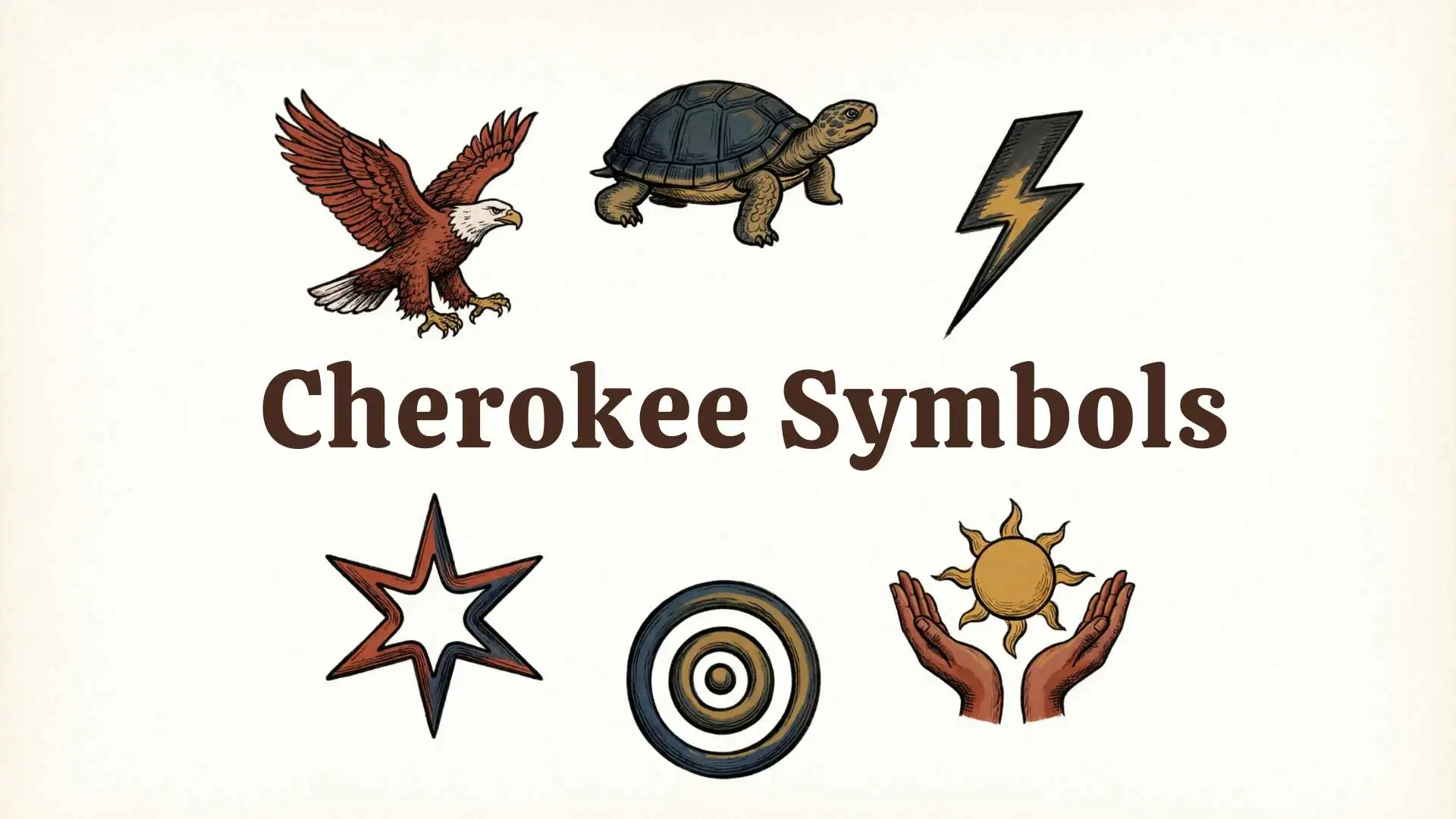
Close your eyes for a moment and imagine a symbol carved into wood, stitched into cloth, or whispered through generations.
It carries a story older than memory, one that speaks of nature, spirit and identity. Cherokee symbols are not just marks or designs; they are living expressions of a people’s connection to the earth and the unseen world.
In this article, you’ll uncover meanings that go far beyond the surface symbols that echo in dreams, guide emotions, and reveal timeless truths about human life.
What are Cherokee Symbols?
Cherokee symbols are visual representations used by the Cherokee people, one of the most prominent Indigenous tribes of North America. These symbols are deeply tied to their language, spirituality, and daily life. Unlike alphabets in modern languages, Cherokee symbols originally emerged as part of a syllabary system created by Sequoyah in the early 19th century.
But beyond written language, Cherokee symbols also include sacred signs, patterns, animals, and natural elements that represent deeper meanings—life cycles, protection, balance, and harmony with nature.
Historically, these symbols were used in:
- Storytelling and oral traditions
- Ceremonial objects and rituals
- Clothing and beadwork
- Spiritual practices
Each symbol carries a message, often rooted in the belief that everything—trees, rivers, animals, and humans—is interconnected.
Deep Symbolic Meaning
Spiritual Level
On a spiritual level, Cherokee symbols represent balance between the physical and spiritual worlds. Many symbols reflect the idea that life is a circle—beginning, ending, and beginning again. The Cherokee believe in harmony with nature, and their symbols often serve as reminders of this sacred balance.
For example, the circle is not just a shape—it represents the cycle of life, unity, and eternity.
Psychological Level
Psychologically, Cherokee symbols speak to the human need for belonging, identity, and meaning. When people connect with these symbols, they often feel grounded, as if they are rediscovering a forgotten truth about themselves.
Symbols like animals or natural elements can reflect inner emotions:
- Strength
- Fear
- Growth
- Transformation
They act almost like mirrors to the human soul.
Cultural Level
Culturally, these symbols are a powerful expression of Cherokee identity. They preserve history, traditions, and beliefs that have survived centuries of change and hardship. Each symbol is a thread in the larger story of the Cherokee people—telling who they are and where they come from.
Types / Variations of Cherokee Symbols
1. The Seven-Pointed Star
- Visual: A star with seven points
- Meaning: Represents the seven Cherokee clans
- Where it appears: Flags, jewelry, official emblems
This symbol reflects unity and the importance of community.
2. The Water Symbol
- Visual: Flowing, wave-like lines
- Meaning: Life, purification, renewal
- Where it appears: Pottery, rituals, storytelling
Water is sacred—it cleanses both body and spirit.
3. The Fire Symbol
- Visual: Flame-like patterns
- Meaning: Energy, transformation, survival
- Where it appears: Ceremonial fires, myths
Fire represents both creation and destruction—power that must be respected.
4. The Medicine Wheel (Sacred Circle)
- Visual: A circle divided into four parts
- Meaning: Balance, seasons, directions, stages of life
- Where it appears: Spiritual teachings, healing practices
It reminds us that everything is connected.
5. Animal Symbols (Totems)
- Visual: Animals like wolves, bears, eagles
- Meaning: Traits such as courage, wisdom, protection
- Where it appears: Stories, carvings, dreams
Each animal carries a unique spiritual message.
6. Feather Symbol
- Visual: A single feather
- Meaning: Honor, connection to the Creator
- Where it appears: Headdresses, ceremonies
Feathers are sacred gifts from birds, seen as messengers of the sky.
Cherokee Symbols Across Cultures
Though Cherokee symbols are rooted in Indigenous American culture, their meanings resonate across the world.
- Ancient Native American Tribes: Shared similar symbols of nature and spirit, emphasizing harmony with the earth.
- Celtic Culture: The circle and knot symbols also represent eternity and interconnectedness.
- Eastern Traditions: Concepts like balance (yin and yang) echo the Cherokee belief in harmony.
- Modern Western Culture: These symbols are often embraced in tattoos and art as representations of identity and spirituality.
- African Tribal Art: Uses symbolic patterns to tell stories and preserve cultural knowledge, much like Cherokee traditions.
Despite cultural differences, one truth remains: humans everywhere use symbols to understand life.
Cherokee Symbols in Art, Movies & Pop Culture
Cherokee symbols have quietly influenced modern creativity:
- Movies: Often used to represent Indigenous identity, wisdom, or connection to nature.
- Paintings: Artists incorporate Cherokee patterns to evoke spirituality and tradition.
- Books: Symbolism appears in literature exploring identity, ancestry, and heritage.
- Tattoos: Many people choose Cherokee symbols to express personal meaning, strength, or roots.
- Fashion: Designs inspired by Cherokee art appear in textiles and accessories.
However, it’s important to approach these symbols with respect, as they are not just decorative—they are sacred.
Spiritual & Dream Meaning of Cherokee Symbols
Seeing Cherokee symbols in dreams or meditation can feel powerful and mysterious.
- Circle or Wheel: You are seeking balance or closure in life
- Water Symbol: Emotional healing or renewal is happening
- Animal Symbols: Your subconscious is guiding you through instinct and intuition
- Feather: A message from a higher spiritual presence
These symbols often appear during moments of change, reminding you to trust the journey.
Positive vs Negative Meaning
Like all powerful symbols, Cherokee symbols carry both light and shadow.
Positive Meanings
- Harmony with nature
- Spiritual guidance
- Strength and resilience
- Unity and belonging
Negative Meanings
- Misuse or cultural appropriation
- Misinterpretation of sacred meanings
- Loss of original context
A symbol’s meaning depends on intention, understanding, and respect.
Why Humans Are Attracted to Cherokee Symbols
There’s something deeply magnetic about Cherokee symbols—and it’s not by accident.
Humans are naturally drawn to:
- Stories that connect us to something bigger
- Patterns that feel ancient and meaningful
- Symbols that reflect inner emotions
Cherokee symbols tap into all of these. They remind us of a time when life was simpler, more connected, and more sacred.
Emotionally, they offer:
- A sense of grounding
- A connection to nature
- A feeling of belonging
Psychologically, they act like anchors—helping us make sense of who we are.
FAQs
1. What do Cherokee symbols represent?
They represent spiritual beliefs, natural elements, cultural identity, and life cycles within Cherokee tradition.
2. Are Cherokee symbols the same as the Cherokee alphabet?
No. The Cherokee syllabary is a writing system, while symbols often carry deeper spiritual and cultural meanings.
3. Can anyone use Cherokee symbols?
While they can be appreciated, using them should be done respectfully, understanding their cultural significance.
4. What is the most important Cherokee symbol?
The seven-pointed star is highly significant as it represents the seven Cherokee clans.
5. Do Cherokee symbols have spiritual power?
In Cherokee belief, symbols are deeply connected to spiritual meaning and can guide, protect, or teach.
Conclusion
Cherokee symbols are more than art, they are whispers from the past, carrying wisdom into the present. They teach us about balance, respect and the invisible threads that connect all living things.
In a fast-moving world, these symbols invite us to slow down… to listen… to remember. Because somewhere deep inside, we all understand what they are trying to say.

Julian Shaw
I’ve always been fascinated by the small, quiet stories that make life feel magical. Writing allows me to explore worlds that exist just beyond the everyday, where imagination meets reality. Over the years, I’ve found joy in creating characters that feel real and stories that stay with readers long after the last page. When I’m not writing, you can usually find me wandering through city streets, notebook in hand, capturing little sparks of inspiration. I believe every story has the power to connect us, to make us feel a little less alone. Sharing these tales is my way of leaving a mark on the world.
Books:
-
Whispers in the Wind
-
Shadows of Tomorrow