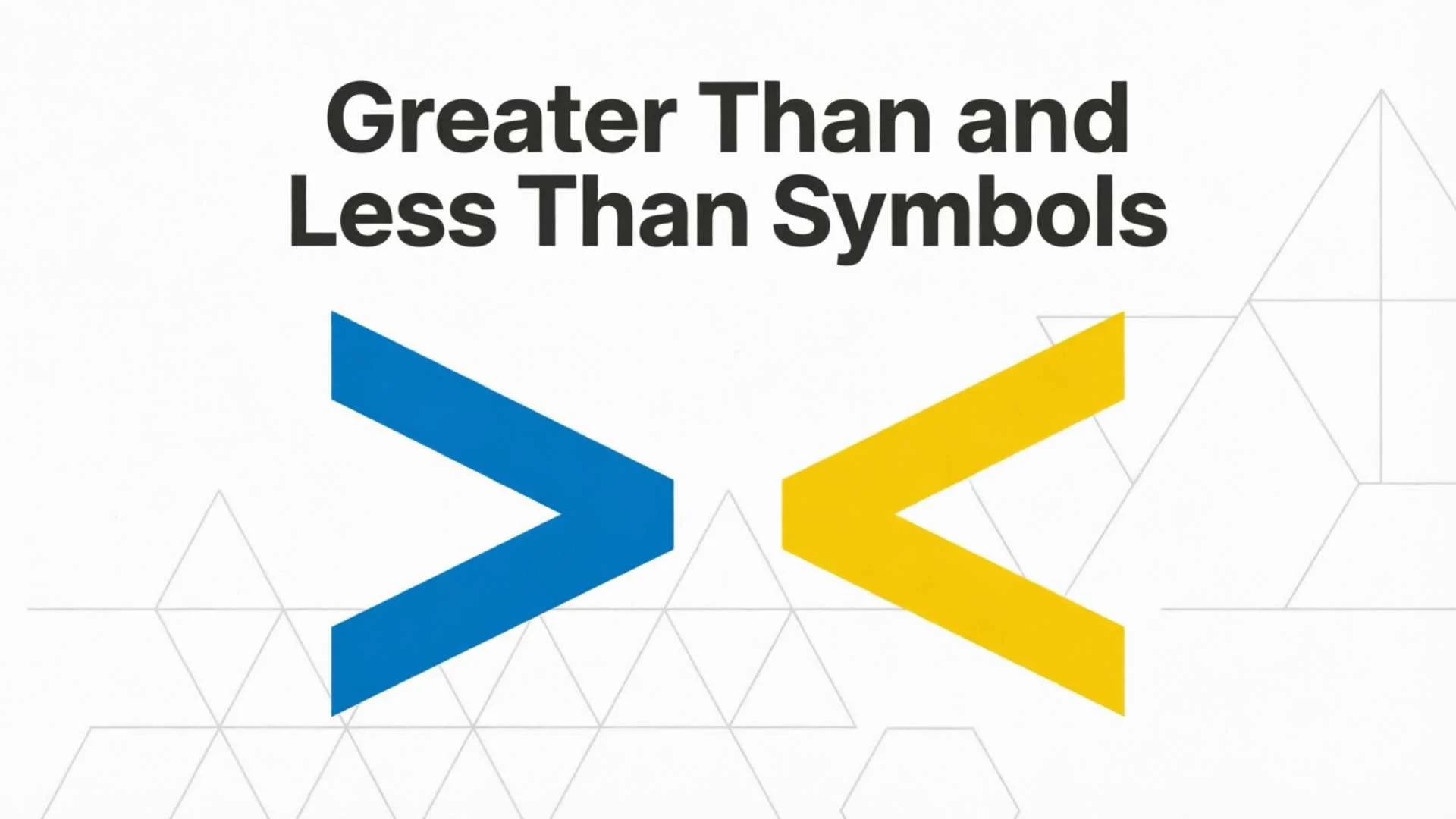
I still remember the first time I saw them, two simple symbols that somehow felt like they carried authority: > and <.
At first glance, they seemed small, almost insignificant. But over time, I realized they quietly shape how we understand value, comparison, and even truth itself.
From classrooms to coding screens, from financial decisions to philosophical thinking, these symbols influence how we judge what matters more—and what matters less.
This isn’t just about math. It’s about how humans interpret importance, hierarchy, and meaning through the simplest of signs.
Let’s explore the deeper story behind the greater than and less than symbols, a story that goes far beyond numbers.
What is Greater Than and Less Than Symbols?
The greater than (>) and less than (<) symbols are mathematical signs used to compare two values.
- Greater than (>) means one value is bigger than another
Example: 8 > 3 (8 is greater than 3) - Less than (<) means one value is smaller than another
Example: 2 < 5 (2 is less than 5)
A Brief Historical Glimpse
These symbols were introduced in the 16th century by mathematician Thomas Harriot, who needed a simple way to compare quantities. Before that, comparisons were written out in words slow, clunky, and inefficient.
Harriot’s symbols changed everything. They made comparison visual, instant, and universal.
But what’s fascinating is this: even centuries later, these symbols still shape how we think—not just mathematically, but emotionally and culturally.
Deep Symbolic Meaning
At their core, the greater than and less than symbols represent more than numerical comparison, they reflect how we understand balance, desire, and worth.
Spiritual Meaning
Spiritually, these symbols mirror the idea of alignment and imbalance.
- The open side of the symbol (like >) can represent receiving energy or abundance
- The pointed side can represent focus, direction, or intention
In many interpretations, they symbolize:
- The flow of energy from less to more
- The natural movement toward growth and expansion
Psychological Meaning
Psychologically, humans are wired to compare.
We constantly evaluate:
- Who is doing better?
- What is more valuable?
- Where do I stand?
These symbols echo that internal dialogue:
- “Am I enough?”
- “Is this better than that?”
They represent the human tendency to measure self-worth through comparison a habit as ancient as humanity itself.
Cultural Meaning
Culturally, these symbols embody hierarchy and structure.
From wealth and status to knowledge and power, societies are built on comparisons:
- More vs less
- Better vs worse
- Success vs failure
The symbols > and < have become visual shorthand for these ideas.
Types / Variations of Greater Than and Less Than Symbols
While the basic symbols are simple, there are several important variations that expand their meaning:
1. Greater Than (>)
- Visual: Open to the right, pointed to the left
- Meaning: Indicates a larger value
- Where seen: Mathematics, coding, logic systems
2. Less Than (<)
- Visual: Open to the left, pointed to the right
- Meaning: Indicates a smaller value
- Where seen: Math, education, data comparison
3. Greater Than or Equal To (≥)
- Visual: Greater than symbol with a line underneath
- Meaning: Either greater or exactly equal
- Where seen: Algebra, statistics, programming
4. Less Than or Equal To (≤)
- Visual: Less than symbol with a line underneath
- Meaning: Either smaller or equal
- Where seen: Mathematical equations, economics
5. Not Equal To (≠)
- Visual: Equal sign with a slash
- Meaning: Two values are different
- Where seen: Logic, computing, philosophy of difference
Each variation adds nuance, because comparison isn’t always absolute. Sometimes, it exists in the gray areas between equality and difference.
Greater Than and Less Than Symbols Across Cultures
Though mathematical symbols are universal today, the idea of comparison has existed across cultures for thousands of years.
Ancient Civilizations
In early societies like Mesopotamia and Egypt, comparison was expressed through trade and measurement grain, land, wealth. While symbols weren’t the same, the concept of “more vs less” was central to survival.
Greek Philosophy
Greek thinkers explored ideas of greater good vs lesser evil, laying philosophical groundwork for comparison beyond numbers.
Eastern Traditions
In Eastern philosophies, balance often mattered more than comparison. Concepts like harmony suggested that being “greater” wasn’t always ideal equilibrium was.
Medieval Europe
Hierarchies dominated society, kings above nobles, nobles above peasants. The idea of “greater than” was deeply embedded in social structure.
Modern Global Culture
Today, these symbols are everywhere:
- Finance (profits vs losses)
- Technology (algorithms and conditions)
- Education (grading and assessment)
They’ve become a universal language of comparison.
Greater Than and Less Than Symbols in Art, Movies & Pop Culture
You might not notice it, but these symbols influence creative expression in subtle ways.
Movies & Storytelling
Narratives often revolve around:
- One force being greater than another
- Growth from “less than” to “greater than”
It’s the essence of character development.
Books & Literature
Authors explore themes of:
- Worth vs inadequacy
- Power vs weakness
The emotional version of > and < plays out in every conflict.
Tattoos
Some people tattoo these symbols as reminders:
- meaning “I am greater than my struggles”
- < symbolizing humility or openness
Fashion & Design
Minimalist designs sometimes incorporate these symbols to convey:
- Direction
- Progress
- Comparison
Spiritual & Dream Meaning of Greater Than and Less Than Symbols
Seeing these symbols in dreams or meditation can carry symbolic meaning.
- Greater than (>) in dreams may represent growth, ambition, or feeling superior
- Less than (<) may reflect insecurity, humility, or feeling undervalued
In spiritual contexts, they may symbolize:
- The balance between ego and humility
- The journey from lack to abundance
Positive vs Negative Meaning
Like many symbols, these carry dual meanings.
Positive
- Growth and progress
- Clarity in decision-making
- Understanding value
Negative
- Comparison-driven insecurity
- Feelings of inadequacy
- Judgment and inequality
The same symbol that helps us measure success can also make us feel not enough.
Why Humans Are Attracted to These Symbols
Humans are natural comparers.
From childhood, we learn:
- Bigger vs smaller
- Faster vs slower
- Better vs worse
These symbols simplify complex judgments into something instantly understandable.
But there’s a deeper reason:
They reflect our inner desire to understand our place in the world.
We want to know:
- Am I growing?
- Am I succeeding?
- Where do I stand?
The symbols > and < give us a language for those questions.
FAQs About Greater Than and Less Than Symbols
1. How do I remember which symbol is greater than or less than?
A common trick: the open side of the symbol always faces the larger number.
2. Who invented greater than and less than symbols?
They were introduced by mathematician Thomas Harriot in the 1500s.
3. Why are these symbols important?
They help compare values quickly and are essential in math, science, and programming.
5. What does ≥ and ≤ mean?
They mean “greater than or equal to” and “less than or equal to.”
6. Can these symbols have emotional meaning?
Yes, they often symbolize comparison, self-worth, and personal growth.
Conclusion
At first glance, the greater than and less than symbols seem like simple tools, just a way to compare numbers. But when you look closer, they reveal something deeper about us. They mirror how we measure success, how we judge ourselves, and how we navigate a world built on comparison. Yet here’s the quiet truth:
Your worth cannot be reduced to a symbol. You are not greater than or less than, you are simply you, evolving beyond comparison. And maybe, just maybe, the real lesson these symbols teach us… is not about who is more or less, but about understanding value without losing ourselves in it.

Nora Bennett
Nora Bennett is a storyteller at heart, always finding magic in the everyday moments of life. From a young age, she discovered the joy of weaving emotions into words, creating characters that feel like old friends. Writing, for her, is both an adventure and a sanctuary—a way to explore the world and herself. She loves connecting with readers who share her passion for heartfelt stories and unforgettable journeys. When she’s not crafting her next tale, Nora enjoys quiet mornings with a cup of coffee and a notebook full of ideas. Her stories are meant to inspire, comfort, and spark imagination in everyone who reads them.
Books:
-
Whispers of Yesterday
-
Echoes of Tomorrow