Logic symbols are the silent architects of every clear thought you have ever trusted.
From the moment you decided to read this sentence instead of scrolling away, your mind was running on invisible switches, gates, and connectors that philosophers and mathematicians have spent millennia refining.
Hidden inside these tiny marks lies the entire history of human reason, the blueprint for every computer program, courtroom argument, and moment of personal clarity you have ever experienced.
What Are Logic Symbols?
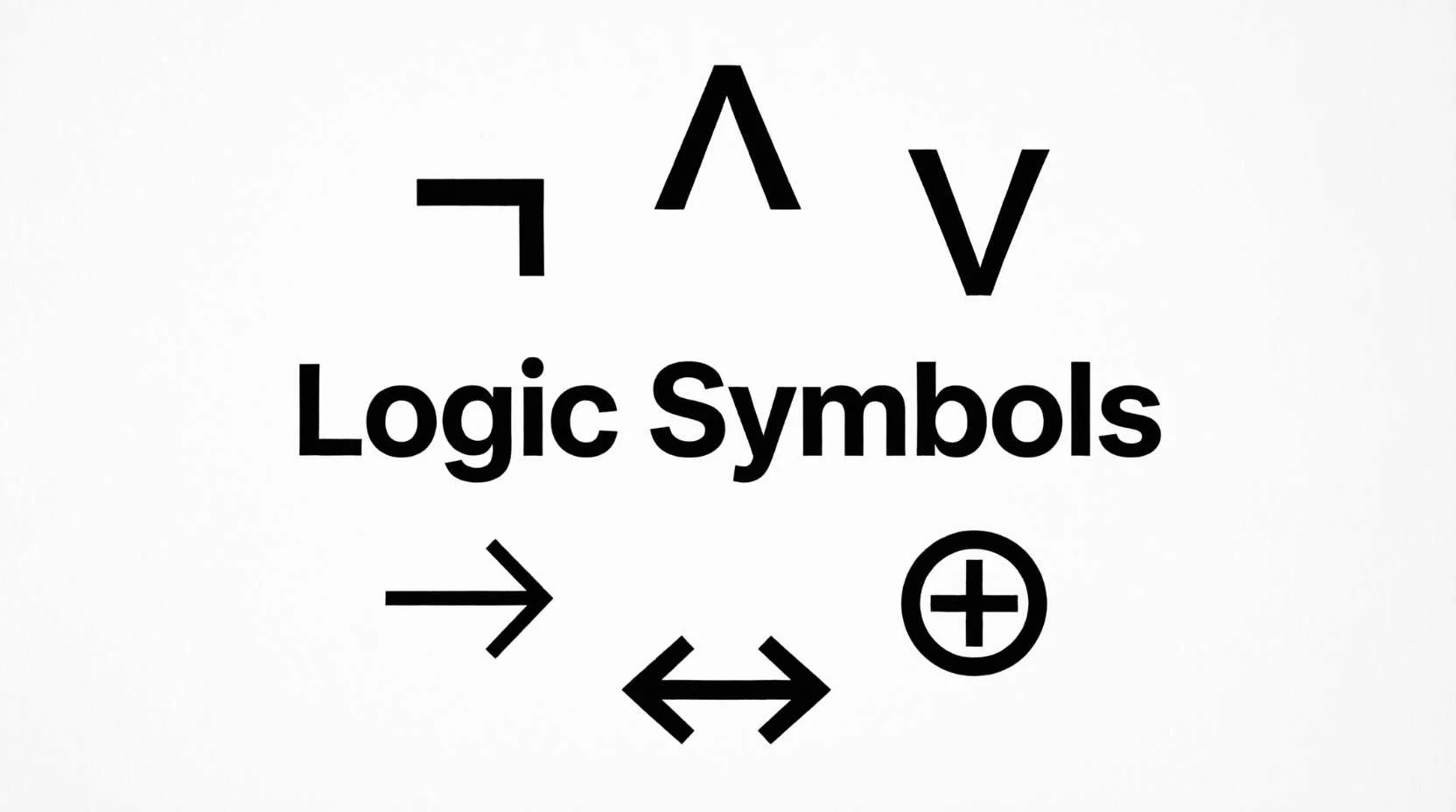
Logic symbols are visual shorthand for the fundamental operations of reasoning: and, or, not, if then, if and only if. They transform messy human language into precise, unbreakable chains of truth. A single symbol like ∧ (logical conjunction) can replace the word “but” in all its emotional complexity, stripping away feeling to reveal pure structure.
Historically, these symbols emerged from ancient Greek philosophy. Aristotle, the father of formal logic, wrote his laws in long Greek sentences. But by the 19th century, mathematicians like George Boole and Gottlob Frege realized that words betrayed thought. Emotion, ambiguity, and culture polluted meaning. So they invented a new alphabet: not for sounds, but for truth itself.
The cultural significance of logic symbols cannot be overstated. When the German logician Gottlob Frege introduced the first modern quantifier in 1879 in his Begriffsschrift, he planted the seed for artificial intelligence, programming languages, and every digital device you own. Today, logic symbols appear in everything from the code running your phone to the silent reasoning you use when you say, “If I leave now, I will catch the train.”
Deep Symbolic Meaning
The Spiritual Level
On a spiritual level, logic symbols represent the search for absolute truth. In Buddhist philosophy, the law of non contradiction (symbolized as ⊥, the falsum) mirrors the concept of sunyata: emptiness is not a thing, but the absence of thingness. When a Zen monk declares, “The cup is neither broken nor whole,” they are playing with the logical law of excluded middle (P ∨ ¬P). Logic symbols become meditation tools, forcing the mind to confront paradox.
The Psychological Level
Psychologically, logic symbols map directly onto how your brain makes decisions. The symbol ∧ (and) requires both conditions to be true, just as your mind demands both hunger and food availability before you eat. The symbol ∨ (or) operates as your internal risk calculator: this path or that path. Carl Jung would recognize the logical constant ⊤ (verum, always true) as the archetype of the Self: the unchanging witness behind all mental noise.
The Cultural Level
Culturally, logic symbols are the DNA of authority. Legal systems run on implication (→): “If the defendant knew the weapon was loaded, then intent exists.” Scientific papers hide quantifiers (∀ for “all,” ∃ for “there exists”) in plain sight. To learn logic symbols is to learn how power structures justify themselves. It is no accident that democracies teach logic in schools: an illogical citizen cannot spot a false promise.
Types and Variations of Logic Symbols
1. Conjunction (∧)
Visual description: A wedge pointing upward, like an “A” without the crossbar.
Meaning: True only when both connected statements are true. In everyday life, “I am tired ∧ I need coffee” means you only act if both conditions hold.
Where it appears: Every computer processor’s AND gate, every contract where two signatures are required, every love letter that says “I love you ∧ I choose you.”
2. Disjunction (∨)
Visual description: A wedge pointing downward, like a boat’s hull.
Meaning: True if at least one statement is true. Inclusive or exclusive? Classical logic uses inclusive (∨) meaning “or both.” Latin had vel for inclusive, aut for exclusive. English blurs them dangerously.
Where it appears: Restaurant menus (“soup ∨ salad”), criminal law (“theft ∨ fraud”), your own mind when you say “I’ll work ∨ I’ll rest.”
3. Negation (¬, ~)
Visual description: A small dash or tilde placed before a statement.
Meaning: Flips true to false, false to true. The most powerful symbol in logic. With ¬ alone, you can build every other symbol (a fact called functional completeness).
Where it appears: Every password field (“not correct”), every apology (“I did not mean it”), every spiritual awakening (“I am not my thoughts”).
4. Implication (→, ⇒)
Visual description: An arrow pointing right.
Meaning: “If P then Q.” Crucially, this is false only when P is true and Q is false. Many beginners stumble here: a false premise implies anything. “If the moon is cheese, then pigs fly” is technically true.
Where it appears: Every promise (“If you call, I will answer”), every law of physics (“If mass increases, so does gravity”), every broken heart (“If you loved me, you would have stayed”).
5. Biconditional (↔, ≡)
Visual description: A double headed arrow or three horizontal lines (like a triple bar).
Meaning: “P if and only if Q.” Both statements rise or fall together. In mathematics, this is equality. In relationships, it is mutual understanding.
Where it appears: Definitions (“A bachelor ↔ unmarried man”), encryption keys, symmetrical vows.
6. Quantifiers: Universal (∀) and Existential (∃)
Visual description: ∀ is an upside down “A.” ∃ is a backwards “E.”
Meaning: ∀ means “for all.” ∃ means “there exists at least one.” Together, they can express every statement in mathematics and science.
Where it appears: Scientific laws (“∀ objects, F = ma”), detective work (“∃ a witness who saw the car”), spiritual search (“∃ a path to peace”).
7. Logical Constants: ⊤ (verum) and ⊥ (falsum)
Visual description: ⊤ is a capital T shape. ⊥ is an upside down T (the bottom symbol).
Meaning: ⊤ is always true. ⊥ is always false. They are the alpha and omega of reasoning.
Where it appears: Computer science base cases, philosophical arguments about reality, meditation on what can never be doubted.
Logic Symbols Across Cultures
Ancient Greece: Aristotle used words, not symbols, but his syllogisms (All men are mortal; Socrates is a man; therefore Socrates is mortal) contain the blueprint. The Stoics developed early propositional logic, calling true propositions axiomata.
Medieval Islam: Scholars like Al Farabi and Avicenna refined Aristotelian logic, adding temporal modalities (always true, sometimes true). They wrote in beautiful Arabic prose, and their influence reached Europe through Andalusia.
Ancient India: Sanskrit logicians of the Nyaya school developed a five limb syllogism (proposition, reason, example, application, conclusion) that parallels Western logic but with explicit examples. Their symbol for negation was implicit in sentence structure.
Medieval Europe: Scholastics like Peter Abelard and Thomas Aquinas used Latin words (et, vel, non) but began inventing shorthand. The true explosion came with Leibniz, who dreamed of a characteristica universalis: a universal symbolic language.
Modern Global Culture: Today, logic symbols are universal. A Japanese programmer, a Brazilian judge, and a Kenyan engineer all read ∀ and ∃ identically. These symbols have achieved what no spoken language ever has: perfect cross cultural translatability.
Logic Symbols in Art, Movies and Pop Culture
Movies: In The Matrix, the red pill ∨ blue pill choice is pure disjunction (∨). Neo’s awakening is negation (¬): “You are not the One” becomes “You are the One” when falsehood flips to truth. The Oracle speaks in implications: “You will have to choose… if you want to know the truth.”
Paintings: M.C. Escher’s lithographs like Relativity visualize logical impossibilities: stairs that loop back on themselves violate transitivity (if A > B and B > C then A > C). René Magritte’s The Treachery of Images (“This is not a pipe”) is a lesson in the difference between a symbol and its referent, captured by the negation symbol.
Books: Lewis Carroll, a professional logician, filled Alice in Wonderland with logical jokes. The Cheshire Cat’s “We’re all mad here” is a universal quantifier (∀ people in Wonderland, that person is mad). In Gödel, Escher, Bach, Douglas Hofstadter uses logic symbols as characters in dialogues about consciousness.
Tattoos: People tattoo the therefore symbol (∴) to mean “I act deliberately.” Others choose ∀ for “everything happens for a reason” or ∃ for “I matter.” A semicolon tattoo (not strictly a logic symbol but cousin to the quantifier) represents negation of suicide: “My story is not over.”
Fashion: High end brands use logical symbolism as minimalist elegance. The Alexander McQueen collection Plato’s Atlantis featured implication arrows. Streetwear uses ∧ and ∨ as geometric patterns, their meaning hidden from those who do not know.
Spiritual and Dream Meaning of Logic Symbols
Seeing a logic symbol in a dream often signals a need for clarity. If you dream of the implication arrow (→), your unconscious may be working through a conditional fear: “If I fail, then I am worthless.” The biconditional (↔) in a dream appears when you seek balance: work ↔ rest, give ↔ receive.
Meditation practitioners report seeing the negation symbol (¬) as a flashing light during deep states. This represents the realization that “I am not my thoughts.” In Advaita Vedanta, the teaching “Neti, neti” (not this, not that) is a verbal negation symbol repeated until all false identities fall away.
The universal quantifier (∀) appears in peak experiences as a feeling of “allness.” Mystics from Rumi to Teresa of Avila describe “seeing everything at once.” That is ∀ in experiential form: every being, every moment, held simultaneously.
The existential quantifier (∃) appears in dreams of hope. After loss or despair, you might dream of a single glowing symbol. That ∃ means “there is still one reason to live.”
Positive vs. Negative Meanings of Logic Symbols
The same symbol can serve light or darkness depending on its use.
Conjunction (∧) positively: “I am loved ∧ I belong” builds self worth.
Conjunction (∧) negatively: “I must be perfect ∧ I must never rest” drives burnout.
Implication (→) positively: “If I breathe, then I can begin again” offers grace.
Implication (→) negatively: “If you disagree, then you are my enemy” justifies violence.
Negation (¬) positively: “I am not my diagnosis” liberates identity.
Negation (¬) negatively: “You are not enough” destroys confidence.
The biconditional (↔) can create prison cells (“Love ↔ Sacrifice”) or sacred contracts (“Respect ↔ Freedom”).
Even the falsum (⊥), the constant false, has positive use. Recognizing what is false clears ground for truth. Every scientist saying “This hypothesis is false” honors ⊥. Every person leaving an abusive relationship says, “The promise of safety was always false.”
Why Humans Are Attracted to Logic Symbols
We are drawn to logic symbols because we are drawn to certainty in an uncertain world. Your brain’s anterior cingulate cortex lights up when you resolve ambiguity. A logic symbol is a tiny machine for resolving ambiguity in one glance.
Psychologically, these symbols offer the comfort of binary truth. Life is gray; logic symbols are black and white. But that starkness is medicine for the overwhelmed mind. When you cannot decide whether to stay or leave a job, writing the decision as (P → Q) ∧ (¬P → R) calms the chaos.
There is also beauty in their minimalism. A single ∀ holds the entire concept of “everything.” A single ¬ reverses reality. We love them the way we love haiku: maximum meaning in minimum form.
Storytelling example: A woman named Elena, trapped in circular arguments with her partner, learned logic symbols. She wrote on a whiteboard: “You said (P → Q) but I observed (P ∧ ¬Q).” For the first time, her partner saw the contradiction without shame. The symbol did the judging, not Elena. Their fights became conversations. She later said, “The negation symbol saved my marriage. It let me say ‘not true’ without saying ‘you liar.’”
Frequently Asked Questions
What is the meaning of ∧ in logic?
The ∧ symbol (conjunction) means “and.” It produces a true statement only when both statements connected by it are true. For example, “It is raining ∧ it is cold” is true only if both rain and cold are happening.
What does ⊥ mean in symbolic logic?
⊥ (called falsum, bottom, or the up tack) represents a statement that is always false. It is the logical constant for falsehood, the opposite of ⊤ (verum, always true). In proofs, showing that an assumption leads to ⊥ proves the assumption false (proof by contradiction).
How do logic symbols differ from mathematical symbols?
Mathematical symbols (+, −, ×, ÷) operate on numbers. Logic symbols (∧, ∨, ¬, →) operate on truth values (true/false). However, there is deep overlap: Boolean algebra treats true as 1 and false as 0, making logic symbols a special case of arithmetic.
Can logic symbols be used in everyday writing?
Yes, but sparingly. Some philosophy and computer science textbooks use them inline. However, outside technical writing, English words (“and,” “or,” “not,” “if”) are preferred for readability. The symbols shine in diagrams, truth tables, and note taking.
What is the oldest logic symbol still in use?
The therefore symbol (∴) dates back to ancient Greek manuscripts and medieval Latin scholasticism. The because symbol (∵) is younger. But the oldest logic symbol in continuous use may be the bar for negation, which appears in Aristotle’s margin notes.
Why is learning logic symbols difficult for beginners?
Because natural language trains us to accept ambiguity. Logic symbols demand precision. For example, “or” in English can be inclusive (“sugar or cream, maybe both”) or exclusive (“you pay or you leave, not both”). Logic forces you to choose. That clarity feels restrictive until you experience its power.
Conclusion
Logic symbols are not cold. They are the most compassionate gift philosophy ever gave to the human heart. In a world that shouts contradictions and buries truth in emotion, these tiny signs offer silent clarity. The next time you feel lost, draw an implication arrow on your hand. Let it remind you: if you breathe, then hope remains. And that small truth is enough to begin again.

Julian Shaw
I’ve always been fascinated by the small, quiet stories that make life feel magical. Writing allows me to explore worlds that exist just beyond the everyday, where imagination meets reality. Over the years, I’ve found joy in creating characters that feel real and stories that stay with readers long after the last page. When I’m not writing, you can usually find me wandering through city streets, notebook in hand, capturing little sparks of inspiration. I believe every story has the power to connect us, to make us feel a little less alone. Sharing these tales is my way of leaving a mark on the world.
Books:
-
Whispers in the Wind
-
Shadows of Tomorrow