
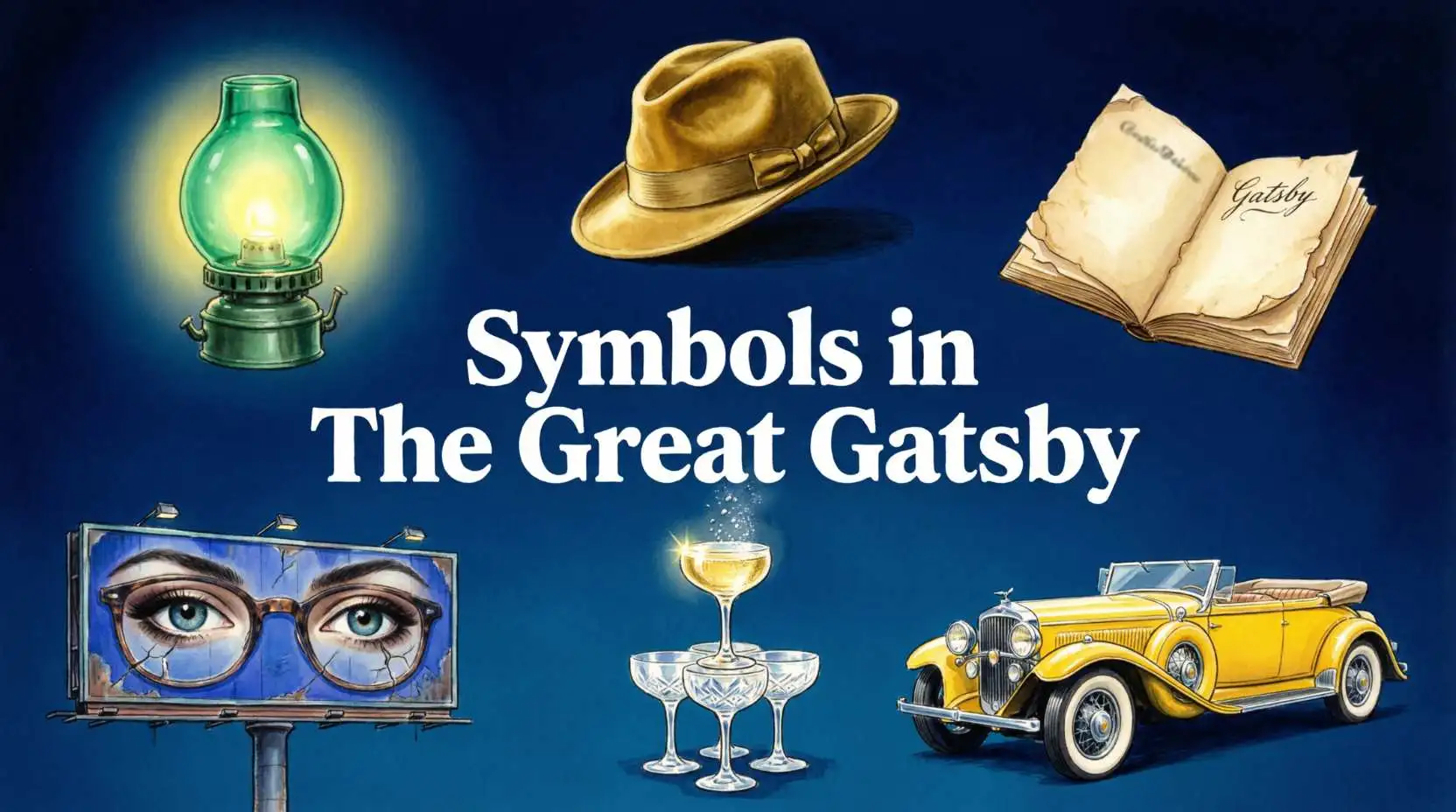
“Symbols in The Great Gatsby” are not just literary devices, they are emotional mirrors reflecting our deepest desires and fears.
From longing for success to chasing love that slips away, these symbols connect directly to human psychology and history.
They whisper truths about ambition, illusion, and identity that still shape our lives today. If you have ever chased a dream that felt just out of reach, this story already belongs to you.
In this article, you will uncover meanings hidden beneath the surface that most readers never fully see.
What Are Symbols in The Great Gatsby?
Symbols in The Great Gatsby are objects, places, colors, and characters that carry deeper meanings beyond their literal presence. Written by F. Scott Fitzgerald in 1925, the novel reflects the Jazz Age in America, a time of wealth, glamour, and hidden emptiness.
These symbols help readers understand themes like the American Dream, love, class division, and moral decay. They are not random details. Each one is carefully placed to reveal the emotional and psychological struggles of the characters.
Historically, the novel captures a moment when society was changing fast. Wealth was rising, but so was confusion about identity and purpose. Culturally, these symbols represent a universal truth, that humans often chase illusions while ignoring reality.
Deep Symbolic Meaning
Spiritual Level
On a spiritual level, the symbols represent the human soul’s endless search for meaning. The green light, for example, becomes a symbol of hope that feels divine yet unreachable. It reflects how people look for purpose beyond material success.
Psychological Level
Psychologically, these symbols reveal obsession, desire, and denial. Gatsby’s world is built on illusion. The symbols show how people create false realities to cope with pain and longing. They highlight the mind’s tendency to romanticize what it cannot have.
Cultural Level
Culturally, the symbols represent the American Dream and its failure. They expose a society that values wealth over truth. These meanings still resonate today, where success is often measured by appearance rather than reality.
Major Types and Variations of Symbols in The Great Gatsby
The Green Light
Visual description
A small green light shining across the water at the end of Daisy’s dock
Meaning
Hope, dreams, and the unattainable
Where it appears
At the end of Daisy’s dock, visible from Gatsby’s mansion
This symbol represents Gatsby’s dream of love and success. It shows how people chase goals that always seem just out of reach.
The Valley of Ashes
Visual description
A gray, lifeless wasteland covered in dust and smoke
Meaning
Moral decay and the consequences of greed
Where it appears
Between West Egg and New York City
This place reflects the dark side of wealth. It shows what happens when society ignores those left behind.
The Eyes of Doctor T. J. Eckleburg
Visual description
A large billboard with faded blue eyes watching over the valley
Meaning
Judgment, God, or the loss of spiritual values
Where it appears
Above the Valley of Ashes
These eyes symbolize a world where morality has faded. They suggest that even if society ignores truth, something still watches.
Gatsby’s Mansion
Visual description
A grand, luxurious house filled with lights and parties
Meaning
Wealth, illusion, and loneliness
Where it appears
In West Egg
The mansion shows how material success can hide emotional emptiness. Despite the glamour, Gatsby is deeply alone.
Daisy’s Voice
Visual description
Soft, charming, and enchanting
Meaning
Wealth, desire, and illusion
Where it appears
Whenever Daisy speaks
Her voice represents everything Gatsby longs for. It is beautiful but ultimately shallow, reflecting the emptiness behind wealth.
Symbols in The Great Gatsby Across Cultures
American Culture
In the United States, these symbols represent the American Dream. They show both its beauty and its failure. The dream promises success but often leads to disappointment.
Ancient Perspectives
In ancient cultures, symbols like light often represented divine truth. In Gatsby, the green light becomes a false version of that truth, showing how modern dreams can lose spiritual meaning.
European Interpretation
European readers often see the novel as a critique of capitalism. The symbols highlight how wealth can corrupt values and relationships.
Modern Global Culture
Today, these symbols are universal. People around the world relate to chasing dreams, facing inequality, and struggling with identity.
Eastern Philosophical View
From an Eastern perspective, the symbols reflect attachment and illusion. They align with ideas that desire leads to suffering when people cling to unrealistic goals.
Symbols in The Great Gatsby in Art, Movies and Pop Culture
In movies, especially film adaptations of The Great Gatsby, these symbols are visually powerful. The green light glows brighter, the parties feel louder, and the emptiness feels deeper.
In paintings and art, the Valley of Ashes inspires images of industrial decay and lost humanity.
In books, many modern stories borrow these symbols to explore themes of ambition and illusion.
In tattoos, the green light is a popular design. People use it to represent hope, dreams, or a reminder of something they cannot reach.
In fashion, the glamour of Gatsby’s world influences vintage styles, reflecting both beauty and excess.
Spiritual and Dream Meaning of Symbols in The Great Gatsby
When people dream of similar symbols, they often reflect inner desires and struggles.
A green light in a dream can symbolize hope or a goal you are chasing.
A wasteland like the Valley of Ashes may represent emotional emptiness or burnout.
Watching eyes can symbolize guilt or a feeling of being judged.
Spiritually, these symbols suggest a journey between illusion and truth. They remind us to question what we are chasing and why.
Positive vs Negative Meaning
Positive Meaning
Symbols like the green light can represent hope, ambition, and the courage to dream. They show the human ability to imagine a better future.
Negative Meaning
At the same time, these symbols reveal obsession, illusion, and moral decay. They show how dreams can become destructive when they are based on false ideas.
This dual meaning makes the symbols powerful. They reflect both the beauty and danger of human desire.
Why Humans Are Attracted to These Symbols
Humans are naturally drawn to symbols because they simplify complex emotions. The symbols in The Great Gatsby connect deeply to universal experiences.
Everyone has chased something they could not fully reach. Everyone has felt the pull of success, love, or identity. These symbols capture those feelings in a way that words alone cannot.
Psychologically, symbols allow people to project their own experiences onto a story. Emotionally, they create a sense of connection.
That is why readers keep returning to this novel. It does not just tell a story, it reflects the reader’s own life.
FAQs
What is the most important symbol in The Great Gatsby?
The green light is considered the most important symbol because it represents Gatsby’s dreams and the idea of the American Dream itself.
What does the Valley of Ashes symbolize?
It symbolizes moral decay and the consequences of wealth and industrialization on society.
Why are the eyes of Doctor T. J. Eckleburg important?
They represent judgment and the loss of spiritual values in a materialistic world.
How do symbols support the theme of the American Dream?
They show both the hope and failure of the dream, revealing how it can become an illusion.
What does Gatsby’s mansion symbolize?
It represents wealth and success on the surface, but also loneliness and emptiness underneath.
Conclusion
Symbols in The Great Gatsby are not just elements of a story, they are reflections of the human soul. They reveal how dreams can inspire us and destroy us at the same time.
Through these symbols, we see the beauty of hope and the danger of illusion. The novel quietly asks a question that still matters today, what are you truly chasing, and is it real?

Freddie Wood
Hi! I’m Freddie Wood, a storyteller at heart and a lifelong explorer of ideas. Writing has always been my way of making sense of the world, turning ordinary moments into stories that linger in your mind. I love blending emotions with adventure, and I’m fascinated by the way words can connect people across distances and experiences. When I’m not writing, you’ll find me wandering through nature, listening to music, or sketching out ideas for my next story. My goal is always to create books that stay with readers long after the last page.
Books by Freddie Wood:
-
The Hidden Path
-
Shadows of Tomorrow