Every family holds secrets. Some whispered across dinner tables. Some buried in silence. And some drawn in a language so ancient, so revealing, that just one symbol can unlock three generations of pain, love, trauma, and triumph. That language is written in genogram symbols.
Imagine holding a map not of cities or rivers, but of your own bloodline. A map that shows who betrayed whom, who died of a broken heart, who passed down courage like an heirloom, and who still haunts the empty chair at family gatherings. This is not fantasy. This is the quiet power of genogram symbols. And once you learn to read them, you will never see your family the same way again.
What Are Genogram Symbols?
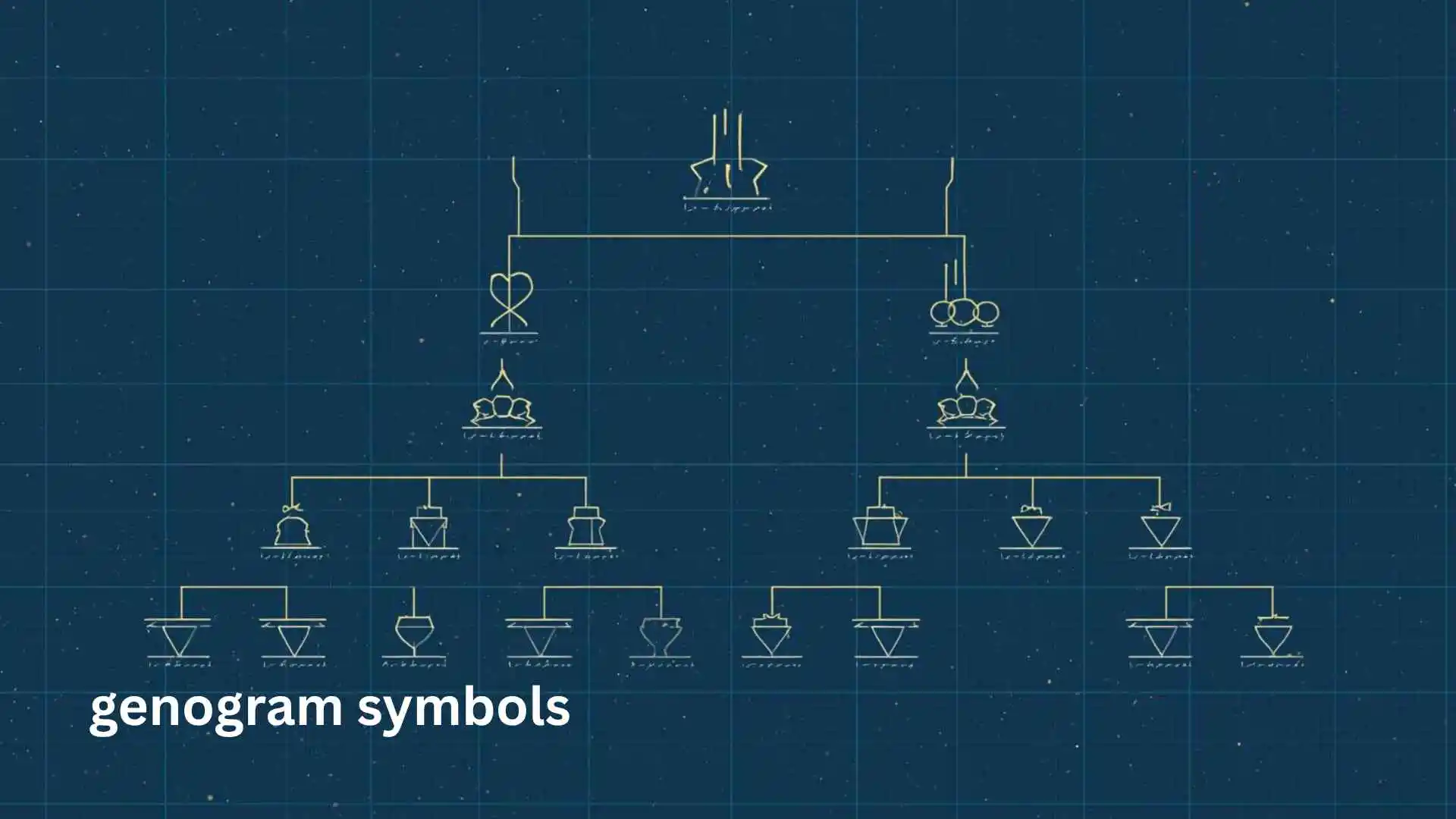
A genogram is far more than a family tree. While a standard tree simply records names and birth dates, a genogram captures the emotional and psychological architecture of a family. It is a visual language created in the 1970s by psychiatrist Murray Bowen and later refined by Monica McGoldrick and Randy Gerson. Genogram symbols transform complex human relationships into simple geometric shapes, lines, and patterns.
At its core, a genogram uses three foundational symbols: squares for males, circles for females, and horizontal or vertical lines to represent marriage, divorce, separation, or death. But the true depth lies in the variations. These symbols appear in clinical psychology, social work, genetic research, and even spiritual counseling. Culturally, they represent humanity’s eternal attempt to map connection. From medieval European heraldry to Indigenous Australian songlines, we have always tried to draw the invisible threads between souls.
Deep Symbolic Meaning of Genogram Symbols
A Spiritual Level
Spiritually, genogram symbols represent karma and legacy. A triangle drawn around a family member often signifies the scapegoat. In many traditions, the scapegoat carries the family’s hidden shame. When you see that triangle on a genogram, you are looking at a soul chosen by unconscious family forces to suffer so others could feel clean. What Christianity calls “bearing the cross,” family systems call “projection.” The symbol becomes a holy wound drawn on paper.
A Psychological Level
Psychologically, each genogram symbol mirrors internal family systems. A double horizontal line through a marriage represents divorce, but it also represents emotional cutting. It says, “We once shared a circle and a square. Now we are separated by a scar.” A dotted line around a child indicates adoption. That broken border speaks of belonging and longing. It whispers, “I was chosen, but I was also given away.” These symbols are not cold data. They are frozen emotions.
A Cultural Level
Across cultures, genogram symbols function as modern hieroglyphs. In Latin American families, a shaded circle might represent a curandera or healer. In Japanese genograms, a small black dot beside a name often marks a hikikomori — someone who has withdrawn from social life. In African American genograms after the Great Migration, a jagged line sometimes represents the rupture of families moving from South to North. The symbols absorb collective trauma and resilience.
Types and Variations of Genogram Symbols
Understanding genogram symbols means mastering their variations. Here are the most important ones.
The Basic Structural Symbols
Square and Circle
Visual description: A solid square for male, solid circle for female.
Meaning: Biological sex assigned at birth.
Where it appears: Every genogram. Medical charts, therapy intake forms, genealogy reports.
Triangle
Visual description: A triangle drawn around the square or circle.
Meaning: Identified patient or family scapegoat — the person who carries the family’s symptoms.
Where it appears: Family therapy, addiction counseling, trauma work.
X through the shape
Visual description: A bold X crossing out the square or circle.
Meaning: Deceased.
Where it appears: Any genogram tracking loss, grief, or inherited trauma.
Emotional Relationship Symbols
Double horizontal line
Visual description: Two parallel lines between two shapes.
Meaning: Marital bond.
Where it appears: All relationship mapping.
Double line with a single slash
Visual description: Two lines with one diagonal slash through them.
Meaning: Separation.
Where it appears: Families with ambiguous loss, divorce pending.
Double line with two slashes
Visual description: Two parallel lines crossed by two diagonal slashes.
Meaning: Divorce.
Where it appears: High-conflict families, custody genograms.
Jagged line
Visual description: A zigzag line connecting two symbols.
Meaning: Conflictual relationship.
Where it appears: Domestic violence assessments, sibling rivalry mapping.
Three parallel lines
Visual description: Three equal lines between shapes.
Meaning: Very close or fused relationship.
Where it appears: Enmeshed families, codependency patterns.
Dotted line
Visual description: Broken or dashed line.
Meaning: Distant or emotional cutoff.
Where it appears: Estranged parents and children, adopted individuals and birth families.
Medical and Genetic Symbols
Half shaded circle/square
Visual description: One half dark, one half light.
Meaning: Carrier of a genetic trait without symptoms.
Where it appears: Cancer genetics, cystic fibrosis mapping, hereditary counseling.
Diagonal line through shape
Visual description: A line from top left to bottom right.
Meaning: Living with a physical or mental disability.
Where it appears: Disability studies, neurodiversity affirming genograms.
Genogram Symbols Across Cultures
No single culture owns the language of genogram symbols. But each civilization has shaped its meaning.
Ancient China
Family diagrams in imperial China used red circles for male ancestors and yellow squares for females — the reverse of modern Western genograms. Red symbolized yang energy. Yellow symbolized yin. When a child died before age seven, they drew no symbol at all, only a small dot. That dot represented a soul who had not yet fully entered the world of the living.
Medieval Europe
Heraldic family trees used animals instead of geometric shapes. A lion meant a warrior ancestor. A dove meant a clerical line. But the most powerful symbol was the broken chain drawn between two generational branches. That chain marked a family member excommunicated from the church or banished from the village. It is the medieval version of today’s dashed line for emotional cutoff.
Indigenous Māori (New Zealand)
The whakapapa is not drawn with squares and circles. It is chanted. But when adapted to genogram symbols, Māori practitioners often replace the standard male square with a marae shape (a small open courtyard) and the female circle with a waka (canoe). The marae represents standing and speaking. The waka represents journey and birth. These symbols transform genograms from cold science into living poetry.
Modern Scandinavia
In Swedish and Norwegian social work, genogram symbols often include a small crown above the square or circle for anyone who has completed folkhögskola (folk high school) — a uniquely Nordic institution for adult learning. The crown symbolizes not royalty but dignity after hardship. It says, “This person learned again after breaking.”
Middle Eastern Families
In Arabic genograms, a black dot inside a circle represents a hijabi woman. A small crescent beside a square represents a man who has completed the Hajj pilgrimage. These adaptations show how genogram symbols absorb religious identity without losing their clinical power.
Genogram Symbols in Art, Movies, and Pop Culture
Art imitates life, and life imitates genograms.
Movies
In Ordinary People (1980), the therapist Dr. Berger draws a genogram with Timothy Hutton’s character. The symbol for his dead brother appears with an X. But then Dr. Berger adds a faint pencil outline around the X — an unofficial genogram symbol meaning “ghost presence.” The camera holds that symbol for seconds longer than expected. Viewers feel the weight of the unseen.
Paintings
Frida Kahlo’s painting My Grandparents, My Parents, and I is a visual genogram. She uses no standard symbols but paints a sperm and egg floating above her parents. In genogram language, that floating connection represents a cutoff with ambivalence. Kahlo draws herself neither fully connected nor fully separate. She invents her own genogram symbols because the standard ones could not hold her pain.
Books
In Yaa Gyasi’s Homegoing, the novel itself is a literary genogram. Each chapter represents a generation. But Gyasi uses fire as a recurring symbol. In genogram terms, the fire is a repeating relational pattern — trauma passed from mother to daughter. The page becomes a genogram drawn in flames.
Tattoos
Among family therapists, getting a genogram symbol tattooed is a growing trend. Most common: a small hollow circle for a child lost to miscarriage or stillbirth. The hollow center represents the absence that remains present. One therapist in Oregon has a dotted line tattooed on her wrist connecting her grandmother’s name to her own — a reminder that distance does not mean disconnected.
Fashion
The 2021 Alexander McQueen collection featured embroidered squares and circles arranged like a genogram across a black velvet gown. The designer’s statement read: “We wear our ancestors.” The fashion world had accidentally discovered what family therapists have always known. Genogram symbols are not clinical. They are sacred.
Spiritual and Dream Meaning of Genogram Symbols
When genogram symbols appear in dreams or meditation, their meaning shifts from factual to symbolic.
Seeing a square in a dream
A square represents the masculine, the structured, the unexpressed. If the square appears empty, the dreamer may be disconnected from paternal lineage. If the square is cracked, the dreamer carries unhealed father wounds.
Seeing a circle in a dream
The circle is the feminine, the womb, the container of emotion. A floating circle without connection lines suggests a mother who was physically present but emotionally absent. A broken circle suggests miscarriage or abortion energy still alive in the family field.
Seeing an X in meditation
The X over a shape in a waking meditation often represents a death the dreamer never fully grieved. But in some spiritual traditions, the X is not an ending. It is a crossing point. The X marks where the living and dead can meet. That is why some therapists now use a dotted X to represent ancestors who are both dead and present.
Seeing a triangle around yourself
If you dream of a triangle surrounding your own symbol, you have identified yourself as the family scapegoat. This dream is a call to step outside the triangle. Not to deny the family pattern, but to stop letting it define you.
Positive vs Negative Meaning of Genogram Symbols
Every genogram symbol carries both light and shadow. The same shape can represent strength or suffering depending on context.
The Double Line (Marriage)
Positive: Commitment, chosen family, safety.
Negative: Enmeshment, loss of self, obligation without love.
The Dashed Line (Emotional Cutoff)
Positive: Healthy boundaries, escape from abuse, self preservation.
Negative: Unresolved grief, silent generational curses, loneliness.
The Triangle (Scapegoat)
Positive: The scapegoat is often the most aware member of the family. They break cycles. They leave. They heal.
Negative: The scapegoat carries shame that was never theirs. They are exiled from belonging.
The X (Death)
Positive: Release from suffering, end of a painful lineage pattern, ancestor becoming a guide.
Negative: Unfinished business, sudden loss, words left unsaid.
The Shaded Shape (Genetic Carrier)
Positive: Awareness, prevention, breaking silence around hereditary illness.
Negative: Fear of passing down something broken, survivor’s guilt, predictive shame.
The most beautiful truth of genogram symbols is that they do not judge. They simply hold space for paradox. A family can be both loving and wounding. A person can be both free and alone. The genogram draws both truths with the same line.
Why Humans Are Drawn to Genogram Symbols
We are pattern seeking animals. But more than that, we are meaning making animals. Genogram symbols satisfy a primal need to see invisible structures made visible.
Psychological attraction
Carl Jung wrote that humans project meaning onto symbols when literal language fails. Genogram symbols succeed where words stumble. How do you say “my mother loved me but could not hold me” in a sentence? That sentence is paragraphs long. In a genogram, it is a dotted line. One symbol holds a library of feeling.
Emotional storytelling
Every person who draws their genogram for the first time cries. Not because the symbols are sad, but because the symbols tell the truth. A young woman sees her grandmother’s circle with an X and remembers the cancer. A grandfather sees the triangle around his son and realizes for the first time that his son was the family’s emotional garbage can. The symbols do not create pain. They reveal pain that was already there, waiting for permission to be seen.
Spiritual longing
We are drawn to genogram symbols because we want to know where we came from. Not just names and dates, but emotional origins. Who loved too much? Who could not love at all? Who left too early? Who stayed too long? These symbols answer questions that DNA tests cannot. They map the soul of a family.
FAQs About Genogram Symbols
1. What is the difference between a genogram and a family tree?
A family tree records biological relationships and basic facts like birth and death. A genogram uses specialized symbols to show emotional patterns, relationship quality, medical history, and psychological dynamics across at least three generations.
2. What does a triangle in a genogram mean?
A triangle drawn around a square or circle identifies the family scapegoat or “identified patient.” This person unconsciously carries the family’s unresolved emotional problems, addictions, or symptoms so that other members can remain stable.
3. How do you show a miscarriage on a genogram?
A small hollow circle (not attached to any line) placed between the parents with a diagonal line through it. Some genogram practitioners also add a small X inside the hollow circle to represent a stillbirth after 20 weeks.
4. Can genogram symbols change meaning across cultures?
Yes. While basic shapes (square for male, circle for female) are widely standardized, many cultures adapt symbols. For example, some Indigenous genograms use animal symbols, and Middle Eastern genograms may include religious markers like the crescent for Hajj pilgrims.
5. What does a jagged line mean between two family members?
A jagged or zigzag line represents a conflictual relationship. This can range from frequent arguments to physical violence. The more jagged the line, the more severe the conflict. Some therapists use multiple jagged lines for severe abuse.
6. How do you show an adopted child in genogram symbols?
Draw a dotted line around the child’s circle or square for adopted child. Draw a solid line from the adoptive parents but write “adopted” near the dotted border. For the biological parents, draw a dashed vertical line downward to indicate genetic connection without legal or emotional custody.
Conclusion
Genogram symbols are not clinical abstractions. They are love letters written in geometry. They are grief drawn as lines. They are hope hidden inside a hollow circle. Every family has a story too large for words. Those stories live in the space between squares and circles, in the weight of a double line broken by a single slash, in the silence of a dotted line that never quite reaches the next generation. When you learn to read these symbols, you learn to read the heart of your own bloodline. And in that reading, you finally find the power not just to understand your family, but to heal it.

Julian Shaw
I’ve always been fascinated by the small, quiet stories that make life feel magical. Writing allows me to explore worlds that exist just beyond the everyday, where imagination meets reality. Over the years, I’ve found joy in creating characters that feel real and stories that stay with readers long after the last page. When I’m not writing, you can usually find me wandering through city streets, notebook in hand, capturing little sparks of inspiration. I believe every story has the power to connect us, to make us feel a little less alone. Sharing these tales is my way of leaving a mark on the world.
Books:
-
Whispers in the Wind
-
Shadows of Tomorrow