
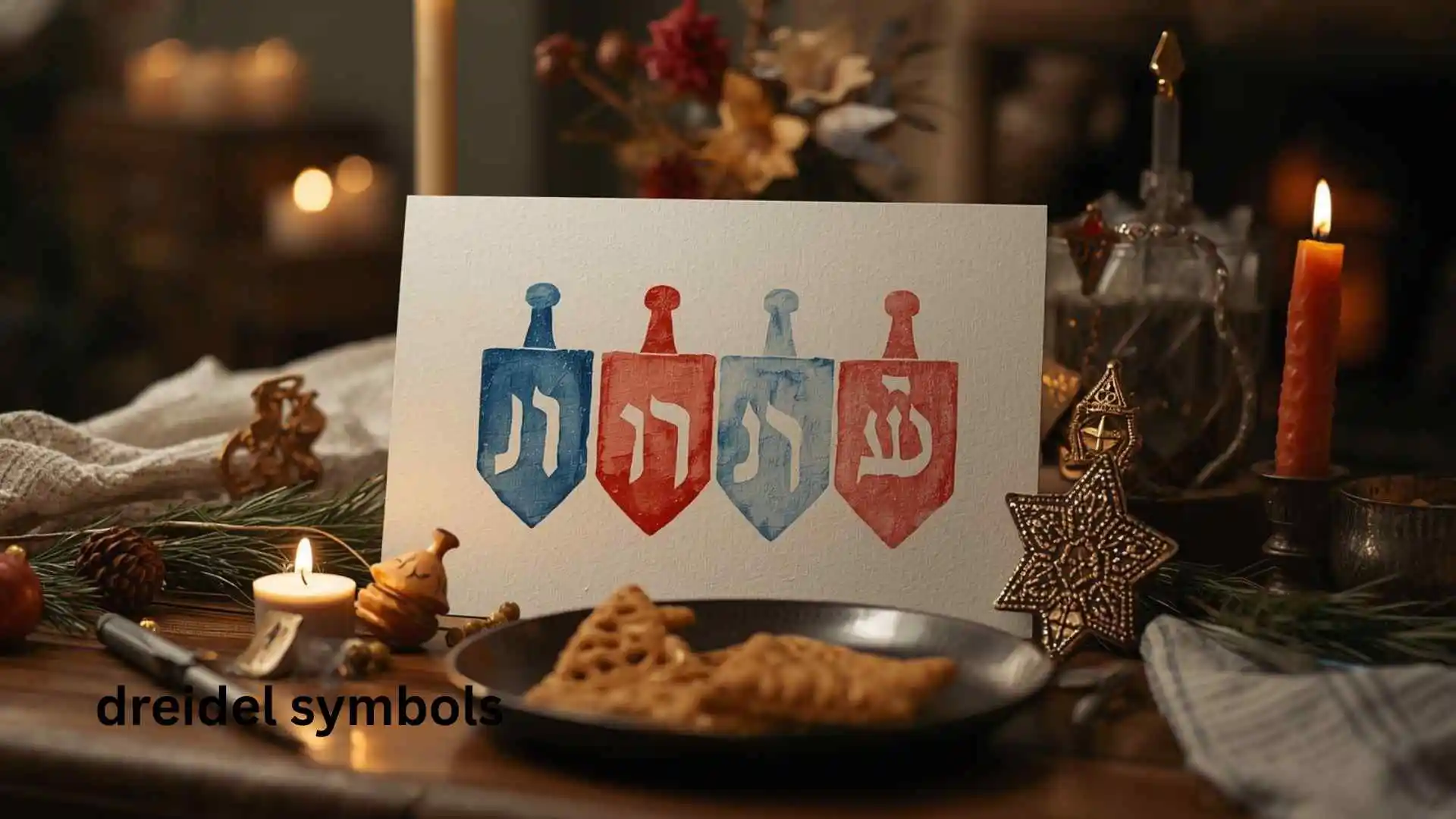
A small spinning top made of wood or metal at first glance, the dreidel looks like just a children’s game. But for centuries, it has carried stories of survival, hope, and quiet resistance during times of fear.
When families gather and the dreidel spins, it is not just a game of chance—it is a living memory of history and identity passed through generations.
Behind its four simple symbols lies a world of meaning that connects psychology, spirituality, and cultural resilience in ways most people never realize.
This article uncovers the hidden depth behind dreidel symbols and why they continue to hold emotional power even today.
What are Dreidel Symbols?
Dreidel symbols are the four Hebrew letters found on the sides of a traditional spinning top used during the Jewish festival of Hanukkah.
These letters are:
- נ (Nun)
- ג (Gimel)
- ה (Hei)
- ש (Shin)
Together, they form the phrase “Nes Gadol Haya Sham,” which means “A great miracle happened there.”
Historically, the dreidel was more than a toy. It became a symbolic tool of cultural preservation during times when practicing Jewish traditions was restricted. On the surface, it looked like a harmless game, but it quietly protected identity and faith.
Deep Symbolic Meaning of Dreidel Symbols
Spiritual Meaning
On a spiritual level, dreidel symbols represent divine presence hidden within everyday life.
Each spin symbolizes uncertainty, reminding believers that life unfolds through a mix of chance and faith. The letters reflect a miracle that cannot always be seen but is always believed.
Psychological Meaning
Psychologically, the dreidel represents coping with uncertainty.
Life rarely feels predictable, and the spinning motion mirrors human experiences of risk, hope, and emotional surrender.
It teaches acceptance—sometimes we win, sometimes we lose, but meaning is found in the process itself.
Cultural Meaning
Culturally, dreidel symbols represent survival under pressure.
During historical periods of oppression, Jewish communities used the dreidel as both a game and a coded expression of identity. It became a quiet act of resistance disguised as play.
Types / Variations of Dreidel Symbols
1. Nun (נ)
- Visual: Simple curved Hebrew letter
- Meaning: “Nothing happens” (no win or loss in the game)
- Symbolism: Stillness, neutrality, patience
- Where it appears: Jewish cultural games, educational traditions
2. Gimel (ג)
- Visual: Angular, strong-looking letter
- Meaning: “Get everything”
- Symbolism: Reward, fullness, unexpected blessing
- Where it appears: Hanukkah traditions, storytelling games
3. Hei (ה)
- Visual: Open structure with a gap
- Meaning: “Take half”
- Symbolism: Balance, sharing, moderation
- Where it appears: Cultural teachings about fairness and exchange
4. Shin (ש)
- Visual: Three-pronged shape
- Meaning: “Put in”
- Symbolism: Contribution, sacrifice, investment in the future
- Where it appears: Ritual storytelling, cultural symbolism
Dreidel Symbols Across Cultures
Jewish Tradition
In Jewish culture, dreidel symbols are deeply tied to Hanukkah and the miracle of the oil that lasted eight days.
Ancient Symbolic Games
Similar spinning-top games existed in ancient Greece and Rome, often used for gambling or decision-making, though without spiritual meaning.
European Medieval History
In medieval Europe, Jewish communities adapted the dreidel as a disguised educational tool during times of restriction.
Modern Western Culture
Today, dreidel symbols appear in holiday decorations, educational toys, and cultural awareness programs, symbolizing diversity and tradition.
Global Pop Culture
In modern global culture, the dreidel is often used in films, cartoons, and holiday storytelling as a symbol of festive tradition and identity.
Dreidel Symbols in Art, Movies & Pop Culture
Dreidel symbols often appear in:
- Films: As Hanukkah representations in family scenes
- Paintings: Depicting traditional Jewish life and celebrations
- Books: As metaphors for fate and faith
- Tattoos: Representing heritage, identity, and resilience
- Fashion: Used in holiday-themed clothing and jewelry
In these forms, the dreidel becomes more than a game—it becomes a visual story of belonging.
Spiritual & Dream Meaning of Dreidel Symbols
In dreams, seeing a dreidel can symbolize uncertainty in life decisions.
- A spinning dreidel may reflect emotional confusion or transition
- A falling dreidel may symbolize lost control or fear of outcomes
- A stable dreidel may represent balance and clarity
Spiritually, it can represent cycles of life, destiny, and divine timing—reminding the dreamer that life is always in motion.
Positive vs Negative Meaning of Dreidel Symbols
Positive Meaning
- Hope during hardship
- Miracles and blessings
- Cultural survival
- Joy and celebration
Negative Meaning
- Uncertainty and risk
- Loss or imbalance
- Dependence on chance
- Emotional instability
The dual meaning shows that the same symbol can represent both joy and struggle depending on context.
Why Humans Are Attracted to Dreidel Symbols
Humans are naturally drawn to spinning motion and symbolic objects.
From a psychological perspective, the dreidel represents:
- The unpredictability of life
- The hope for better outcomes
- The emotional comfort of tradition
On a deeper level, it connects people to ancestry and memory. Even those outside the culture often feel a sense of curiosity and warmth when they see it, because it reflects universal human experiences—chance, hope, and meaning.
FAQs About Dreidel Symbols
1. What do the dreidel symbols mean?
They represent the Hebrew phrase “A great miracle happened there.”
2. Why are there four dreidel symbols?
Each symbol represents a different game outcome and a letter in the miracle phrase.
3. Is the dreidel only used during Hanukkah?
Yes, it is mainly associated with Hanukkah traditions.
4. What is the spiritual meaning of a dreidel?
It symbolizes faith, miracles, and life’s unpredictability.
5. Are dreidel symbols religious?
They are cultural-religious symbols connected to Jewish history and tradition.
6. What does spinning a dreidel represent?
It represents chance, fate, and the flow of life.
7. Why is the dreidel important today?
It preserves cultural identity and teaches historical memory through play.
Conclusion
Dreidel symbols are far more than decorative letters on a spinning toy—they are living echoes of history, resilience, and belief.
They carry the memory of survival disguised as play, and they remind us that even in uncertainty, meaning can still be found.
Every spin tells a story: of chance, of hope, and of a miracle that \to live in human memory across generations.
Discover More topics:
- The Secret Language of Circuits | How Wiring Diagram Symbols Map the Human Need for Order
- Vow of the Disciple Symbols | The Sacred Marks of Eternal Promise

Sophia Reed
Hi, I’m Sophia Reed, a storyteller at heart who finds magic in everyday moments. Ever since I could hold a pen, I’ve been weaving tales that explore love, courage, and the unexpected twists of life. Writing allows me to connect with readers on a deeper level, sharing emotions and experiences that resonate across worlds. When I’m not lost in my stories, you can find me wandering through quiet streets, sipping coffee, or dreaming up my next plot twist. I believe every story has the power to inspire, heal, and transport. Through my books, I hope to leave a piece of my imagination with you.
Books:
-
Whispers of the Heart
-
Shadows and Sunlight