
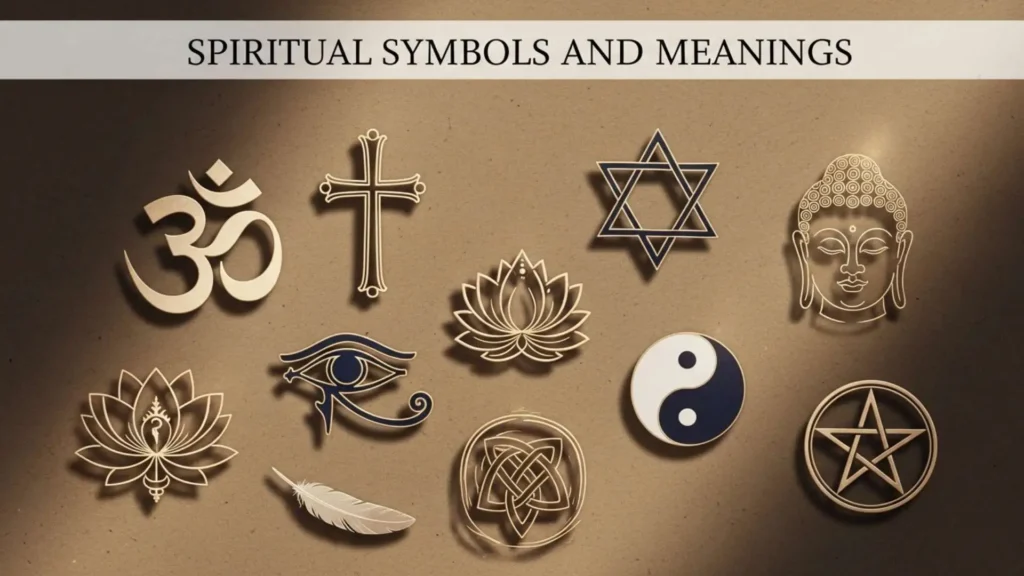
“Spiritual symbols and meanings”have shaped the human story since the first cave paintings touched stone.
Across continents and centuries, people have turned to sacred signs to explain life, death, love, fear, and hope.
These symbols speak a language deeper than words, reaching into our subconscious and awakening something ancient within us.
In this guide, you will uncover the hidden layers behind the most powerful spiritual symbols and discover meanings you may have never truly seen before.
What Are Spiritual Symbols and Meanings?
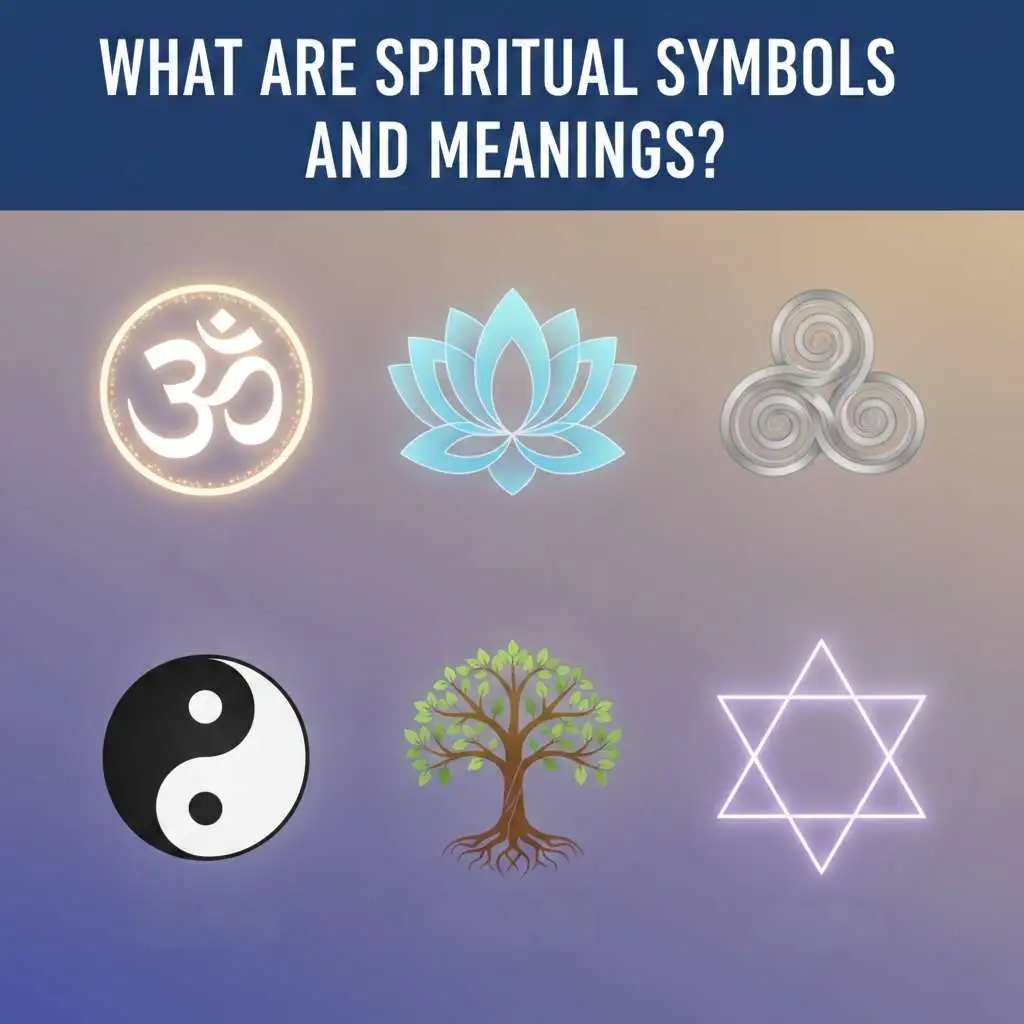
Spiritual symbols and meanings refer to visual signs, shapes, and icons that represent deeper truths about existence, consciousness, and the unseen world. Long before written language, humans carved symbols into rock, painted them on walls, and carried them as talismans.
From the sacred geometry of ancient temples to the protective charms worn around the neck, spiritual symbols act as bridges between the physical and spiritual realms. They compress vast ideas into simple shapes. A circle can represent eternity. A cross can represent sacrifice and salvation. A lotus can represent rebirth.
Historically, civilizations such as Ancient Egypt, Ancient Greece, India, and China used symbols to communicate divine wisdom, cosmic order, and moral teachings.
These symbols are not random drawings. They are psychological anchors and spiritual maps.
Deep Symbolic Meaning
Spiritual Level
On a spiritual level, symbols function as portals. They connect the visible world with invisible energies. When someone meditates on a mandala or prays before a cross, the symbol becomes a focal point for faith and transcendence.
Consider the Tree of Life. Across cultures, it represents the connection between heaven, earth, and the underworld. Spiritually, it reflects unity. It tells us that everything is connected.
Symbols often carry sacred geometry. Circles represent infinity because they have no beginning or end. Triangles symbolize balance between mind, body, and spirit.
Psychological Level
Psychologist Carl Jung believed symbols emerge from the collective unconscious. According to Jung, certain images such as the mother, the shadow, or the hero appear across cultures because they are archetypes embedded in human psychology.
When you see a symbol repeatedly in dreams, it may reflect internal transformation. A snake may represent fear or healing. A door may represent opportunity or transition.
Symbols give shape to emotions that words cannot easily express. They comfort us during grief and inspire us during uncertainty.
Cultural Level
Culturally, spiritual symbols create shared identity. They unite communities under common belief systems. A crescent moon on a flag signals faith. A sacred animal painted on tribal skin expresses ancestry and protection.
Through festivals, rituals, architecture, and art, symbols carry generational memory.
Types and Variations of Spiritual Symbols and Meanings
Below are some of the most powerful and widely recognized spiritual symbols.
1. The Ankh
Visual Description: A cross with a loop at the top.
Meaning: Eternal life and divine protection.
Where It Appears: Ancient Egypt temples, tomb carvings, jewelry.
The ankh was known as the key of life. Pharaohs were often depicted holding it, symbolizing their connection to immortality.
2. The Lotus Flower
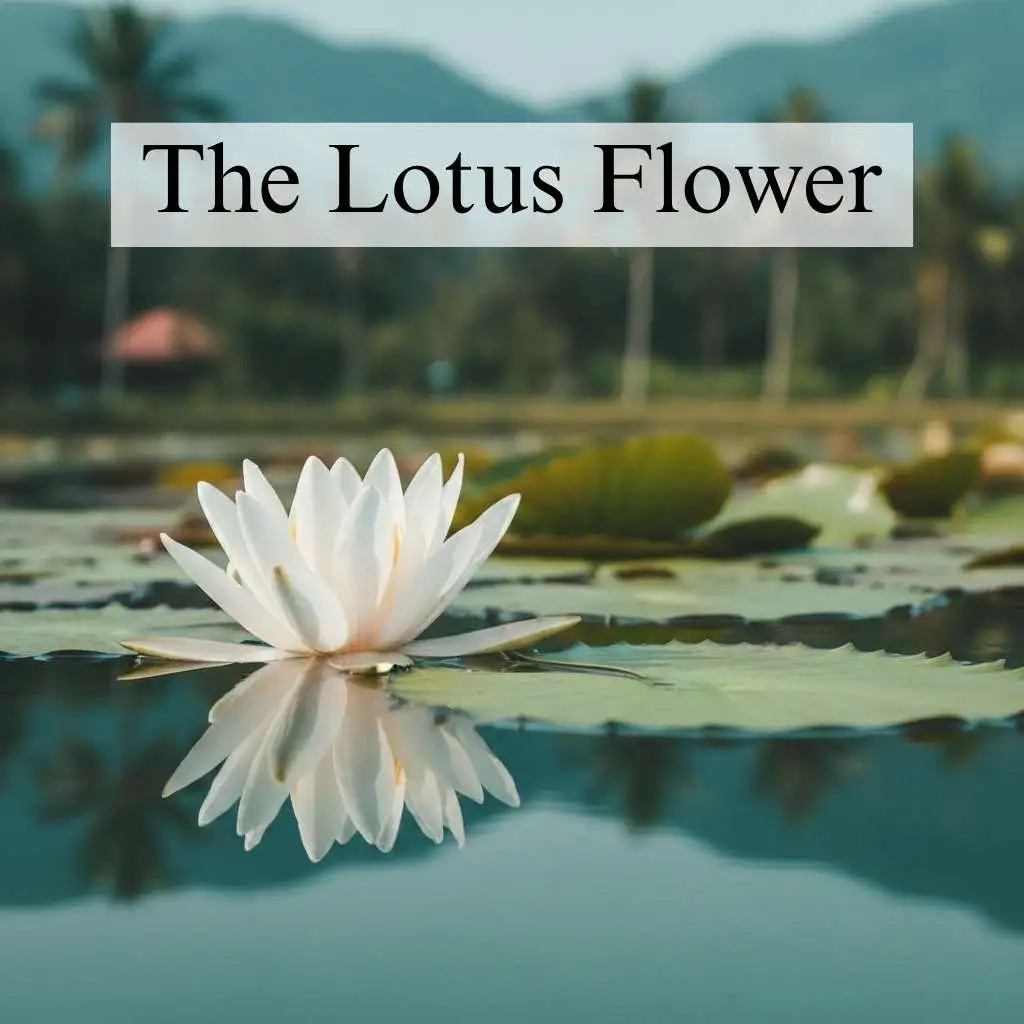
Visual Description: A layered flower rising from muddy water.
Meaning: Purity, enlightenment, rebirth.
Where It Appears: India spirituality, Buddhist art, yoga symbolism.
The lotus grows in mud yet blooms beautifully. Spiritually, it represents rising above suffering.
3. The Yin and Yang
Visual Description: A circle divided into black and white halves, each containing a dot of the opposite color.
Meaning: Balance, duality, harmony.
Where It Appears: China philosophy, Taoism, martial arts.
This symbol teaches that light and darkness coexist. Opposites do not destroy each other. They complete each other.
4. The Cross
Visual Description: Two intersecting lines forming right angles.
Meaning: Sacrifice, salvation, faith.
Where It Appears: Christian churches, art, jewelry.
Central to Christianity, the cross represents redemption and divine love.
5. The Om Symbol
Visual Description: A flowing Sanskrit character.
Meaning: The primordial sound of the universe.
Where It Appears: Hindu scriptures, meditation practices.
In Hinduism, Om is believed to be the vibration from which all creation emerged.
6. The Hamsa Hand
Visual Description: An open palm with an eye in the center.
Meaning: Protection from negative energy.
Where It Appears: Middle Eastern jewelry and home decor.
The Hamsa appears in both Islamic and Jewish traditions as a protective amulet.
Spiritual Symbols and Meanings Across Cultures
Ancient Egypt
In Ancient Egypt, symbols were carved into hieroglyphs and temple walls. The Eye of Horus symbolized protection and royal power.
India
In India, mandalas represent cosmic diagrams. The lotus symbolizes spiritual awakening.
China
In China, dragons symbolize strength and prosperity rather than destruction.
Ancient Greece
In Ancient Greece, the laurel wreath symbolized victory and divine favor.
Native American Traditions
Many Native American tribes use dreamcatchers as protective spiritual tools, filtering negative dreams.
Spiritual Symbols and Meanings in Art, Movies and Pop Culture
Spiritual imagery appears everywhere.
In films like The Matrix, symbols of awakening and illusion reflect spiritual rebirth. Neo represents the archetypal chosen one.
In literature such as The Alchemist, omens guide the hero toward destiny.
Tattoos of mandalas symbolize inner balance. Fashion brands use sacred geometry to evoke mystery and depth.
Artists across centuries embedded spiritual signs into paintings to communicate hidden messages.
Spiritual and Dream Meaning of Spiritual Symbols and Meanings
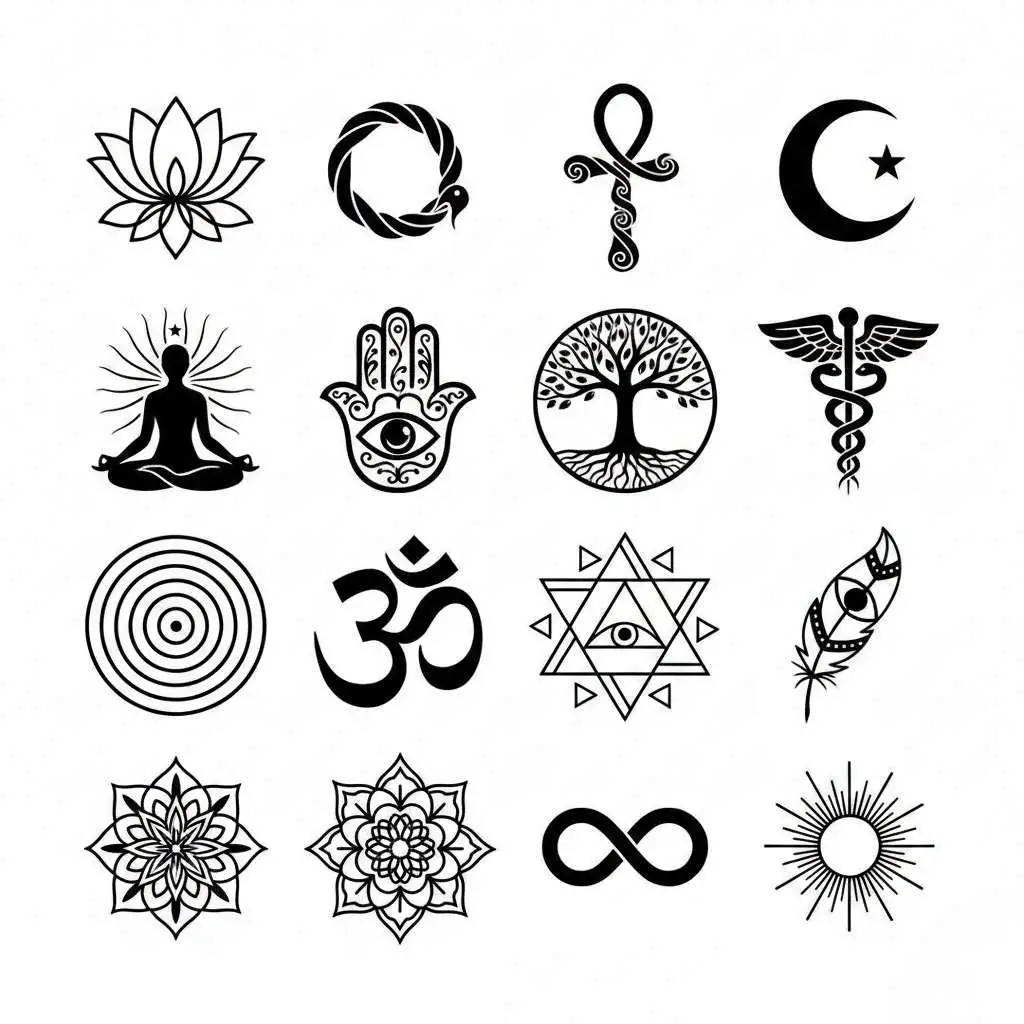
When a symbol appears in dreams, it often signals transformation. Seeing water may represent emotional cleansing. Seeing a staircase may symbolize growth.
During meditation, repeating visual patterns can emerge from the subconscious. Many spiritual traditions believe such visions indicate spiritual awakening.
The meaning always depends on personal context. A snake might represent fear for one person and healing for another.
Positive vs Negative Meaning
Every symbol carries dual potential.
The snake symbolizes wisdom and healing in some traditions. In others, it represents temptation.
Fire can mean destruction or purification.
The same image that brings comfort to one culture may bring fear to another. This duality reminds us that meaning is shaped by belief and experience.
Why Humans Are Attracted to Spiritual Symbols and Meanings
Humans crave meaning. Symbols offer clarity in a chaotic world.
Psychologically, the brain recognizes patterns faster than language. A simple shape can trigger memory and emotion instantly.
Spiritually, symbols give hope. They remind us that life has deeper layers beyond what we see.
Culturally, they create belonging. Wearing a symbol connects you to something larger than yourself.
At an emotional level, symbols feel timeless. When you look at a mandala or ancient carving, you feel connected to ancestors who once searched for answers just as you do.
FAQs About Spiritual Symbols and Meanings
What are the most powerful spiritual symbols?
The most powerful include the cross, lotus, Om, ankh, and Yin Yang. Their power comes from centuries of belief and collective meaning.
Are spiritual symbols universal?
Some symbols appear across cultures, such as the circle or tree. However, interpretation varies depending on tradition and context.
Can spiritual symbols influence the subconscious?
Yes. According to psychological theories, repeated exposure to meaningful symbols can shape thoughts, emotions, and behavior.
Is it okay to wear symbols from another culture?
It is important to understand and respect the cultural and religious significance before using a symbol.
Why do spiritual symbols appear in dreams?
They may reflect subconscious emotions, spiritual transformation, or unresolved internal themes.
Conclusion
Spiritual symbols and meanings are more than artistic designs. They are echoes of humanity’s deepest questions and highest hopes. They carry ancient wisdom, psychological insight, and cultural memory in simple shapes.
When you truly understand a symbol, you do not just see it. You feel it. It becomes a mirror reflecting your fears, your faith, and your future.
Look around. Symbols surround you. The next time one catches your eye, pause. Ask what it is trying to tell you. You may discover that the message has been waiting for you all along.

Freddie Wood
Hi! I’m Freddie Wood, a storyteller at heart and a lifelong explorer of ideas. Writing has always been my way of making sense of the world, turning ordinary moments into stories that linger in your mind. I love blending emotions with adventure, and I’m fascinated by the way words can connect people across distances and experiences. When I’m not writing, you’ll find me wandering through nature, listening to music, or sketching out ideas for my next story. My goal is always to create books that stay with readers long after the last page.
Books by Freddie Wood:
-
The Hidden Path
-
Shadows of Tomorrow