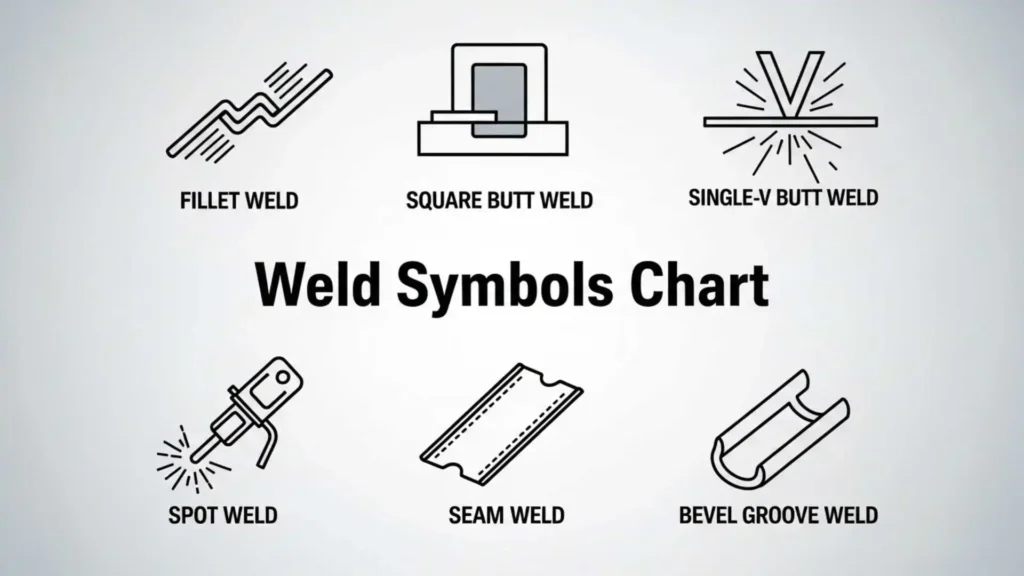
A “weld symbols chart” is more than a reference sheet, it’s the language of modern welding. If you’ve ever looked at engineering drawings or drawings and felt confused, you’re not alone.
Those small lines, triangles, and shapes carry precise instructions that tell a welder exactly what to do. Mastering welding symbols doesn’t take years.
With the right breakdown, you can quickly learn how to read a weld symbol, understand its structure, and apply it in real-world scenarios.
This guide walks you through everything step by step, using simple explanations, practical examples, and structured visuals.
What Is a Weld Symbols Chart and Why It Matters
A weld symbols chart is a standardized visual guide that represents different weld types, sizes, and instructions used in welding processes. Instead of writing long descriptions, engineers use symbols to communicate efficiently.
Think of it like a shortcut language.
Why It Matters in Real Work
- Saves time in reading fabrication welding symbols
- Ensures accuracy in weld geometry
- Reduces costly errors in construction and manufacturing
- Helps welders understand exact weld instructions
“A single weld symbol can replace an entire paragraph of instructions.”
Where You’ll See It
- Structural steel drawings
- Pipeline layouts
- Automotive fabrication plans
- Heavy machinery blueprints
How to Read Weld Symbols
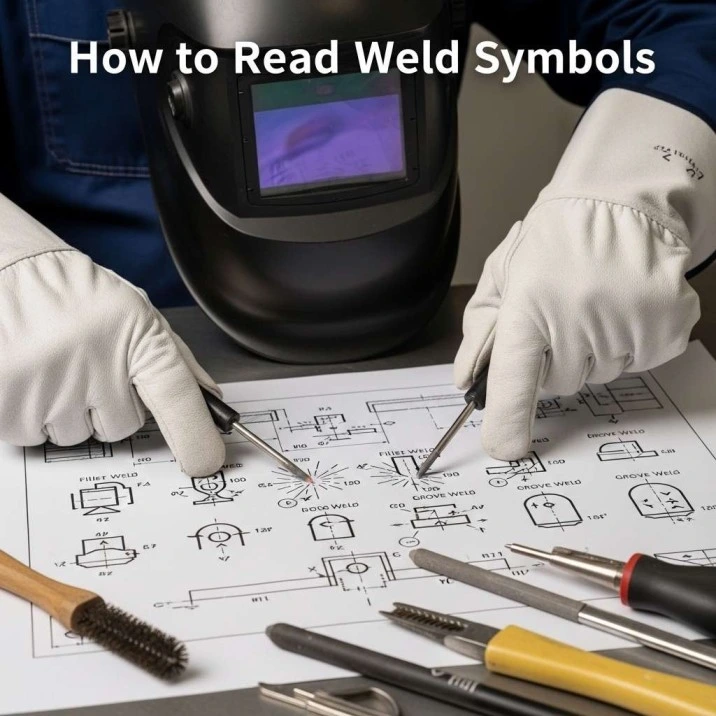
Understanding a welding symbol meaning starts with learning its core parts. Each component plays a specific role.
Understanding the Reference Line and Arrow
The reference line is the backbone of every weld symbol. Everything attaches to it.
- The arrow points directly to the weld joint
- The arrow side tells you where the weld goes
- The other side weld indicates the opposite surface
Quick Breakdown
| Component | Function |
| Reference line welding | Holds all symbol information |
| Arrow | Points to weld location |
| Arrow side weld | Weld on arrow side |
| Other side weld | Weld on opposite side |
Symbol Placement Above and Below the Line
Placement is everything in a welding symbol chart.
- Below the line → weld on arrow side
- Above the line → weld on other side
This small detail changes everything.
Ignore placement, and you risk welding the wrong side entirely.
What the Tail, Flag, and Circle Symbols Mean
These are called supplementary symbols, and they add more instructions.
- Tail → contains process details or notes
- Flag (field weld symbol) → weld done on-site, not in shop
- Circle (all around weld symbol) → weld around entire joint
Weld Symbol Structure Explained
Every weld symbol structure follows a consistent layout.
Core Components
- Reference line
- Arrow line
- Tail
- Weld symbol icon
How They Work Together
Each part contributes to a complete instruction:
- The arrow shows where
- The symbol shows what type
- The dimensions show how much
- The tail shows how to do it
Types of Weld Symbols in the Chart
Different jobs require different types of welding symbols.
Fillet Weld Symbol
The fillet weld symbol is the most common.
Used in:
- T joints
- Lap joints
- Corner joints
It looks like a triangle and represents a weld joining two surfaces at an angle.
Groove Weld Symbols (All Subtypes)
Groove welds are more complex and depend on edge preparation welding.
Common Types
- Square groove weld
- V groove weld
- Bevel groove weld
- U groove weld
- J groove weld
- Flare V groove weld
- Flare bevel groove weld
Comparison Table
| Groove Type | Use Case | Preparation |
| Square | Thin materials | Minimal |
| V-Groove | Thick plates | Angled cut |
| U-Groove | Heavy-duty | Curved prep |
| J-Groove | One-sided weld | Single edge prep |
Plug and Slot Weld Symbols
Used when joining overlapping materials.
- Plug weld → circular hole filled with weld metal
- Slot weld → elongated hole filled
These are common in sheet metal work.
Weld Joint Types and Their Symbols
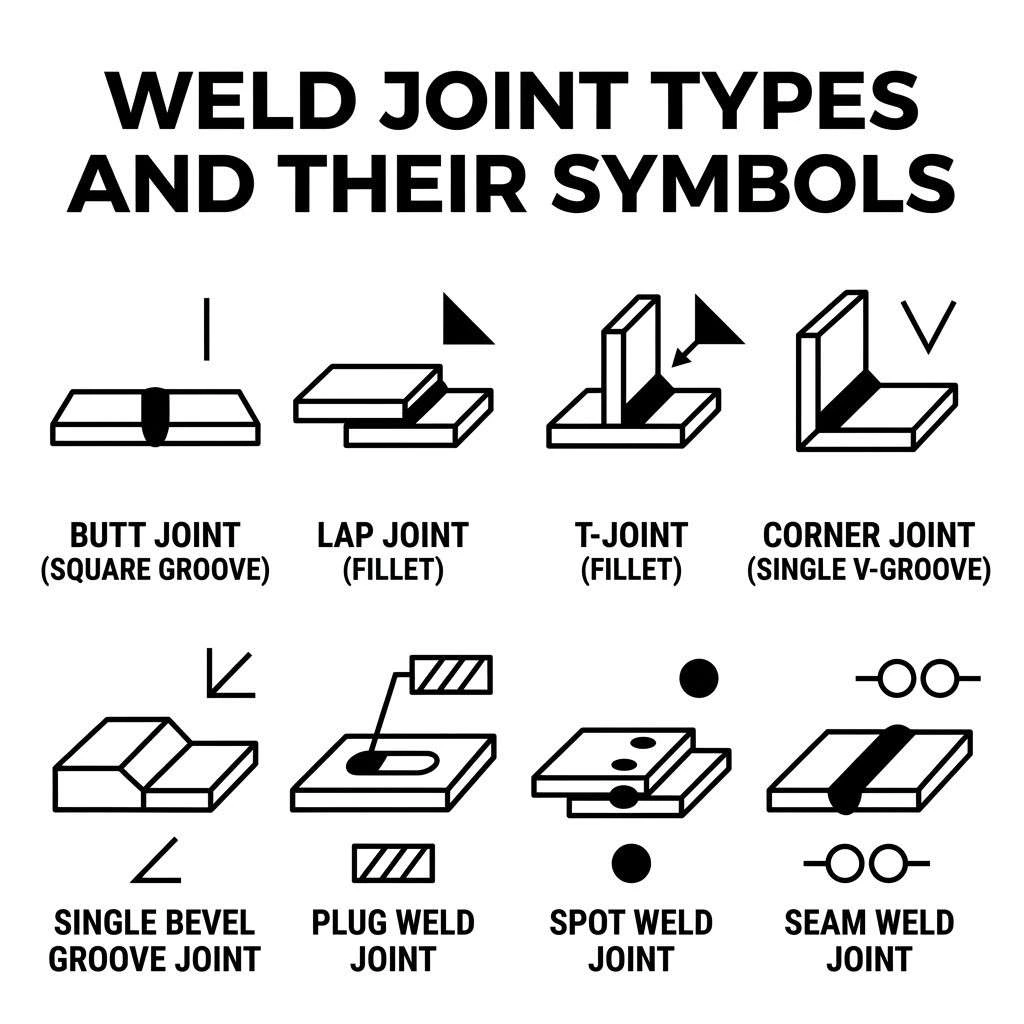
The type of weld joint directly affects the symbol used.
Main Joint Types
- Lap joint
- T joint
- Corner joint
- Edge-to-edge joint
Each joint changes how weld metal deposition occurs.
Weld Dimensions and Measurements on Symbols
Numbers on a welding symbol define size and spacing.
Size and Length Indicators
- Leg size weld → size of fillet weld
- Weld length → total weld distance
- Number of welds → how many times to repeat
Spacing and Pitch
Used in intermittent weld patterns.
- Weld pitch → distance between welds
- Center-to-center distance → spacing accuracy
Depth and Penetration Details
These define weld strength.
- Weld penetration
- Groove depth
- Root opening
- Effective throat weld
The deeper the penetration, the stronger the weld joint.
Additional Welding Symbol Indicators
These refine the weld quality and shape.
Key Indicators
- Weld reinforcement → extra material for strength
- Backing bar welding → support behind joint
- Melt through welding → weld visible from back
- Contour symbols:
- Flat
- Convex
- Concave
Edge Preparation Types
- Chamfered edge weld
- Concave edge weld
- Beveled edges
Preparation impacts weld structure and durability.
Welding Positions and Symbol Application
Position changes how welding is performed.
Main Positions
- Flat
- Horizontal
- Vertical
- Overhead
Each affects:
- Heat control
- Metal flow
- Final weld quality
Intermittent and Continuous Weld Symbols
Not all welds run continuously.
Types
- Continuous weld → unbroken weld
- Chain intermittent weld → aligned segments
- Staggered intermittent weld → alternating pattern
When to Use
| Type | Best For |
| Continuous | Strength-critical joints |
| Intermittent | Cost-saving and lighter loads |
Welding Symbols Chart
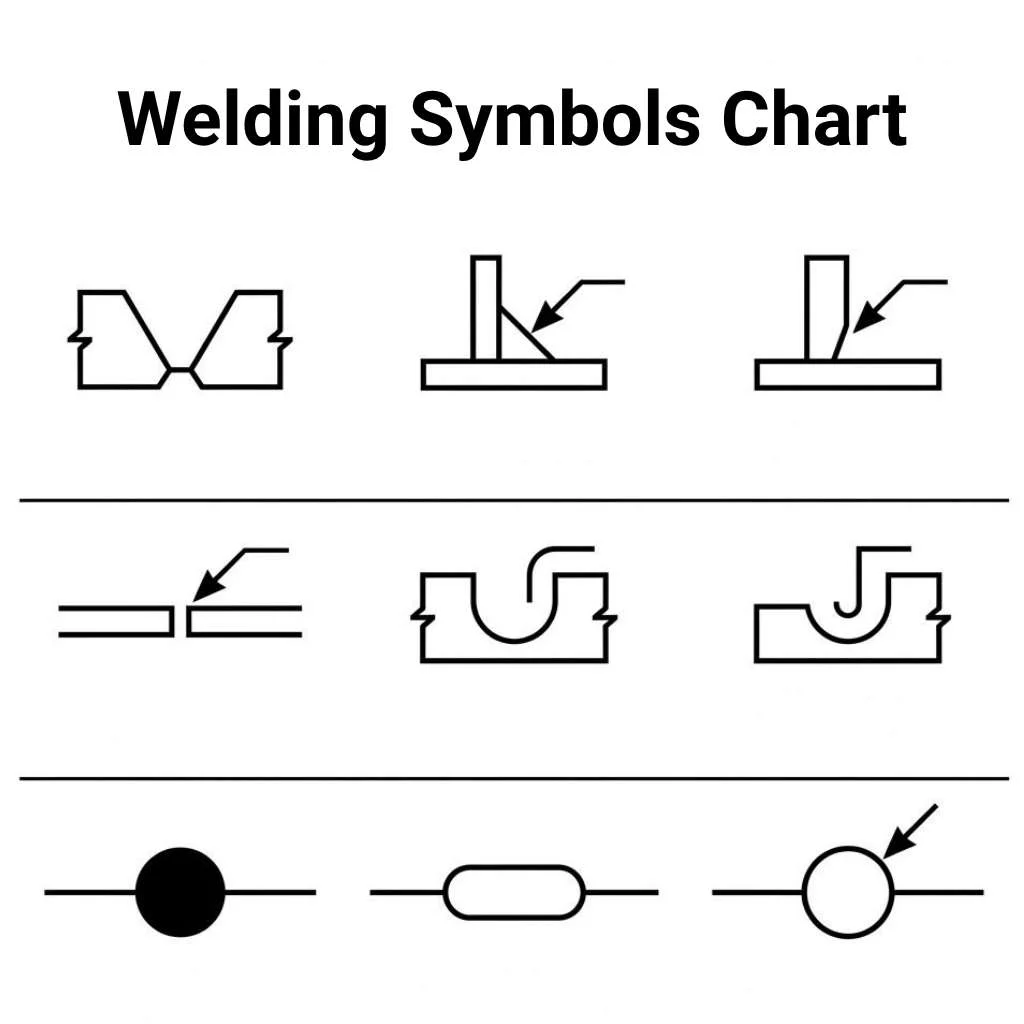
A complete welding symbol chart groups symbols into categories.
Main Sections
- Basic weld symbols
- Groove weld variations
- Supplementary symbols
How to Read Faster
- Start with the reference line welding
- Identify symbol shape
- Check dimensions
- Look for extra indicators
ANSI and AWS Welding Symbol Standards
Standardization keeps everyone aligned.
Key Authorities
- American Welding Society
- ANSI/AWS A2.4
These standards define:
- Symbol design
- Interpretation rules
- Consistency across industries
Without standards, welding instructions would become chaotic.
Common Mistakes When Reading Weld Symbols
Even experienced welders make errors.
Frequent Mistakes
- Misreading arrow direction
- Ignoring symbol placement
- Confusing fillet weld with groove weld
- Overlooking dimension details
Real Consequences
- Structural failure
- Material waste
- Project delays
Practical Examples of Weld Symbols in Drawings
Let’s simplify with a real scenario.
Example
A symbol shows:
- Triangle below line
- “6” on left
- “50-100” on right
Meaning
- Fillet weld
- 6 mm size
- 50 mm weld length
- 100 mm spacing
That’s a full instruction in one symbol.
Pro Tips to Master Welding Symbols Faster
Learning doesn’t have to be slow.
Smart Tips
- Study symbols in groups
- Practice with real welding diagram symbols
- Use flashcards for repetition
- Focus on meaning, not memorization
Patterns matter more than isolated symbols.
Frequently Asked Questions About Weld Symbols
What is the most common weld symbol?
The fillet weld symbol is the most widely used due to its versatility.
What does a circle on a weld symbol mean?
It indicates an all around weld symbol, meaning weld the entire joint.
How do you identify weld size on a symbol?
Look to the left of the symbol on the reference line.
What is the difference between fillet and groove weld symbols?
Fillet welds join surfaces at angles, while groove welds penetrate between edges.
Conclusion | Mastering the Weld Symbols Chart
Understanding a weld symbols chart gives you a serious advantage. It turns complex engineering welding drawings into clear instructions you can follow with confidence.
Focus on structure first. Then learn symbol types. Finally, practice with real examples. Once it clicks, you’ll read weld symbols as easily as plain text. And that’s when your skills truly level up.

Julian Shaw
I’ve always been fascinated by the small, quiet stories that make life feel magical. Writing allows me to explore worlds that exist just beyond the everyday, where imagination meets reality. Over the years, I’ve found joy in creating characters that feel real and stories that stay with readers long after the last page. When I’m not writing, you can usually find me wandering through city streets, notebook in hand, capturing little sparks of inspiration. I believe every story has the power to connect us, to make us feel a little less alone. Sharing these tales is my way of leaving a mark on the world.
Books:
-
Whispers in the Wind
-
Shadows of Tomorrow