Do you ever feel like your life is following a hidden pattern? Like certain moments were meant to happen?
That feeling is exactly why “destiny symbols” have existed for thousands of years. Across cultures, people created powerful symbols to explain fate, purpose, and life direction.
These symbols don’t just look interesting. They carry deep meaning about how life unfolds.
In this guide, you’ll explore the most important symbols of destiny, their real meanings, and how they still influence modern life.
What Are Destiny Symbols?
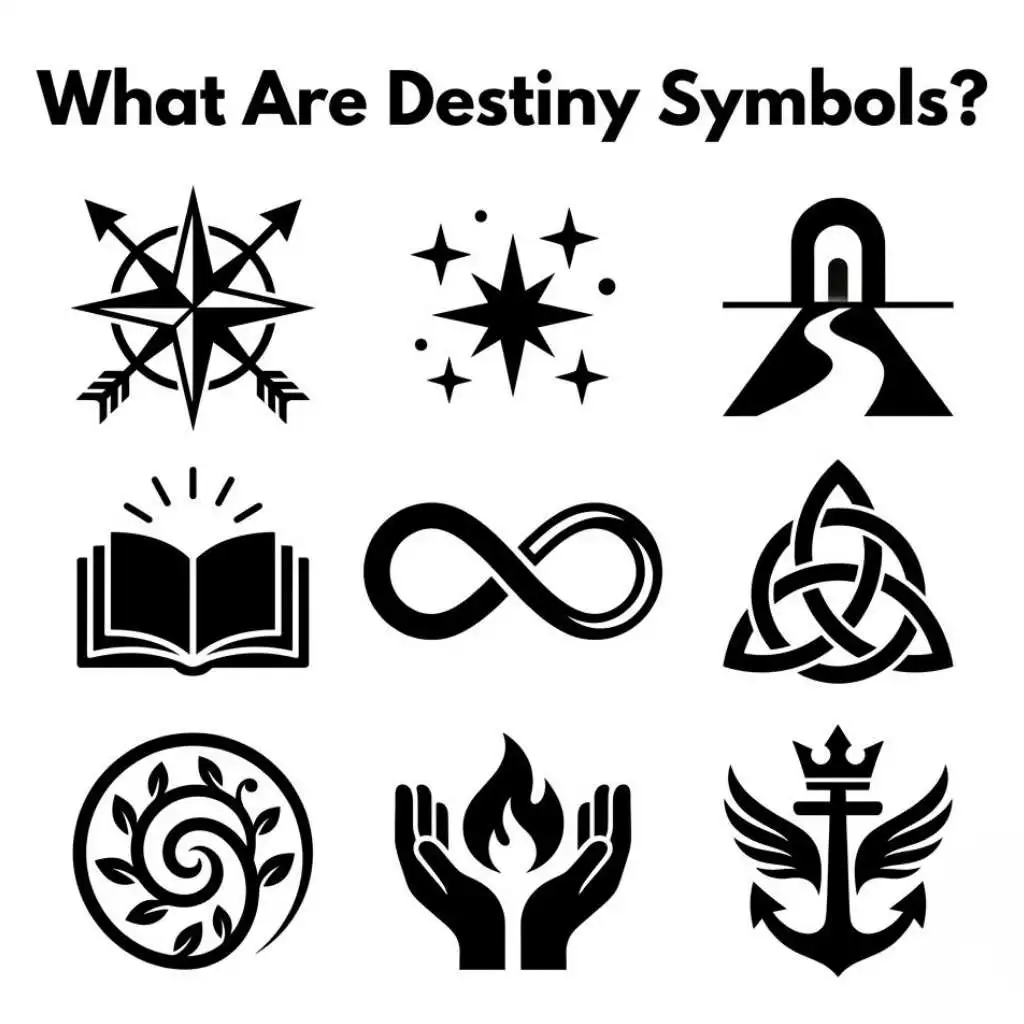
At their core, destiny symbols represent the idea that life follows a path. Sometimes that path feels planned. Other times, it feels shaped by your choices.
Here’s the simplest way to understand it:
- Fate = What is meant to happen
- Destiny = The path your life takes
- Free will = The choices you make along the way
So when people search for meaning of fate symbols or symbols of destiny, they’re really asking:
“Is my life guided, or am I in control?”
The answer? Most cultures say it’s both.
The Deep Meaning Behind Destiny and Fate
Before jumping into symbols, it helps to understand the philosophy.
Destiny vs Free Will | A Simple Breakdown
| Concept | Meaning |
| Fate | Fixed events that cannot change |
| Destiny | A flexible life path |
| Free Will | Your power to choose |
Think of it like this:
- Destiny is the map
- Free will is how you travel it
This idea shows up in almost every culture, which is why fate in mythology is such a rich topic.
Core Themes Found in Destiny Symbols
When you study ancient symbols of fate, patterns appear again and again. These aren’t random. They reflect how humans understand life.
Universal Concepts
- Life path meaning → Everyone is on a journey
- Predetermined destiny → Some events feel fixed
- Interconnected destiny → Lives are linked together
- Cycle of life and death → Nothing truly ends
- Divine destiny → Higher power influences life
Recurring Symbolic Motifs
You’ll notice these shapes and objects often:
- Thread / yarn → Life being controlled
- Wheel → Cycles and change
- Circle / loop → Eternity
- Labyrinth → Complex life journey
- Compass → Direction and purpose
These motifs form the foundation of spiritual symbols of fate across civilizations.
Most Powerful Destiny Symbols and Their Meanings
Now let’s break down the most important symbols of destiny and what they actually represent.
Thread and Weaving Symbols (Control of Life)
These are some of the oldest mythology fate symbols ever recorded.
Key Figures and Meanings
- Moirai (Greek)
- Clotho spins the thread (birth)
- Lachesis measures it (life span)
- Atropos cuts it (death)
- Norns (Norse)
- Urd (past)
- Verdandi (present)
- Skuld (future)
- Parcae (Roman)
- Similar roles to the Moirai
Symbolism Explained
- Thread = your life
- Spinning = beginning
- Measuring = duration
- Cutting = end
This is one of the clearest examples of fate as control.
Connection Based Symbols (Invisible Bonds)
Not all destiny is about control. Some symbols show connection.
Red Thread of Fate
- Origin: Chinese and Japanese folklore
- Meaning: Two people are connected forever
Even if separated, they will meet again.
This is one of the most searched long-tail keywords like meaning of red thread of fate in Chinese culture.
Web of Wyrd
- Norse symbol representing interconnected events
- Shows how past, present, and future are linked
Key Idea
Destiny isn’t just about you. It’s about who you’re connected to.
Cyclical Symbols (Life Never Ends)
These symbols explain spiritual cycles meaning.
Ouroboros
- Snake eating its own tail
- Represents eternal cycles
Wheel of Fortune
- Life constantly changes
- Good and bad phases repeat
Wheel of Dharma (Dharmachakra)
- Found in Buddhism and Hinduism
- Represents life, death, and rebirth
Core Meaning
- Life is not linear
- Everything repeats in cycles
This directly connects to cycle of life and death symbolism.
Life–Death Balance Symbols
These symbols explain the connection between life and the afterlife.
Ankh
- Egyptian symbol of eternal life
- Represents immortality
Owuo Atwedee
- African symbol of death’s inevitability
- Often shown as a ladder
Insight
Death isn’t the end. It’s part of spiritual destiny.
Journey and Direction Symbols
Some symbols of destiny focus on movement and choice.
Labyrinth
- Represents a complex life path
- Not a straight journey
Compass
- Symbolizes guidance
- Helps find direction in life
Meaning
- Life is unpredictable
- You must navigate it
Destiny Symbols Across Different Cultures
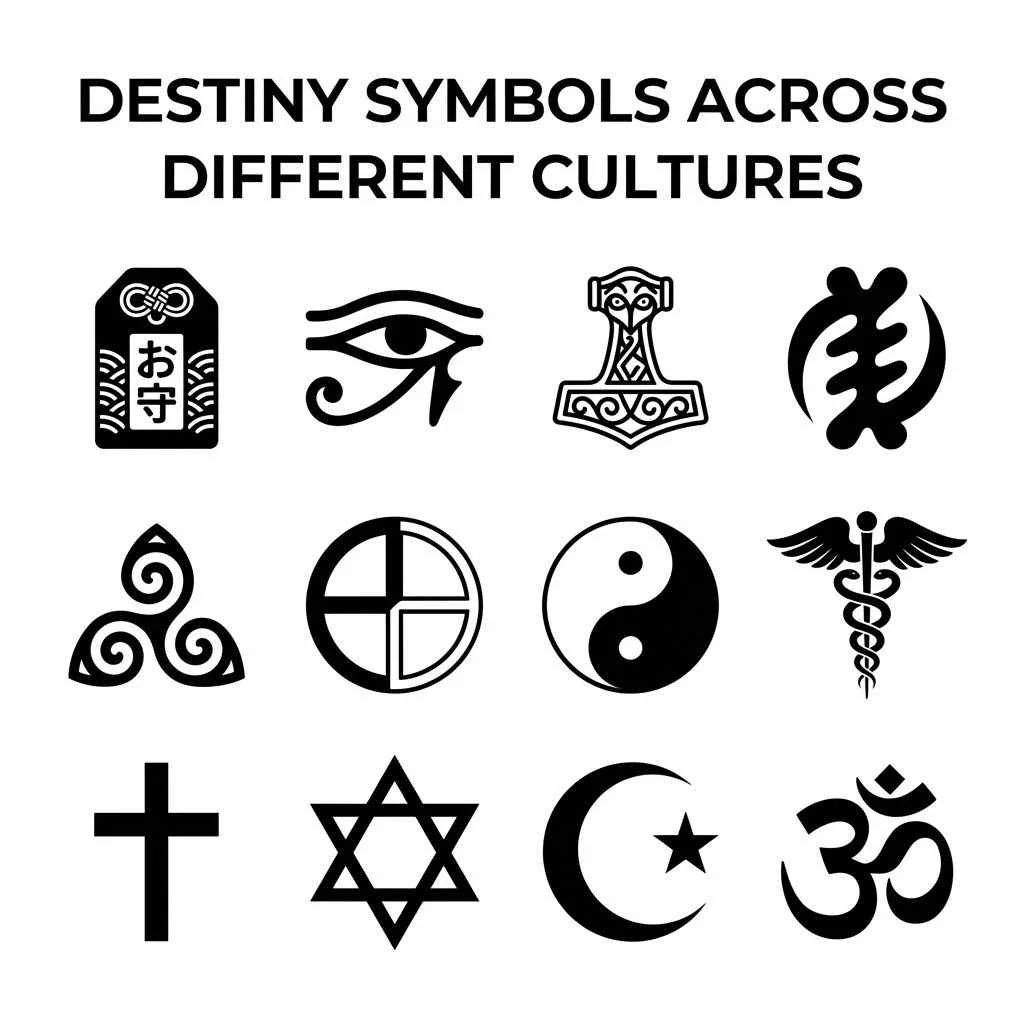
Let’s explore how different civilizations understood human fate meaning.
Greek and Roman Mythology
- Strong belief in predetermined destiny
- Moirai and Parcae controlled life
Key belief: You cannot escape fate.
Norse Mythology
- Fate tied to time
- Represented by the Norns
Key belief: Fate exists, but actions still matter.
Chinese and Japanese Folklore
- Focus on relationships
- Red Thread symbolizes connection
Key belief: Destiny connects people.
Egyptian Mythology
- Focus on afterlife
- Ankh represents eternal existence
Key belief: Life continues beyond death.
Slavic and Baltic Traditions
- Rožanicy and similar figures determine fate at birth
Key belief: Destiny begins the moment you are born.
Fate vs Free Will | The Real Debate
This topic has fascinated philosophers for centuries.
Two Opposing Views
View 1: Everything is Predetermined
- Life is already written
- You follow a fixed script
View 2: You Control Your Destiny
- Choices shape your future
- Nothing is fixed
Balanced Perspective
Most cultures agree on this:
Destiny sets the stage.
You decide how the story plays out.
This idea aligns with destiny and choice and fate vs free will discussions.
Destiny Symbols in Literature and Modern Media
Even today, these symbols appear everywhere.
Famous Examples
- Macbeth → prophecy controls actions
- Percy Jackson → Greek fate system
- The Sandman → destiny as a character
- God of War → breaking fate
Why It Matters
These stories prove one thing:
- Humans still question destiny
- Ancient symbols remain relevant
Etymology | Where the Word “Fate” Comes From
Understanding language helps explain belief.
Latin Roots
- Fatum → “that which has been spoken”
- Fata → divine prophecy
Meaning Behind It
Fate was seen as something declared by gods.
This connects directly to Latin origin of fate and fate etymology.
How Destiny Symbols Are Used Today
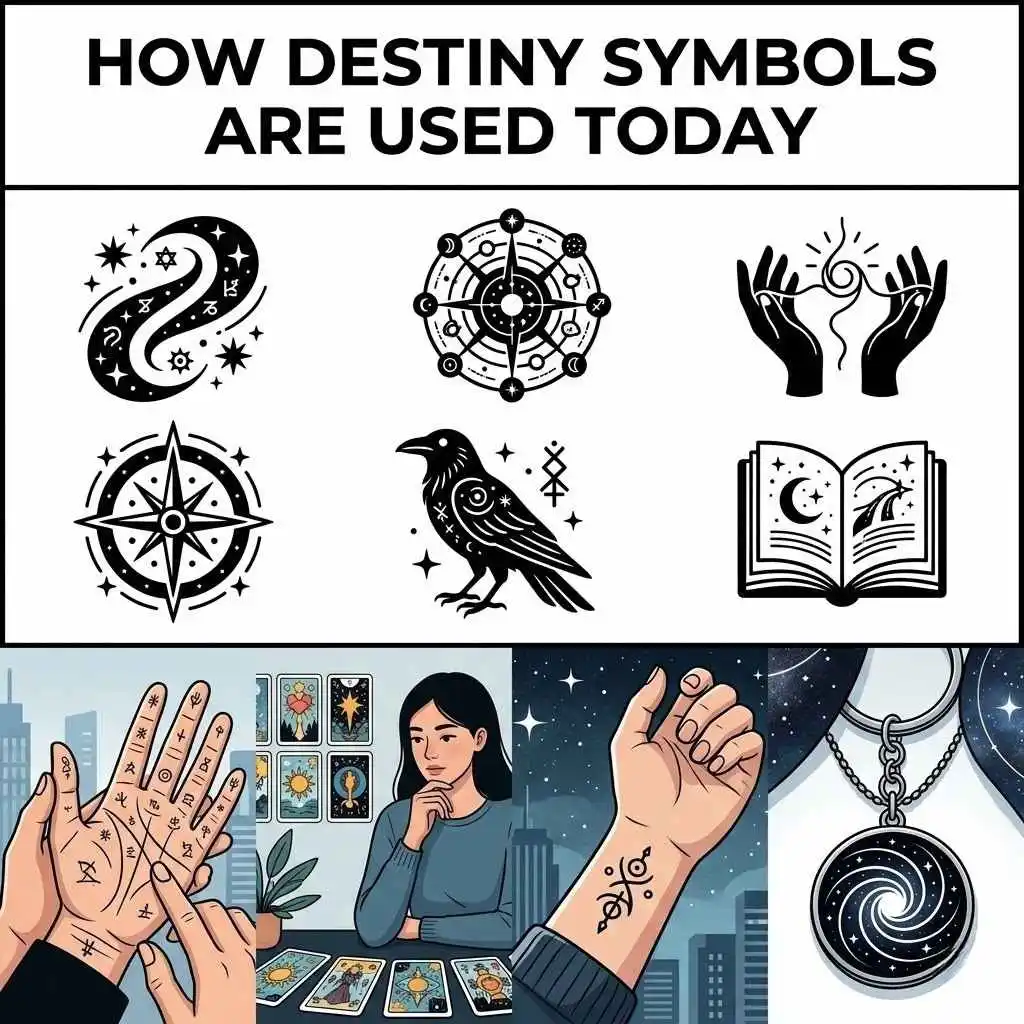
You might be surprised how common they still are.
Modern Uses
- Tattoos representing life path
- Jewelry with spiritual meaning
- Art and storytelling
- Personal growth tools
Psychological Role
These symbols help people:
- Understand uncertainty
- Find meaning in events
- Feel connected to something bigger
How to Choose a Destiny Symbol for Yourself
Not all symbols mean the same thing. Choose one that matches your beliefs.
Quick Guide
| Your Belief | Best Symbol |
| Everything is connected | Red Thread |
| Life repeats in cycles | Ouroboros |
| Fate is controlled | Moirai |
| Life is a journey | Labyrinth |
| Seeking direction | Compass |
Ask Yourself
- Do I believe in control or freedom?
- Do I see life as a journey or a cycle?
- Do I value connection or independence?
Your answers will guide you.
Common Misconceptions About Destiny Symbols
Let’s clear up a few myths.
Myth 1: Destiny means no control
Reality: You still make choices.
Myth 2: All cultures see fate the same way
Reality: Interpretations vary widely.
Myth 3: These symbols are only religious
Reality: They also have psychological meaning.
Are You Following Destiny or Creating It?
Here’s the truth.
Destiny isn’t a straight road. It twists, turns, and surprises you.
Sometimes life feels planned. Other times, it feels completely random.
Maybe destiny isn’t something fixed. Maybe it’s something you discover as you move forward.
And maybe… it’s both.
Conclusion
Destiny symbols reveal how humans understand life, purpose, and connection. From ancient myths to modern stories, these symbols still guide thinking.
Some show control, others show choice. In the end, destiny feels less like a rule and more like a journey. One you walk, step by step.

Julian Shaw
I’ve always been fascinated by the small, quiet stories that make life feel magical. Writing allows me to explore worlds that exist just beyond the everyday, where imagination meets reality. Over the years, I’ve found joy in creating characters that feel real and stories that stay with readers long after the last page. When I’m not writing, you can usually find me wandering through city streets, notebook in hand, capturing little sparks of inspiration. I believe every story has the power to connect us, to make us feel a little less alone. Sharing these tales is my way of leaving a mark on the world.
Books:
-
Whispers in the Wind
-
Shadows of Tomorrow