“Chinese yuan symbols �” carry more than financial value, they hold centuries of identity, belief, and silent cultural storytelling.
From ancient trade routes to modern global markets, these symbols have shaped how people see wealth, power, and prosperity. You might see them every day yet never notice the deeper meanings hidden within their strokes.
This article will uncover the emotional, spiritual, and cultural layers behind these symbols in a way you’ve never explored before.
What Are Chinese Yuan Symbols �?
Chinese yuan symbols � refer to the signs and characters used to represent China’s official currency, the yuan. The most common symbol you’ll recognize is ¥, often used globally in financial contexts. In Chinese writing, the yuan is represented by the character 元, which historically meant “origin” or “beginning.”
These symbols are not random. They come from a long evolution of Chinese writing, trade systems, and imperial standardization. During ancient dynasties, money appeared in forms like bronze coins with square holes. Over time, these evolved into written symbols that reflected both economic and philosophical ideas.
The character 元 originally symbolized the source of things, suggesting that money was not just a tool but a foundation of life and stability. This deep-rooted meaning still echoes in how the yuan symbol is perceived today.
Deep Symbolic Meaning
Spiritual Level
On a spiritual level, Chinese yuan symbols reflect balance and flow. In traditional Chinese thought, wealth is connected to harmony, not greed. The rounded shapes and structured lines in these symbols mirror the idea of energy circulating smoothly, much like the concept of Qi.
Money is seen as energy that must move. When it flows freely, it brings abundance and peace. When blocked, it creates imbalance.
Psychological Level
Psychologically, the yuan symbol represents security and control. People associate it with stability, success, and the ability to shape their future. Even subconsciously, seeing this symbol can trigger feelings of ambition or comfort.
It becomes more than currency. It becomes a symbol of achievement and self-worth.
Cultural Level
Culturally, the yuan symbol is tied to prosperity and national pride. It reflects China’s economic strength and historical resilience. It also carries Confucian values of discipline, order, and responsibility in wealth management.
In many households, money is respected, not just spent. The symbol itself becomes a quiet reminder of that philosophy.
Types / Variations of Chinese Yuan Symbols �
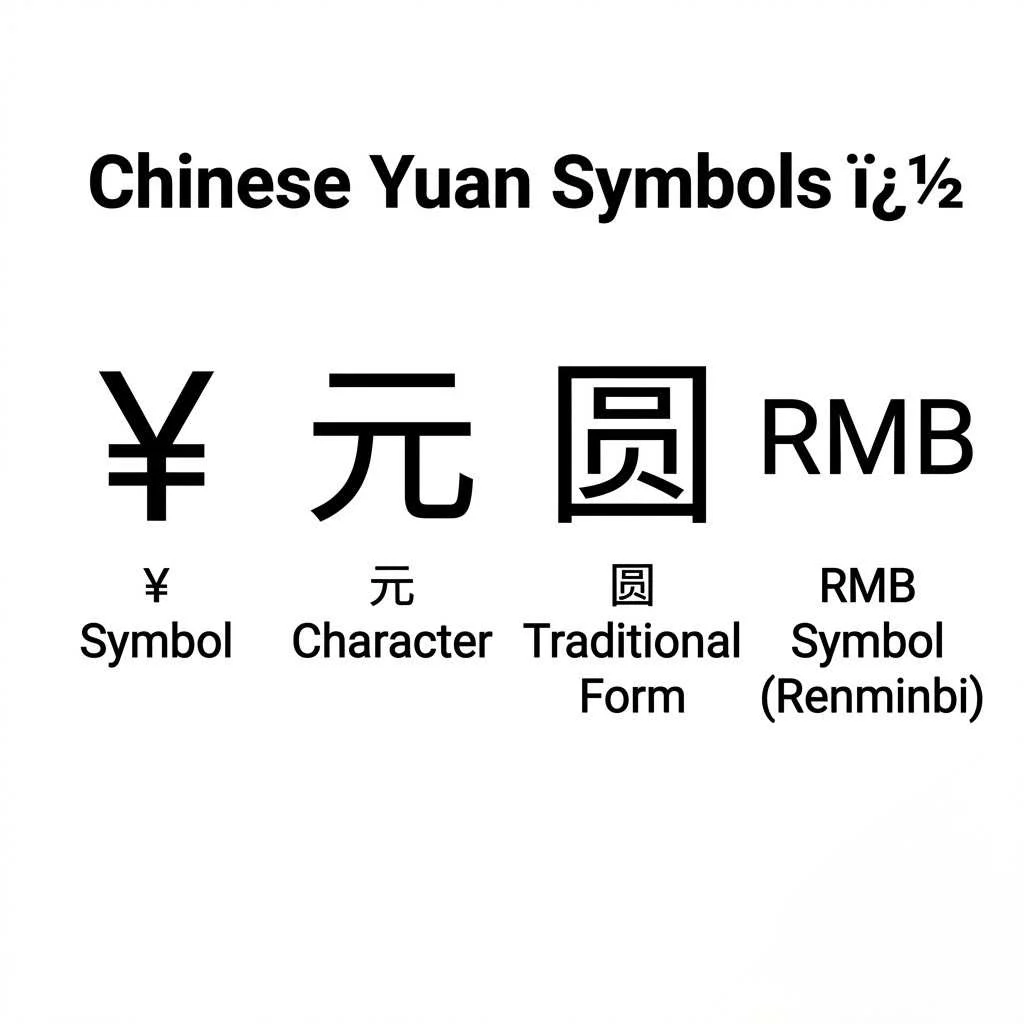
1. ¥ Symbol
Visual Description: A capital Y with two horizontal lines across the stem
Meaning: Modern financial representation of the yuan
Where It Appears: Global markets, price tags, banking systems
This is the most recognized version worldwide. The double lines represent stability and balance, reinforcing trust in the currency.
2. 元 Character
Visual Description: A square structured Chinese character
Meaning: Origin, beginning, foundation
Where It Appears: Official Chinese documents, language, traditional contexts
This version carries deeper philosophical meaning. It connects money to the idea of life’s starting point.
3. 圆 Traditional Form
Visual Description: More complex Chinese character with enclosed elements
Meaning: Completeness and wholeness
Where It Appears: Historical texts, older financial records
This variation emphasizes unity and fullness, suggesting that wealth completes life’s needs.
4. RMB Symbol (Renminbi)
Visual Description: Often written as RMB alongside ¥
Meaning: “People’s currency”
Where It Appears: International trade, economic discussions
This version highlights the collective nature of wealth, tying it to society rather than individuals.
Chinese Yuan Symbols � Across Cultures
Ancient China
In ancient China, currency symbols were deeply tied to cosmology. Round coins with square holes represented heaven and earth. The yuan symbol inherited this idea of balance between forces.
East Asia
Countries like Japan also use the ¥ symbol, though for the yen. This shared symbol shows cultural exchange and historical influence across the region.
Western World
In Western contexts, the yuan symbol represents China’s economic rise. It often appears in discussions about global power and financial competition.
Modern Global Culture
Today, the yuan symbol stands as a sign of globalization. It appears in stock markets, digital wallets, and international trade, symbolizing connection across borders.
Digital Economy
In the age of digital payments, the yuan symbol is evolving again. It now represents innovation, especially with China’s push toward digital currency systems.
Chinese Yuan Symbols � in Art, Movies & Pop Culture
In movies, the yuan symbol often appears in scenes involving trade, power, or underground economies. It signals influence and control.
In art, it is used to represent wealth and sometimes critique materialism. Artists may distort or exaggerate the symbol to question society’s obsession with money.
In tattoos, people choose yuan symbols to represent prosperity, ambition, or connection to Chinese heritage.
In fashion, the symbol appears in bold prints, often symbolizing luxury or global awareness.
In books, especially those focused on business or geopolitics, the yuan symbol represents shifting economic power.
Spiritual & Dream Meaning of Chinese Yuan Symbols �
Seeing Chinese yuan symbols in dreams can carry powerful messages.
- Finding the symbol may suggest new opportunities or financial growth
- Losing it may reflect fear of instability or loss
- Repeating symbols can indicate a strong desire for success or recognition
In meditation, focusing on this symbol can represent grounding and attracting abundance. It becomes a visual anchor for intention and manifestation.
Positive vs Negative Meaning
Positive Meaning
- Prosperity and abundance
- Stability and security
- Growth and opportunity
- Balance in life
Negative Meaning
- Greed and material obsession
- Fear of loss
- Power struggles
- Emotional attachment to wealth
Like any symbol, its meaning depends on how it is perceived and used.
Why Humans Are Attracted to This Symbol
Humans are naturally drawn to symbols that represent survival and success. Money, in any form, plays a central role in life. The yuan symbol combines visual simplicity with deep meaning, making it both easy to recognize and emotionally powerful.
It also connects to universal desires. Security, respect, and freedom. When people see this symbol, they don’t just think of money. They think of possibilities.
There is also a psychological effect of repetition. Seeing the symbol in markets, apps, and daily life reinforces its importance. Over time, it becomes embedded in the mind as a sign of value and achievement.
FAQs
What does the Chinese yuan symbol � mean?
It represents China’s currency and symbolizes wealth, stability, and economic power.
Why does the yuan symbol look like ¥?
The design was created for simplicity and global recognition, with lines representing balance and structure.
Is the yuan symbol the same as the yen symbol?
Yes, both use ¥, but they represent different currencies in China and Japan.
What is the difference between yuan and RMB?
Yuan is the unit of currency, while RMB refers to the overall monetary system called Renminbi.
Does the yuan symbol have spiritual meaning?
Yes, it is often associated with energy flow, abundance, and balance in traditional beliefs.
Conclusion
Chinese yuan symbols � are far more than financial marks. They carry the weight of history, the depth of philosophy, and the pulse of modern life. From ancient meanings of origin and balance to today’s global economic influence, these symbols quietly shape how people think about wealth and success.
When you look at them again, you won’t just see currency. You’ll see a story of human ambition, cultural identity, and the timeless search for stability and meaning.

Freddie Wood
Hi! I’m Freddie Wood, a storyteller at heart and a lifelong explorer of ideas. Writing has always been my way of making sense of the world, turning ordinary moments into stories that linger in your mind. I love blending emotions with adventure, and I’m fascinated by the way words can connect people across distances and experiences. When I’m not writing, you’ll find me wandering through nature, listening to music, or sketching out ideas for my next story. My goal is always to create books that stay with readers long after the last page.
Books by Freddie Wood:
-
The Hidden Path
-
Shadows of Tomorrow